After a lightning event, the first thing seen on site is usually a single burnt-out or failed device. That image is so direct that it invites an immediate causal attribution — "poor quality," or "this batch is defective." From an engineering perspective, however, lightning energy can enter a system through several entries — power, signal, and grounding — while the equipment end typically presents only the terminal symptom of damage; the consequence of lightning may be to interrupt the safe operation of a system, not just a single-device fault. The damage occurs at the device, but that does not mean the energy acted only at the device. Once the conclusion stops at "equipment quality," the investigation tends to stop at replacing the device, leaving the hidden hazard on the entry side in place.
1. Where the Misjudgment Begins: Terminal Visible, Entries Invisible
The misjudgment is not a matter of competence; the observation window is simply too narrow. During a lightning event, what can be seen directly, photographed, and written into a fault ticket is the smoking or failed device, whereas the transient processes that occurred on the power line, signal line, and grounding path usually leave no visible trace afterwards. The fault description therefore naturally leans toward "the device broke" and is easily filed under existing categories such as "equipment quality" or "supply quality."
The key point is that the location of damage and the location of the energy entry are two different things. Terminal damage tells us that energy reached this point; it cannot be used to infer that the energy was generated only here or acted only here. Equating the two converts an entry-side problem into a single-device problem.
2. Three Entries for Lightning Energy: Power, Signal, and Grounding
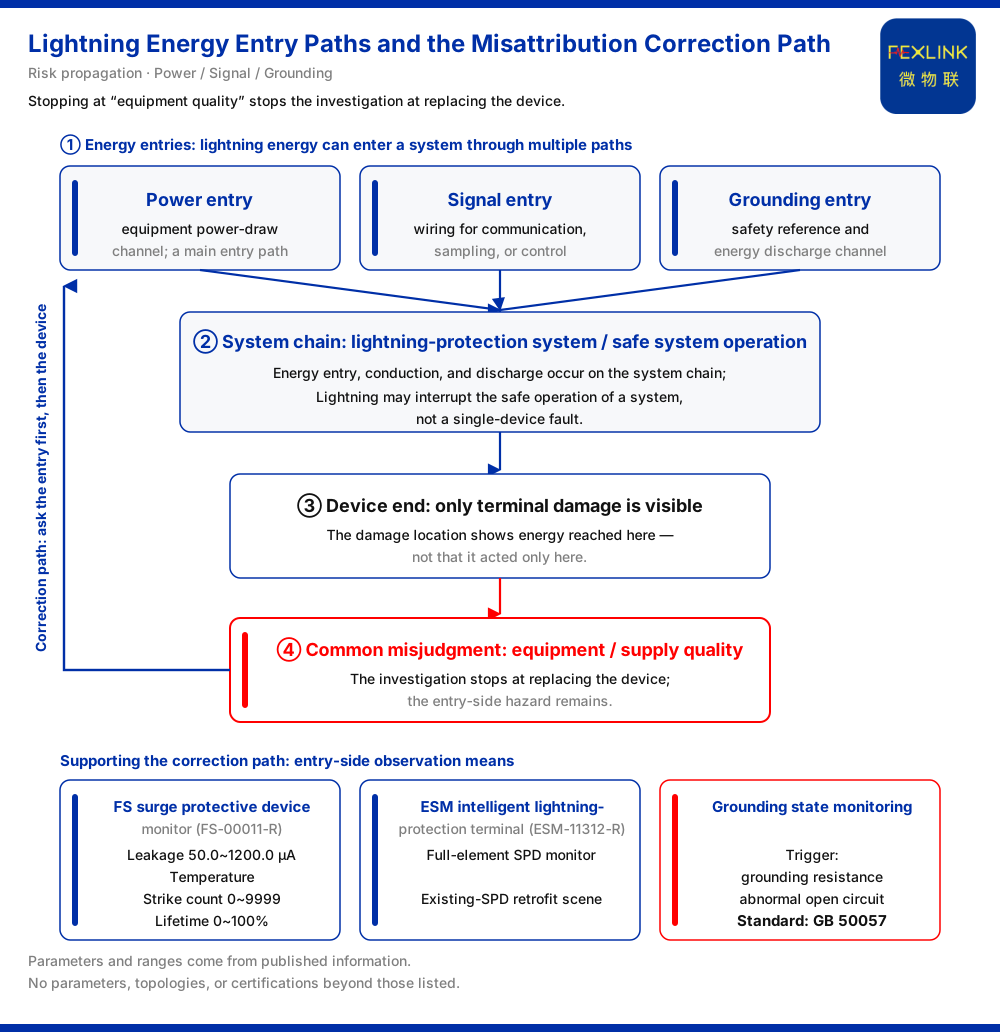
From an engineering perspective, lightning energy can enter a system through multiple entries, including power, signal, and grounding. These three correspond to the three classes of path that connect a system to its external environment:
- Power entry: the channel through which equipment draws power, and a principal path for energy ingress. - Signal entry: the wiring channel through which equipment communicates, samples, or controls, which can likewise become an ingress path. - Grounding entry: the grounding system is both a safety reference and a discharge channel, and its condition directly affects how energy is distributed and released.
That the entry count is plural determines the investigation logic. Looking only at the device itself assumes there is just one entry; where multiple entries exist, handling only the device end cannot cover the other paths through which energy may enter.
3. Upgrading from "Single-Unit Damage" to a "System Safe Operation" Topic
At the level of engineering judgment, the consequence of lightning may interrupt the safe operation of a system, not just a single-device fault. This distinction sets the level of judgment: the object affected by lightning can be a system, and device damage is merely one terminal result that the system presents after being affected.
A monitoring system is divided into the perception layer, edge layer, platform layer, and application layer, and the perception layer collects monitoring modules and sensors, including surge protective device monitoring, grounding resistance monitoring, lightning-current/transient-current monitoring, and ES-series monitoring modules. Seen through this layered view, a single device is only one node in the chain. Node damage is a local phenomenon, whereas energy entry, conduction, and discharge involve the connections between nodes. Qualifying a lightning event as an "equipment-quality problem" therefore means explaining the response of an entire chain with the problem of one node — a mismatch of level.
The more accurate characterization is this: it is a system-level lightning-protection investigation. Replacing equipment answers only "has the damaged node been restored"; a system investigation answers "why could the energy reach here, and will it come again."
4. The Correction Path: Move Attention Back to Power, Signal, and Grounding
Since the investigation should return to the power, signal, and grounding links, the available means should revolve around the state of those three rather than replacement at the device end alone.
On the surge protective device side, the FS surge protective device monitor (FS-00011-R) can be used to observe the working state of the surge protective device. The monitoring elements of this class of monitor include leakage current 50.0~1200.0 μA, temperature, lightning strike count 0~9999, and lifetime estimation 0~100%. The value of these elements is not in a single reading but in turning "has the entry side already absorbed an impact, and is the component still serviceable?" from invisible into recordable.
In a fuller SPD monitoring scenario, the ESM intelligent lightning-protection monitoring terminal (SPD monitor, e.g. ESM-11312-R) can serve as a full-element monitoring terminal. For retrofit projects, "surge protective device status monitoring (retrofit of existing SPDs)" is listed as an independent application scenario, recommending an SPD monitor, an intelligent lightning-protection monitoring terminal, and an SPD lightning-protection base (FSP-21000-R).
The grounding link also has a definite basis for judgment. The safety red line takes "grounding resistance abnormal open circuit" as its trigger condition, based on GB 50057. This elevates grounding status from "invisible in normal times" to a red-line condition that can trigger and be traced to a standard. Correspondingly, the FR grounding resistance monitor (FR-01311) is one of the collection devices at the perception layer, used to bring grounding status into continuous observation. When the state of the grounding entry can be tracked continuously, the energy distribution and discharge path after a lightning event can be reconstructed, rather than inferred only after a device has burned out.
It must be emphasized that the above is an adjustment of the investigation direction, not a conclusion about the cause of any particular incident. Monitoring means address the question of "visibility"; whether a hazard exists and how to handle it still requires on-site survey and project planning.
5. Judgment Order: Ask the Entry First, Then the Device
Correcting the misjudgment can be reduced to a simplified order of judgment:
1. First confirm where the damage occurred — treat the terminal symptom as a starting point, not a conclusion; 2. Then return to the three entries of power, signal, and grounding, and check the paths through which energy may enter and be released; 3. For links such as grounding that have a definite trigger condition, verify their state against GB 50057 and the red-line requirement for grounding resistance; 4. Only then return to the device itself to handle the damaged node.
The point of this order is that it downgrades "equipment quality" from a default conclusion to the last hypothesis awaiting confirmation. Whether a device is qualified is a question that requires evidence, not a conclusion that can be drawn directly from the fact of damage after a lightning event.
Scope and Limits
This article explains why lightning-induced equipment damage is easily misjudged as an equipment-quality problem and why the investigation should return to the power, signal, and grounding links. The monitoring elements cited for the surge protective device monitor (leakage current 50.0~1200.0 μA, temperature, lightning strike count 0~9999, lifetime estimation 0~100%) are the parameters of that class of product and do not represent the configuration of other products. The red-line requirement taking "grounding resistance abnormal open circuit" as a trigger condition, with GB 50057 as its basis, is only a reference to that rule and does not constitute an extension to other standard clauses. Within the scope of this topic, no statistical proportion of lightning damage misjudged, no equipment failure rate, certification, accuracy, or case data is asserted, and this article does not infer any.