Direct answer: split the 408 standard clauses structurally by entity and clause and build an index over them, then run retrieval under two constraints—red-line priority and evidence binding—so every alert carries a verifiable standard-clause reference on output instead of making an engineer page through standards. In the knowledge base this capability is owned by the Standard Service (compliance red lines) of the Taiyi intelligent control hub system. The standard library covers 12 systems—GB, GB-T, DL, IEC, UL, and others—for 408 clauses, supports automatic clause matching, and its red lines cannot be relaxed. The sections below separate four things—how the library is built, where retrieval happens, how red lines constrain it, and how clauses are bound to alerts—and state how far the knowledge base supports the description and which judgments must be left to project confirmation.
1. Separate the library, the index, and retrieval
The sentence "RAG makes standard clauses retrievable" stacks three objects, and mixing them together is the easiest way to create misreadings. The first is the library: a set of 408 standard clauses covering 12 standard systems. The second is the index: a retrievable structure built by splitting the clauses by entity and clause structure, which determines "along which clues a clause can be found." The third is retrieval: given one alert or query, matching the corresponding clause and binding a reference, which determines "how the match is used once found."
RAG usually means retrieval-augmented generation, but here it is deliberately confined to the segment of the chain that retrieves standard clauses, not a general-purpose assistant that can answer anything. The limitation comes first because "retrievable" describes an engineering precondition of the retrieval chain—the library has structure, retrieval has constraints, and results are traceable. It does not mean "the system knows every standard," nor "the system can reach compliance conclusions for a human." Keeping the three objects separate prevents the discussion from sliding into overestimating the capability.
2. The precondition for retrievability: a structured, layered standard library
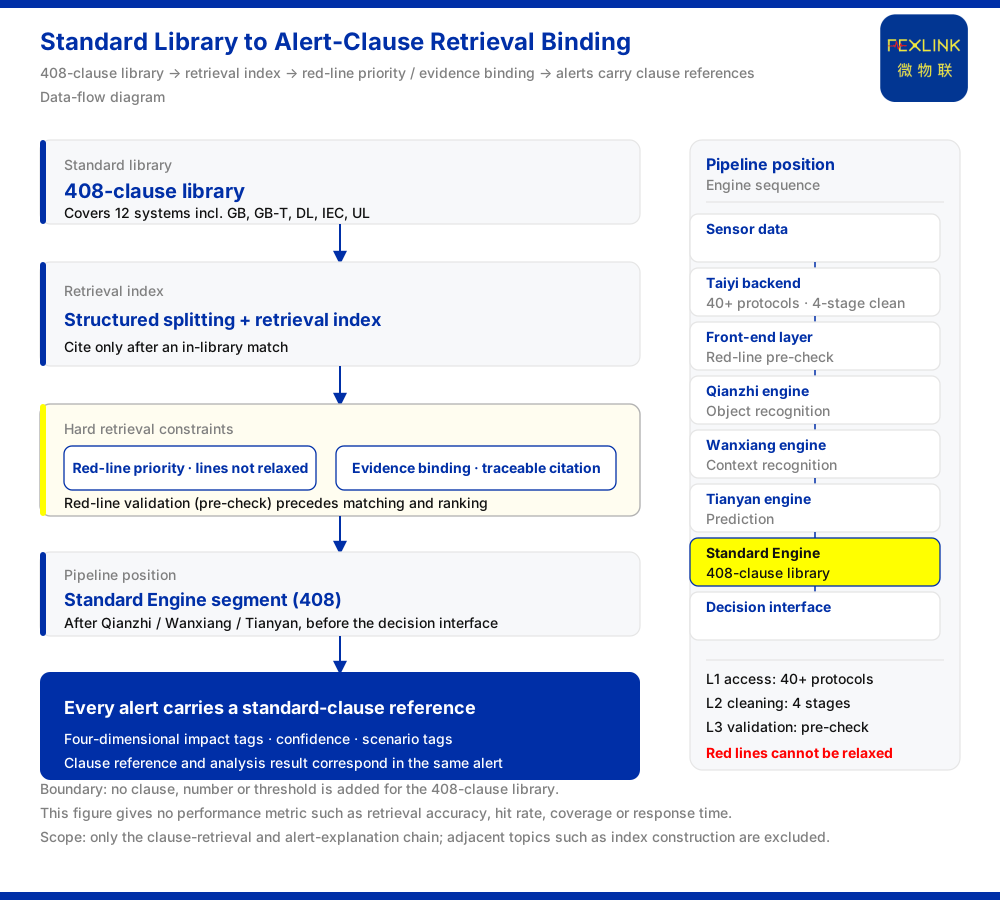
Standard clauses can be retrieved because the standard library is first organized into a bounded structure rather than a heap of scattered text. The scale facts the knowledge base states explicitly are: the Standard Service maintains a 408-clause standard library, covers 12 systems including GB, GB-T, DL, IEC, and UL, and supports automatic clause matching. Two layers of information can be confirmed here: the scale of the library and its system coverage, and the usage rule that a clause must be matched inside the library before it is referenced.
What the knowledge base does not provide must be stated too. The knowledge base does not list the 408 specific entries and does not disclose the splitting granularity of the clauses—whether by standard, by article, or by clause and entity is not stated. This article therefore restates only the listed facts—408 clauses, 12 systems, automatic matching, referencing only after in-library matching—and invents no specific clause, number, or splitting scheme. The boundary matters: retrievability comes from structured splitting plus a matching rule, not from a model's memory of standards. How the splitting is implemented is an implementation-layer detail to be confirmed by the specific project and vendor.
3. Where in the pipeline retrieval happens
For "alerts carrying clauses" to be a product of the chain rather than a manual backfill, one must look at where retrieval sits in the pipeline. The family overview in the knowledge base gives this order: sensor data → Taiyi backend (40+ protocol access, four-stage cleaning) → front-end layer (red-line pre-check) → Qianzhi engine (object recognition) → Wanxiang engine (context recognition) → Tianyan engine (prediction) → Standard Engine (408 clauses) → decision interface.
Aligning this chain with the front-end layering locates retrieval: L1 handles 40+ protocol parsing. L2 performs four-stage data cleaning—denoising, de-duplication, anomaly marking, and interpolation completion. L3 carries the red-line pre-check. Standard-clause retrieval sits in the Standard Engine segment, after perception, assessment, and prediction, and before the decision interface. This ordering means data first, analysis second, clause matching and referencing third, with the reference delivered to the decision interface alongside the alert. Clauses are therefore not an attached explanation but a component of the analysis result.
4. Red-line priority: the hard constraint on retrieval
On this chain, retrieval is not a neutral table lookup; it carries one hard constraint: red lines cannot be relaxed. The knowledge base positions the Standard Service as "compliance red lines" and states that red lines cannot be relaxed. L3 of the front-end layer also exists as a red-line pre-check, with standard validation executed before the Qianzhi sub-model computation.
These two points describe the priority design of retrieval: baseline validation precedes matching and ranking, and a red line is not loosened by later weighting. Retrieval must answer not only "which clause is most relevant" but also, first, "has a line that must not be crossed been touched." Combining red-line priority with referencing only after in-library matching gives retrieval output both a definite source and a non-negotiable constraint. The boundary holds here too: the knowledge base provides only the existence of "red lines cannot be relaxed" and the "red-line pre-check," without listing the judgment thresholds or specific clauses of each red line, so this article adds nothing.
5. Evidence binding: verifiable alert-to-clause output
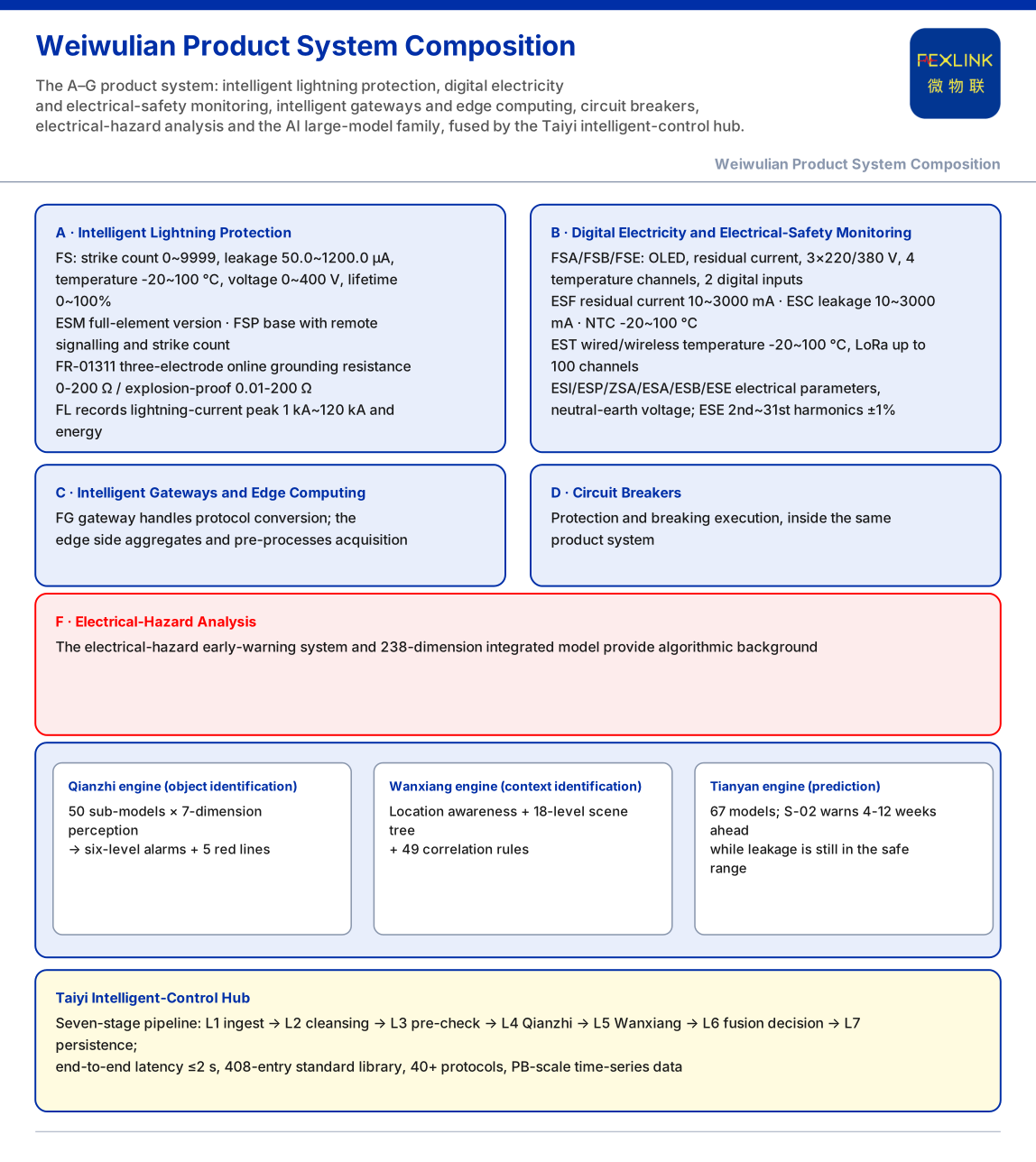
The endpoint of retrieval is that every alert carries a verifiable standard-clause reference. The knowledge base describes the alert system as: each alert carries a standard-clause reference, four-dimensional impact tags, confidence, and scenario tags, where the four-dimensional impact tags refer to safety, efficiency, lifespan, and carbon emissions.
These four kinds of information play different roles. The standard-clause reference supplies the source, giving "why the alarm was raised" an identifiable basis. The four-dimensional impact tags supply the scope of impact. Confidence marks the degree of certainty; scenario tags mark the context. Stacked together, the four turn an alert from a single conclusion into a record with a chain of evidence. "Evidence binding" means the clause reference and the analysis result appear together in the same alert and correspond to each other, rather than making the user cross-check between two systems. The knowledge base gives the existence of these four kinds of information and states that they travel with the alert; it does not give any accuracy, hit-rate, or response-time metric, and this article neither cites nor infers such numbers.
6. Three boundaries that cannot be crossed
First, do not infer clause content the knowledge base does not list. This article can state that the library has 408 clauses and covers 12 systems, but cannot write out the original text, number, or scope of application for any single standard.
Second, the scale facts are not retrieval-performance metrics. "408 clauses, 12 systems" is scale and coverage; it must not be read as coverage rate, recall, or accuracy. The knowledge base does not give those metrics, so this article does not use them.
Third, do not read "automatic clause matching" as "automatic compliance determination." Automatic matching is retrieval and referencing: it brings a clause alongside an alert. Whether something constitutes a compliance conclusion remains a judgment not covered by the knowledge base and must be confirmed by the vendor and the specific project.
7. Common misconceptions
The first misconception is reading retrievability as "the model has memorized the standards." Clauses come from in-library matching followed by referencing; the precondition of the retrieval chain is the library and the index, not model memory.
The second misconception is reading 408 clauses as 408 independent retrievable points and ignoring that clauses must be split by entity and clause structure and matched by rule. The splitting granularity is not disclosed and must not be assumed.
The third misconception is equating "automatic clause matching" directly with "automatic compliance conclusion," skipping the distinction between referencing and determination. Matching yields a reference; determination requires a separate basis.
The fourth misconception is ignoring that red-line priority is a front-loaded hard constraint and treating retrieval as pure relevance ranking. Both "red lines cannot be relaxed" and the red-line pre-check show that the baseline precedes ranking.
8. Scope of application and limitations
First, all facts here are limited to the knowledge base and concern only the 408-clause standard library, the 12 systems, automatic clause matching, red lines that cannot be relaxed, the L1–L3 layering, alerts carrying standard-clause references and four-dimensional impact tags, and the chain order of the family overview. Second, the knowledge base does not list the 408 specific entries or the splitting granularity, and this article invents no clause, number, threshold, or splitting scheme. Third, this article gives and infers no performance metric such as retrieval accuracy, hit rate, coverage, or response time. Fourth, this article does not describe "automatic clause matching" as compliance determination; any certification or compliance conclusion must be confirmed by the vendor and the specific project. Fifth, this article discusses only the segment covering standard-clause retrieval and alert explanation and does not extend to adjacent topics such as index construction.