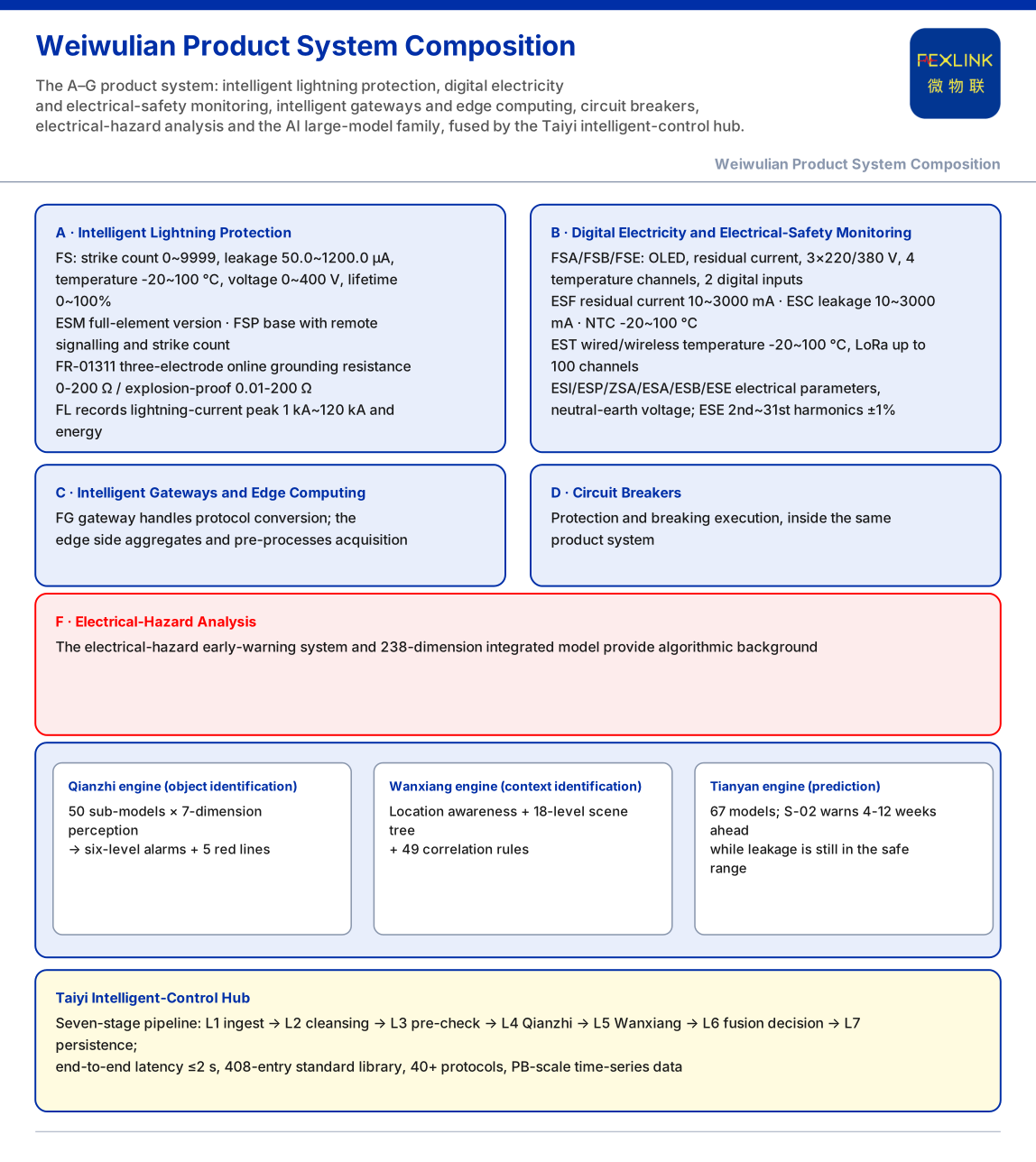

Inside the seven-stage pipeline of the Taiyi intelligent control hub system (V2.0), L3 standard validation carries the red-line pre-check. It runs before the parameter sub-models of the Qianzhi engine (the "Discern Objects" layer, V4.1) are computed. The five red lines are called "non-bypassable," and the first meaning of that phrase is execution order: the red lines run ahead of the models, and once one trips, the system emits the highest-level alarm (BJ2) directly, without entering the downstream weighted computation. To answer "what does each rely on," every red line must be aligned against three things — rule number, trigger condition, and governing standard. The red-line guard table in the knowledge base supplies that alignment: residual current ≥300mA (GB 13955), grounding resistance abnormal open circuit (GB 50057), three-phase voltage imbalance >15% (GB/T 15543), line temperature ≥110°C (GB 16895), and insulation resistance <0.5MΩ (GB/T 16895). This article is bounded by that table: it explains each basis in turn, adds no standard the knowledge base does not list, and does not reproduce the text of any standard.
1. The Full Table First: Condition Versus Basis
Putting the five red lines side by side makes the "basis" column clear:
| Red line | Trigger condition | Basis | |:--|:--|:--| | Residual-current red line | Residual current ≥300mA | GB 13955 | | Grounding red line | Grounding resistance abnormal open circuit | GB 50057 | | Three-phase-imbalance red line | Three-phase voltage imbalance >15% | GB/T 15543 | | Line-temperature red line | Line temperature ≥110°C | GB 16895 | | Insulation-resistance red line | Insulation resistance <0.5MΩ | GB/T 16895 |
The table is the first link in the "standard — threshold — execution position" chain. Each red line is one row, so rule number, trigger condition, and governing standard correspond one-to-one; no single column carries a conclusion alone. Read it row by row: lock the rule number, then the trigger condition, then the basis standard on the same row. Pulling the basis column out and re-sorting it by numeric size or recency loses which standard supports which red line. This article therefore expands each entry as one row, one rule, not as a detached list of five standard numbers.
2. Residual-Current Red Line: ≥300mA, Basis GB 13955
The residual-current red line's trigger condition is a value with a unit and a direction: residual current reaching or exceeding 300mA. The knowledge base registers the governing standard on that row as GB 13955. Note the relationship: 300mA is the trigger condition, GB 13955 is the basis. They occupy two separate columns; they cannot be swapped, and neither allows inferring the specific clause text of the other.
3. Grounding Red Line: Abnormal Open Circuit, Basis GB 50057
The grounding red line differs visibly from the other four: its trigger condition is not a numeric threshold but the state description "grounding resistance abnormal open circuit." This row provides no directly comparable limit number such as 300mA, 15%, or 110°C. Its governing standard is GB 50057. Because the trigger is a state description rather than a number, its judgment depends more heavily on whether the measurement loop can continuously and correctly read grounding resistance; the basis standard only answers under which standard the red line is filed, and does not replace field measurement.
4. Three-Phase-Imbalance Red Line: >15%, Basis GB/T 15543
The three-phase-imbalance red line's trigger condition reads "three-phase voltage imbalance >15%," direction "greater than": only exceeding 15% trips it, while exactly 15% does not constitute an over-limit in the wording. Its governing standard is GB/T 15543. This row binds the power-quality dimension of three-phase imbalance to a specific standard number; read it as a whole row, not by remembering 15% while missing the basis.
5. Line-Temperature Red Line: ≥110°C, Basis GB 16895
The line-temperature red line's trigger condition is line temperature reaching or exceeding 110°C, direction "greater than or equal to," governing standard GB 16895. Temperature is position-sensitive; the same numeric value can carry different meaning at different measurement points. But for this one row of the guard table, the condition available for triggering is "line temperature ≥110°C" and the corresponding basis is GB 16895. This article does not extrapolate any other temperature limit the knowledge base does not write.
6. Insulation-Resistance Red Line: <0.5MΩ, Basis GB/T 16895
The insulation-resistance red line's trigger condition is insulation resistance below 0.5MΩ, direction "less than," governing standard GB/T 16895. Pay particular attention to the numbering style: the line-temperature red line's basis is GB 16895, while the insulation-resistance red line's is GB/T 16895. In this table they are two different bases on two different rows. All numbers are written as the knowledge base has them, with no merging or rewriting.
7. Why the Basis Must Be Read With Execution Position
Listing the five bases alone does not explain why the red lines cannot be bypassed, because "basis" answers standard attribution while "non-bypassable" answers execution position. The knowledge base defines L3 standard validation as the red-line pre-check: it executes before the Qianzhi sub-model computation, and a tripped red line directly outputs BJ2. Read together, the structure is complete — conditions come from the guard table in the knowledge base, bases from the standards registered in that same table, and execution position from L3. Without execution position, "basis" is only a static list; without the basis, execution position has no verifiable source of standards.
The standards answer where the floor comes from; L3 answers when it takes effect — source versus timing. The red lines are a guard table rather than ordinary alarm rules because both are fixed in one mechanism: the bases do not change with model output, and the pre-positioned execution does not change with model weights.
8. The 408-Standard Library: How a Basis Is Matched
The five basis standards are not stored in isolation. The knowledge base records that the standard service of the Taiyi intelligent control hub system contains a 408-standard library (GB, GB/T, DL, IEC, UL and other systems, 12 in total) and supports automatic clause matching. The numbers registered in the guard table can therefore be located to their corresponding clauses for the citation carried by an alarm. This article stops at the standard numbers; clause text follows the standard service result and is not restated here.
9. The Verifiable Chain: Standard — Threshold — Execution Position
The five red lines can be read as one verifiable chain. The first link is the standard: each red line registers one governing standard number, and the five are GB 13955, GB 50057, GB/T 15543, GB 16895, and GB/T 16895. The second link is the threshold or condition: four are a value plus a direction (≥300mA, >15%, ≥110°C, <0.5MΩ), while the grounding red line is the state description "grounding resistance abnormal open circuit." The third link is execution position: all five run pre-positioned in L3 standard validation, and a trip outputs BJ2. Remove any one link and the red lines degrade into a rule table; align all three and they become a guard mechanism in which the standard has a source, the condition is comparable, and the execution has a position.
10. Common Misreadings
- Treating the governing standard as the threshold itself. The basis is a standard number; the threshold is a directional limit or state description. They are two columns. - Remembering only 300mA, 15%, 110°C, and 0.5MΩ while missing the standard on each row, which makes the source impossible to trace. - Confusing the bases of the line-temperature and insulation-resistance red lines: the table writes GB 16895 and GB/T 16895 as two numbers that cannot be merged. - Reading a directional threshold as "equal also trips." The table uses ≥, >, and < to distinguish boundaries, so equality follows each row's wording. - Treating the five bases as parameters adjustable by scenario. They are fixed governing standards, and the execution position is ahead of the models; this article does not present them as relaxable.
11. Scope and Limitations
First, this article is bounded by the red-line guard table in the knowledge base; it gives rule number, trigger condition, and governing standard row by row and adds no standard the knowledge base does not list.
Second, the five governing standards are GB 13955, GB 50057, GB/T 15543, GB 16895, and GB/T 16895. No other standard is listed as a basis, and no standard's applicable clause content is inferred.
Third, the residual-current red line is ≥300mA, the three-phase-imbalance red line is >15%, the line-temperature red line is ≥110°C, the insulation-resistance red line is <0.5MΩ, and the grounding red line is the state description "grounding resistance abnormal open circuit." This article does not rewrite direction or value, and does not write a numeric threshold for the grounding red line.
Fourth, L3's pre-positioned execution and the tripped output of BJ2 are bounded by the knowledge base; the 408-standard library and its 12-system scope are bounded by the knowledge base. Clause text must be matched within that library and is not restated here.
Fifth, this article does not infer product parameters, certifications, cases, or accuracy the knowledge base does not contain, nor extrapolate the five red lines into unregistered situations. Actual execution should follow the corresponding standard-library entries and field measurement.