**Direct answer:** Coordinated scheduling of source, grid, load, storage, and charging cannot begin with an algorithm, because an algorithm can only act on inputs that already reach the data chain. These five domains belong to different devices and systems, and when each samples locally as its own island, the scheduling side receives not computable quantities but readings that cannot be aligned or re-verified. Coordination therefore presupposes that every domain is brought into one sensing–edge–platform–application four-layer chain, with unified ingestion, cleansing, and analysis performed by a central hub. Observability is not a companion feature of coordination but its precondition; without it, the best scheduling algorithm has nothing usable to consume.
1. "Observable" Is Not "Sensors Installed"
In engineering practice, observability is often equated with "monitoring devices are on site." Between a point that can sample data and a scheduling center that can decide with it lie three gaps: the data must be ingestible, clean, and alignable.
Observability for source-grid-load-storage-charging carries at least three layers of meaning. The first is coverage: does every domain — source, grid, load, storage, and charging — have a corresponding collection point? If one is missing, coordination loses a leg. The second is aggregation: can data from different vendors, interfaces, and time bases enter the same chain? The third is usability: has that data been cleansed and validated so an algorithm can consume it directly?
2. The Four-Layer Chain as the Skeleton of Observability
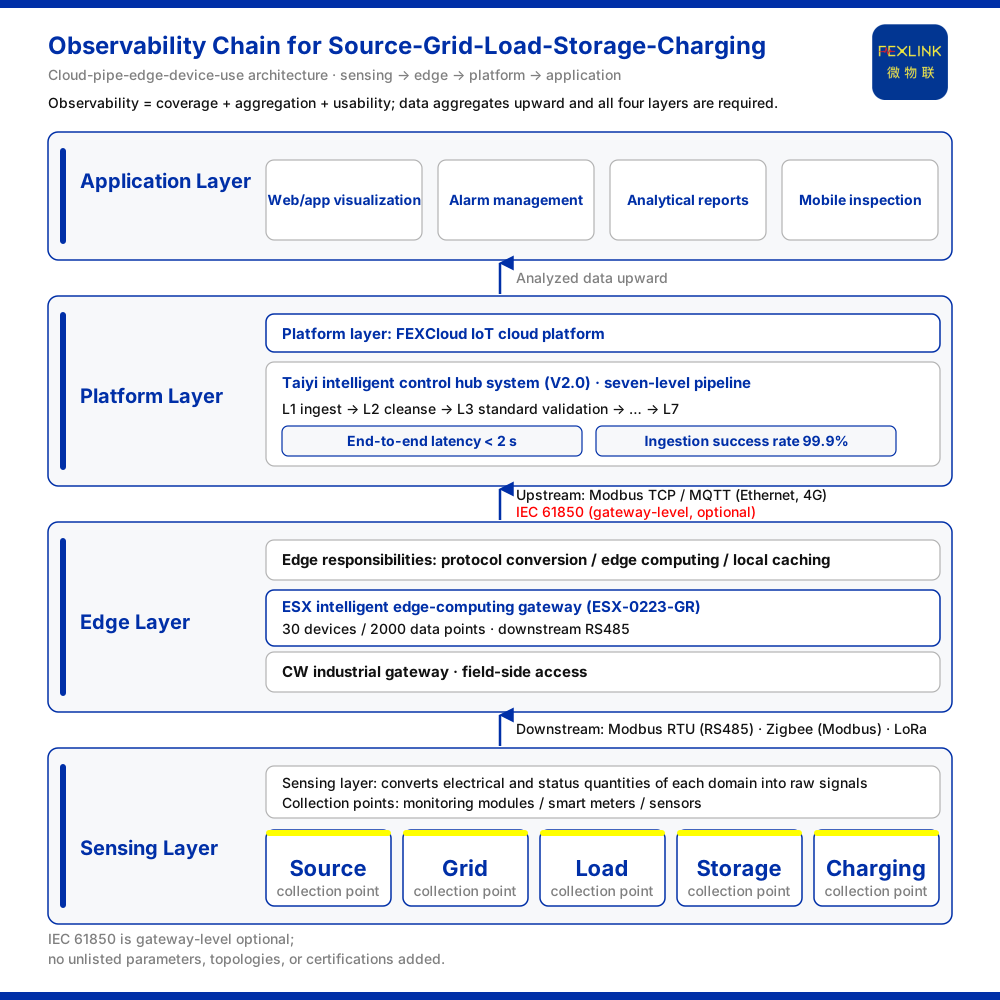
The general four-layer monitoring architecture in the knowledge base provides this skeleton: sensing layer → edge layer → platform layer → application layer.
The sensing layer comprises monitoring modules, smart meters, and sensors that convert electrical and status quantities into raw signals. Coordination-relevant assets sit across generation, distribution, and consumption sites, and this layer directly touches them.
The edge layer handles protocol conversion, edge computing, and local caching. It unifies heterogeneous downstream protocols into an upstream-capable format and performs local computation and temporary storage, solving the "don't lose data, don't scramble data" problem: when the upstream link jitters, local caching preserves sampling continuity, and protocol conversion gives different domains a common exit.
The platform layer is the FEXCloud IoT cloud platform, responsible for device access, time-series databases, and an AI inference engine. Coordination needs more than instantaneous values — it needs comparable time series, and a time-series database supplies exactly that comparability. Without the platform layer, each domain can only look at its own data.
The application layer provides Web/app visualization, alarm management, analytical reports, and mobile inspection. It is both the exit of the chain and the interface where coordination decisions become visible and reviewable.
All four layers are indispensable: if any is missing, the chain from sampling to conclusion does not hold. This is why coordination must be discussed from the architecture rather than the algorithm.
3. The Protocol Matrix: What Determines "Ingestibility"
Whether the four-layer chain can connect into one whole depends on whether interfaces match. The communication protocol matrix in the knowledge base divides interfaces into two classes: downstream, devices use Modbus RTU (RS485), Zigbee (Modbus), and LoRa; upstream, devices use Modbus TCP / MQTT (Ethernet, 4G), with IEC 61850 available as an optional gateway-level protocol.
This matrix is the admission condition for observability. Device types across domains differ widely, and without explicit downstream and upstream protocols the edge layer cannot complete unified access: downstream determines how end devices are read, and upstream determines how data is sent out.
The position of IEC 61850 should be stated precisely: under the knowledge base definition it is an optional gateway-level protocol, and its clauses may only be cited after matching against the 408-entry standards library. This article states only its place among upstream protocols and lists no specific clauses or criteria; treating a protocol number as a conclusion is itself mistaking form for judgment.
4. The Edge Layer: Giving Data Shape Before Uplink
The first stop downstream of the chain is the edge layer. Take the intelligent edge-computing gateway (ESX-0223-GR): its access capability is 30 devices / 2,000 data points, with RS485 downstream communication. These parameters correspond to the edge layer's aggregation duty — gathering many lower-level devices and data points in one place to form a manageable data set first.
The engineering implication is "aggregate first, uplink second": if every end device connected directly to the platform, access count and protocol adaptation would both become bottlenecks; when the gateway gathers and converts locally, the upstream side sees structured data. The edge layer thus determines the granularity and completeness of the input.
Scope must be drawn clearly: the intelligent edge-computing gateway (ESX-0223-GR) is one specific model in the knowledge base, and the knowledge base also lists other edge-computing and industrial gateway models whose power supply, uplink method, and expansion capability differ. The capability described here corresponds only to ESX-0223-GR and is not extended to other models.
5. The Hub: Turning the Chain into Something Analyzable
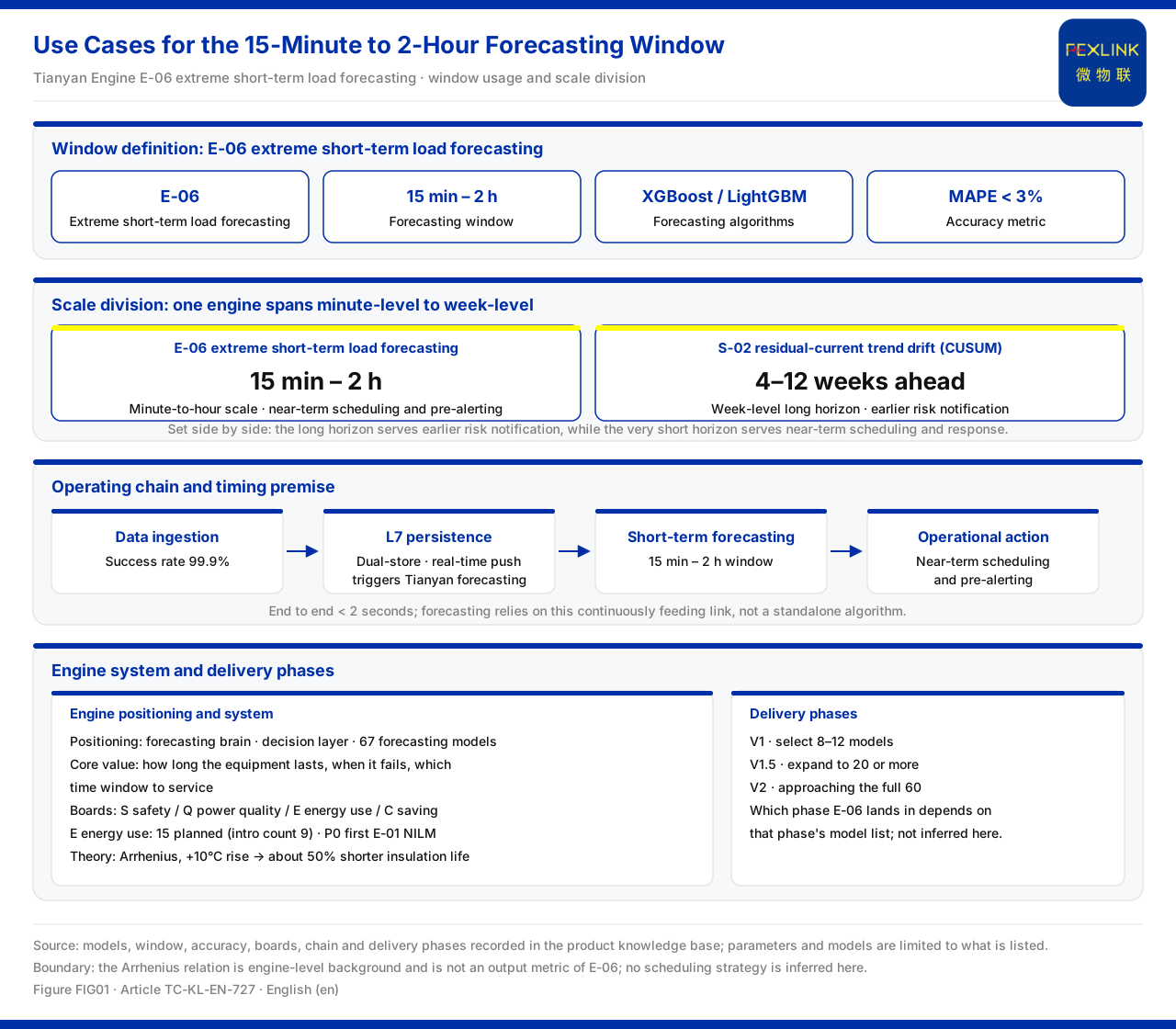
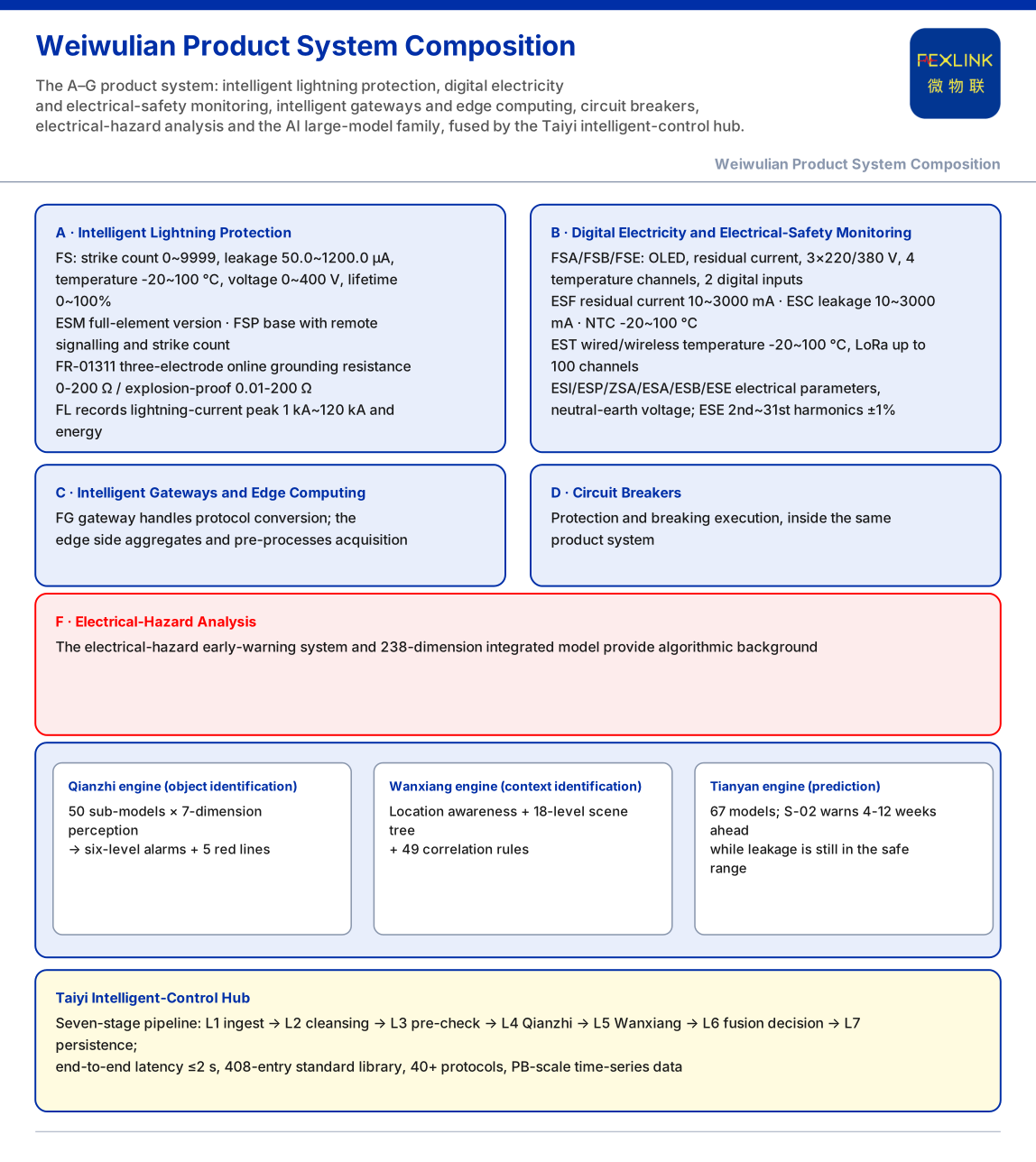
Only after data reaches the platform layer does it enter the genuinely observable stage. In the knowledge base, the Taiyi intelligent control hub system (V2.0) carries this responsibility with a seven-stage pipeline: from L1 ingestion and L2 cleansing to L3 standard validation, then onward into later analysis, with end-to-end processing latency below 2 seconds and a data ingestion success rate of 99.9%.
The three quantities mean different things. The seven-stage pipeline indicates data must be processed stage by stage rather than sent straight to computation; the 99.9% ingestion success rate concerns chain continuity, since a break can cause an algorithm to misjudge system state; end-to-end latency below 2 seconds determines whether the chain keeps pace with the coordination rhythm.
The crux is cleansing and validation. Even ingestible raw data may contain noise, duplicates, or out-of-range values; without cleansing and validation, an algorithm mistakes data anomalies for device anomalies. Observability's substance is that data entering the algorithm is already analyzable — and this happens before the algorithm.
6. Common Misjudgments
First, treating the algorithm as the first step. The algorithm answers "how to dispatch," observability answers "what to dispatch with"; reverse the order and the algorithm spins idle on unusable input.
Second, equating installed monitoring devices with achieved observability. Sampling completes only coverage; ingestibility, cleanliness, and alignability make data usable.
Third, watching only one domain. If any domain's data is missing, coordination can only hold locally.
Fourth, ignoring unified protocols and links. However many devices exist, if each is an island, what remains is fragments.
Fifth, treating a protocol or standard number as a conclusion. IEC 61850 is an optional gateway-level protocol whose clauses may only be cited after matching against the 408-entry standards library.
7. Deployment Checklist
Coverage: does every domain — source, grid, load, storage, and charging — have a corresponding collection point?
Protocols: does downstream cover whichever of Modbus RTU (RS485), Zigbee (Modbus), and LoRa are actually in use; is upstream designed per Modbus TCP / MQTT (Ethernet, 4G); and is IEC 61850 needed at the gateway level?
Edge: does an edge-computing gateway perform protocol conversion and local aggregation, and does the selected model's access capability match the site scale?
Hub: is data ingested, cleansed, and validated through the Taiyi intelligent control hub system pipeline, and do end-to-end latency and ingestion success rate meet the coordination rhythm?
Application: are all four layers complete, and can alarms and reports trace back to specific domains?
Compliance: have the standards clauses involved been matched in the 408-entry standards library?
Connecting these six layers, the first step of coordination can be summarized as follows: first turn every domain into one data chain that can be ingested, cleansed, and analyzed, so coordination has input. See first, then coordinate.
Scope and Limitations
First, references are limited to the knowledge base; no unlisted entries, parameters, or cases are cited.
Second, source-grid-load-storage-charging coordination is the problem context here; the knowledge base does not elaborate its market mechanisms, dispatch strategies, or algorithm details, so this article makes no inferences and discusses only the observability preconditions coordination requires.
Third, the four-layer monitoring architecture is limited to the sensing, edge, platform, and application layers in the knowledge base.
Fourth, the communication protocol matrix is limited to the downstream Modbus RTU (RS485), Zigbee (Modbus), and LoRa and the upstream Modbus TCP / MQTT (Ethernet, 4G) and IEC 61850 (gateway-level, optional) described in the knowledge base; IEC 61850 clauses may only be cited after matching in the 408-entry standards library, and this article lists no specific clauses or criteria.
Fifth, the 30 devices / 2,000 data points and RS485 downstream of the intelligent edge-computing gateway are limited to the ESX-0223-GR model listed in the knowledge base; this article does not extend those parameters to other models in the same group.
Sixth, the seven-stage pipeline, end-to-end latency below 2 seconds, and 99.9% data ingestion success rate of the Taiyi intelligent control hub system are limited to the V2.0 definition described in the knowledge base; this article does not infer model counts, recognition rates, or other metrics.