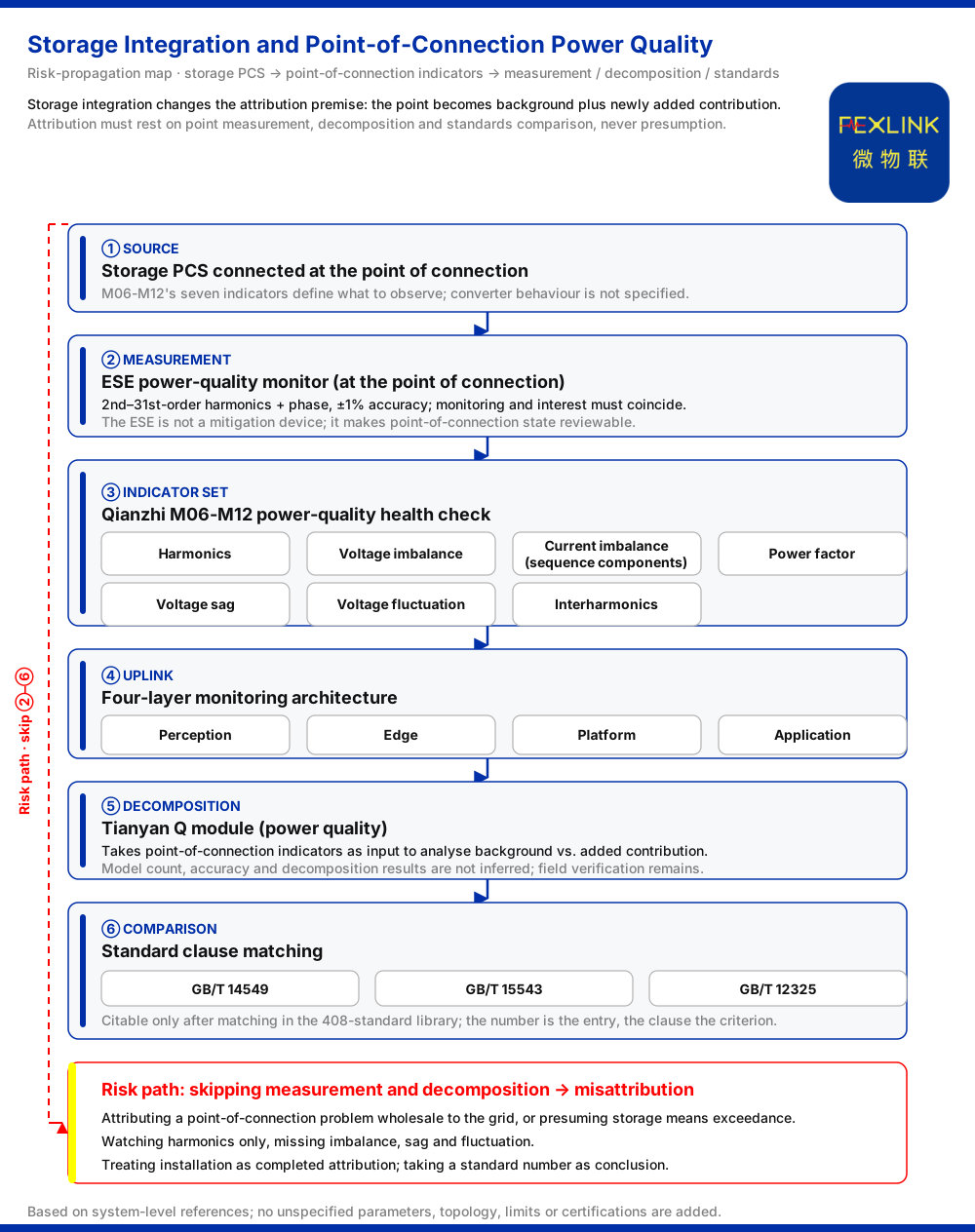
**Direct answer.** Under the knowledge base, what energy-storage integration changes at the point of connection is not a new limiting value but the *attribution premise*: the point shifts from a common coupling point with essentially one source to one where the existing background and the newly added equipment are superimposed. The question changes from "is there a problem at the point of connection" to "how much comes from the pre-existing background and how much from the newly connected storage." The knowledge base does not itemize the storage conversion stage's harmonic signature, nor give a point-of-connection limit, so the actionable answer is methodological: the Qianzhi engine M06-M12 defines which quantities to observe, the ESE power-quality monitor (ESE-22111–22161-R) measures them accurately, and the Tianyan engine's Q module separates contribution from background.
1. What changes first is the attribution premise
The point of connection is a common coupling point where multiple sources and loads meet. Before storage was connected, a power-quality problem there was readily attributed directly to the grid background. After connection, the same point carries both the pre-existing disturbance and the new equipment's variation, and the waveform in one sampling window is the superposition of both sides, not the clean output of one.
Two default assumptions therefore fail. One is that "a point-of-connection problem is necessarily the grid's responsibility" — no longer reachable by presumption. The other is the reverse, "storage always means an exceedance" — the knowledge base does not itemize the storage conversion stage's harmonic signature and limits, and this article makes no assertion about specific equipment. The only certainty is that attribution must rest on measured data at the point of connection, not on inference from what has been connected.
2. Observable: M06-M12 defines which quantities to watch
Attribution begins by fixing what to observe. In the knowledge base, Qianzhi's power-quality health check is carried by the M06-M12 sub-models, covering harmonics (2-50th+THD), voltage imbalance, current imbalance (sequence components), power factor, voltage sag (ITIC/SEMI F47), voltage fluctuation (IEC 61000-4-15) and inter-harmonics.
These seven share three properties. None is a single-point instantaneous value; each reflects waveform quality over a time window — a single-phase RMS current cannot show three-phase symmetry (you must return to sequence components), and a single sample cannot reveal a sag (you need event recording). They cover overall point-of-connection state, not one device's internal parameters. And they form a set: watching harmonics alone loses information, because imbalance, sag and fluctuation affect the same point with different observation methods. Treating M06-M12 as an indicator set fixes the starting point as nameable, acquirable, comparable quantities.
3. Measurable: making the measurement accurate at the point of connection
Once indicators are fixed, they must be measurable. This link is carried by the ESE power-quality monitor (ESE-22111–22161-R), which adds harmonic monitoring to phase monitoring, measures 2nd-to-31st-order harmonics at ±1% accuracy, and provides 2 digital inputs, 1 relay output and RS485 (Modbus).
Each parameter solves a different problem. The 2nd–31st order range means low-order characteristic harmonics are recorded order by order; phase quantities are the precondition for sequence-component analysis and multi-source comparison, without which current imbalance (sequence components) cannot be addressed; ±1% accuracy is the quantitative precondition for "measured accurately." Its role is clear: the ESE power-quality monitor is not a mitigation device but turns the point-of-connection state into reviewable data. Monitoring and interest must coincide — monitoring elsewhere, however accurate, cannot answer a point-of-connection question. On the distribution-circuit side, the FSE multi-parameter electrical intelligent controller (power quality type) (e.g., SFE-11111-R) can provide circuit-level monitoring, with parameters limited to its knowledge-base entry.
4. Decomposable: the Tianyan Q module turns an exceedance into contributions
Accurate data still needs a method to break it apart. In the knowledge base, the Tianyan engine's Q module for power-quality modelling takes point-of-connection indicators as input and analyses contribution composition instead of returning only an exceed/not-exceed conclusion.
The value is clearest in mitigation decisions. Responsibility must be distinguished by source: treating everything as background may let the newly connected party evade its share, while treating everything as new equipment may make the grid-side background problem wrongly paid for. The Q module makes contributions discussable and reviewable, pulling "whose problem is it" back from a contest of positions to data and method. Its result is not self-validating, however: validity depends on acquisition quality at the point of connection and comparison against standards, and this article does not infer the model's accuracy or treat a decomposition result as a conclusion needing no field verification.
5. Acquirable and uplink: the point of connection in the four-layer architecture
Data reaches the analysis end through a chain. The general four-layer architecture gives this path: the perception layer covers monitoring modules, smart meters and sensors, with the ESE power-quality monitor completing raw acquisition at the point of connection; the edge layer handles protocol conversion, edge computing and local caching; the platform layer is the FEXCloud IoT cloud platform, handling device access, the time-series database and the AI inference engine; the application layer provides visualisation, alarms, reports and mobile inspection.
No layer is replaceable. Sag and fluctuation at the point of connection are event-type information, so edge caching preserves data when the uplink is unstable; the platform time-series database makes different periods comparable; the application layer presents indicators and alarms to operations staff. If any layer is missing, the chain from acquisition to conclusion breaks.
6. Comparable: clauses must be matched in the 408-standard library
Point-of-connection harmonics, three-phase imbalance and voltage deviation are compared against GB/T 14549, GB/T 15543 and GB/T 12325, which may be cited only after matching in the 408-standard library.
Matching rather than citing a number matters because a standard number alone is not a criterion. Only a matched clause has a corresponding limit and criterion; skipping this step and treating a number as a conclusion misuses a formal compliance basis. They are listed here only as the comparison entry point.
7. Common misjudgements
First, attributing a point-of-connection problem wholesale to the grid; after storage integration attribution should return to point-of-connection measurements. Second, watching harmonics only — M06-M12 is a set, and voltage imbalance, current imbalance (sequence components), power factor, voltage sag, voltage fluctuation and inter-harmonics are equally in scope. Third, treating device installation as completing attribution; monitoring answers whether data exists, while attribution also needs decomposition and standard comparison. Fourth, using a standard number as a conclusion and skipping clause matching — the number is the entry point, the clause is the criterion. Fifth, extrapolating from one point and one period to an entire station; the operating condition changes with period and mode, so conclusions need a sufficient data window.
8. Checklist for landing at the point of connection
Indicator layer: are all seven quantity classes within M06-M12 scope, or is only harmonics measured? Point layer: does monitoring fall at the point of connection, with acquisition and interest coinciding? Device layer: do the ESE power-quality monitor's harmonic order range, phase and accuracy meet the requirement, and where circuit-level supplementation is needed, are the FSE multi-parameter electrical intelligent controller (power quality type) parameters within its knowledge-base entry? Link layer: are the four layers complete, and will event-type data be discarded on the uplink? Attribution layer: is the Tianyan Q module used to decompose contributions rather than presupposing responsibility? Compliance layer: are the relevant standard clauses matched in the 408-standard library?
Taken together, what changes at the point of connection after storage integration can be summarised in one sentence: it turns from a point one can discuss by experience into one that must be observed, decomposed and compared.
Applicability and limits
First, this article's citations are limited to the knowledge base; it does not cite entries, parameters or cases not listed.
Second, the knowledge base does not itemize the storage conversion stage's harmonic signature or point-of-connection limits; this article does not infer specific harmonic content, distortion rate or limits, nor presuppose any party as the cause.
Third, the harmonics, voltage imbalance, current imbalance (sequence components), power factor, voltage sag, voltage fluctuation and inter-harmonics covered by Qianzhi M06-M12 are limited to the definitions in the knowledge base; other sub-models and alarm grading are not elaborated.
Fourth, the 2nd–31st order harmonics, ±1% accuracy, 2 digital inputs, 1 relay output and RS485 (Modbus) of the ESE power-quality monitor are limited to the knowledge base; the FSE controller's parameters are limited to its knowledge-base entry.
Fifth, the Tianyan Q module is limited to the power-quality model system described in the knowledge base; this article does not infer its model count, accuracy or decomposition results, and attribution still requires field and clause verification.
Sixth, the four-layer architecture of the monitoring system is limited to the perception, edge, platform and application layers described in the knowledge base.
Seventh, the clauses of GB/T 14549, GB/T 15543 and GB/T 12325 must be matched in the knowledge base's 408-standard library before citation; this article does not list specific limits or criteria.