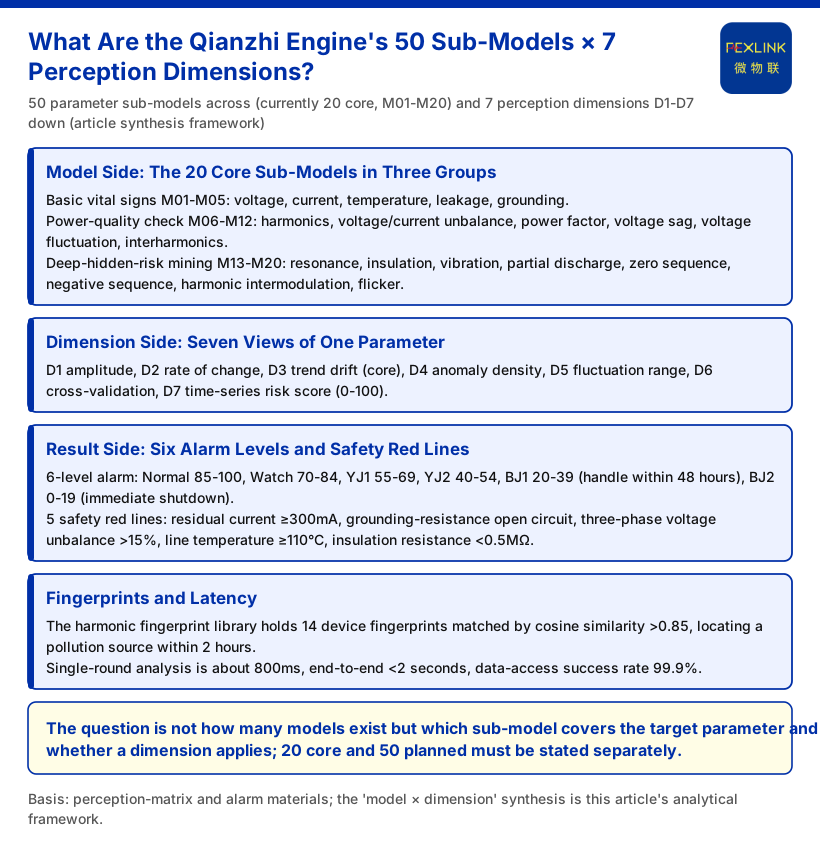
The Qianzhi Engine V4.1 sensing system is, in one sentence, a "model × dimension" matrix: 50 parameter sub-models across the rows (currently 20 core models, M01-M20) and 7 perception dimensions D1-D7 down the columns. Models answer "which parameter to look at"; dimensions answer "from which angle to judge it". Evaluating Qianzhi therefore cannot rest on the number "50" alone: what matters is whether the model-dimension combinations cover the target parameters. It is equally important to separate scopes — the knowledge base contains both "currently 20 core" and "planned 50" phrasings.
Model Side: What the 20 Core Sub-Models Sense
The knowledge base groups the current 20 core sub-models into three sets.
The first set is "basic vital signs" M01-M05, handling the five most fundamental electrical quantities: voltage uses a symmetric two-limit algorithm, current looks at overload factor, temperature applies position-aware correction, leakage current follows time-series trends with pre-screening, and grounding identifies TN/TT/IT systems. This set answers whether the system is still alive and whether the basic vital signs have crossed their limits.
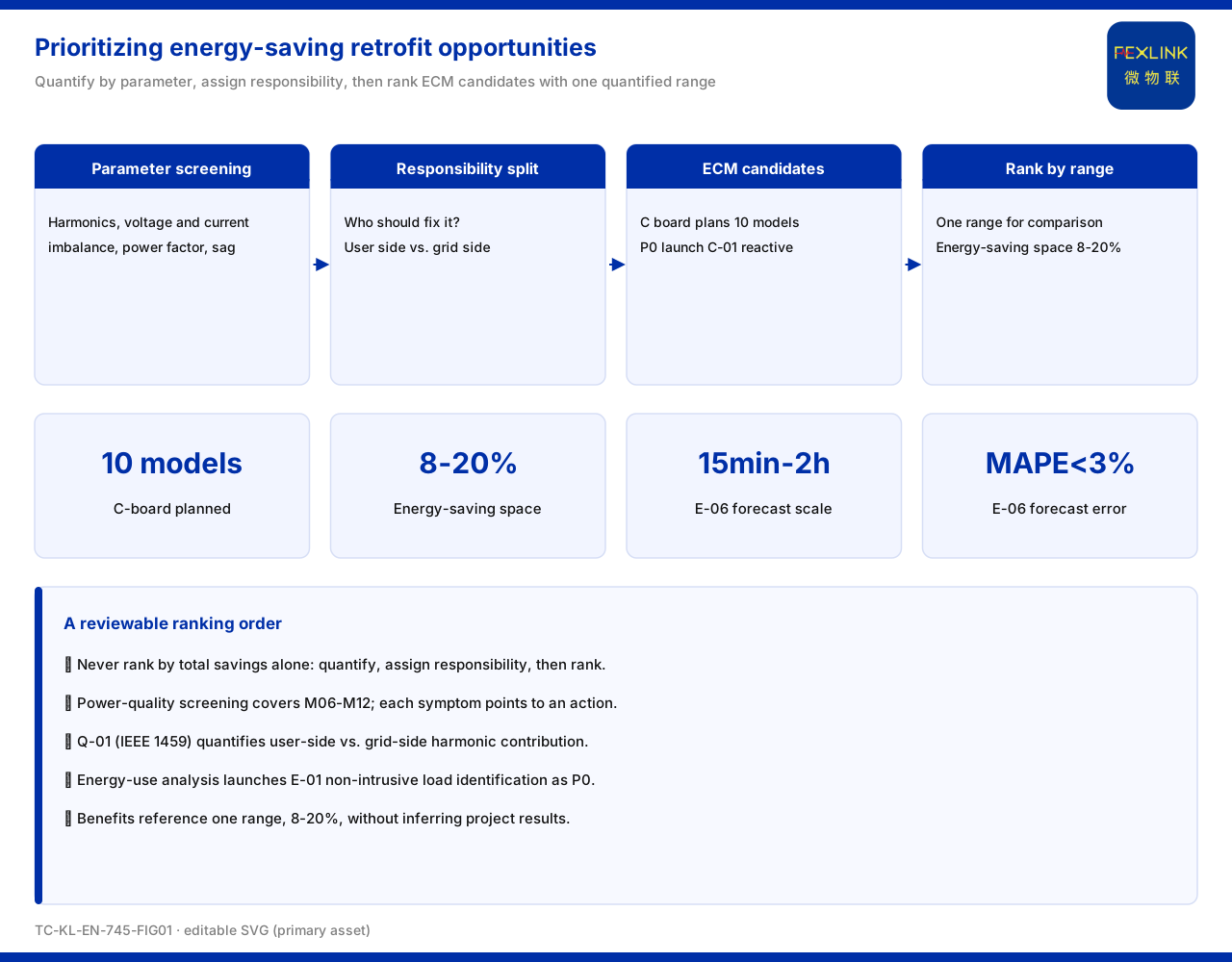
The second set is "power-quality examination" M06-M12, covering seven power-quality problems: harmonics (2nd-50th plus THD), voltage unbalance, current unbalance (using sequence components), power factor, voltage sags (referencing ITIC/SEMI F47), voltage fluctuations (IEC 61000-4-15), and interharmonics. This set answers how good the supply quality is and where disturbances come from.
The third set is "deep hidden-hazard mining" M13-M20, aimed at risks that have not yet surfaced as alarms but are already accumulating: resonance risk, insulation condition (ageing model), vibration analysis, partial-discharge detection, zero-sequence current, negative-sequence components, harmonic intermodulation, and flicker synthesis (Pst/Plt). This set answers whether something that looks normal now will fail later.
The three sets progress from present condition, to quality level, to future hazards. Remembering the parameter names together with their numbers is the precondition for reading Qianzhi's output.
Dimension Side: Why One Parameter Needs Seven Views
With models but no dimensions, sensing degrades into limit-breach alarming. The knowledge base provides a 7-dimension perception matrix that gives the same parameter seven judgement angles:
- D1 amplitude: how far the current value is from the boundary; - D2 rate of change: how fast the value is moving; - D3 trend drift: whether it is slowly and persistently departing from baseline — marked as the core dimension; - D4 anomaly density: how often anomalies occur per unit time; - D5 fluctuation amplitude: how violently the value jitters; - D6 correlation validation: whether other parameters corroborate the phenomenon; - D7 time-series risk score: a 0-100 composite of the above for overall decisions.
Temperature is a concrete example: D1 reads the current degrees, D2 the heating rate, D3 whether it rises slowly over the long term, D5 whether fluctuation is severe, and D7 then produces a composite risk score. The same temperature series can therefore distinguish an occasional fluctuation from continuous degradation — precisely the difference between seven dimensions and a single-point threshold alarm.
Result Side: Six Alarm Levels and Red Lines
The computation of models and dimensions must ultimately become executable conclusions. The knowledge base defines a six-level alarm system on a 0-100 scale: Normal (85-100), Watch (70-84), YJ1 (55-69), YJ2 (40-54), BJ1 (20-39, requiring action within 48 hours), and BJ2 (0-19, requiring immediate shutdown). Each alarm carries not just a level but a standard-clause reference, four-dimensional impact tags (safety/efficiency/lifetime/carbon, each 0-100), a confidence value and a scenario tag. In other words, Qianzhi's output is not the phrase "an alarm fired" but "what level, under which standard, affecting which dimensions, with what confidence".
Beyond the six levels sits a higher-priority set: the red-line guard. The knowledge base lists five red lines that cannot be bypassed and whose thresholds no one may raise:
-: residual current ≥300 mA, per GB 13955; -: abnormal grounding-resistance open circuit, per GB 50057; -: three-phase voltage unbalance >15%, per GB/T 15543; -: line temperature ≥110 °C, per GB 16895; -: insulation resistance <0.5 MΩ, per GB/T 16895.
The division of labour is clear: ordinary alarms take part in weighting and grading, whereas a red line directly forces the highest-level conclusion and is excluded from the weighting computation — in the knowledge base's phrasing, "the national-standard baseline is never breached".
Fingerprints and Latency: The Harmonic Fingerprint Library and ~800 ms
On the power-quality side, the knowledge base also describes a named mechanism: a harmonic fingerprint library containing 14 device fingerprint classes, examples being FP-01 three-phase rectifier, FP-03 six-pulse inverter, FP-05 UPS, FP-06 charging pile and FP-12 PV inverter. It matches by cosine similarity >0.85 and, per the knowledge base, can locate the pollution source within 2 hours where conventional methods take weeks. In the selection mapping, "harmonic tracing and responsibility attribution" corresponds to Qianzhi M06 plus the fingerprint library, plus Tianyan Q-01 (IEEE 1459).
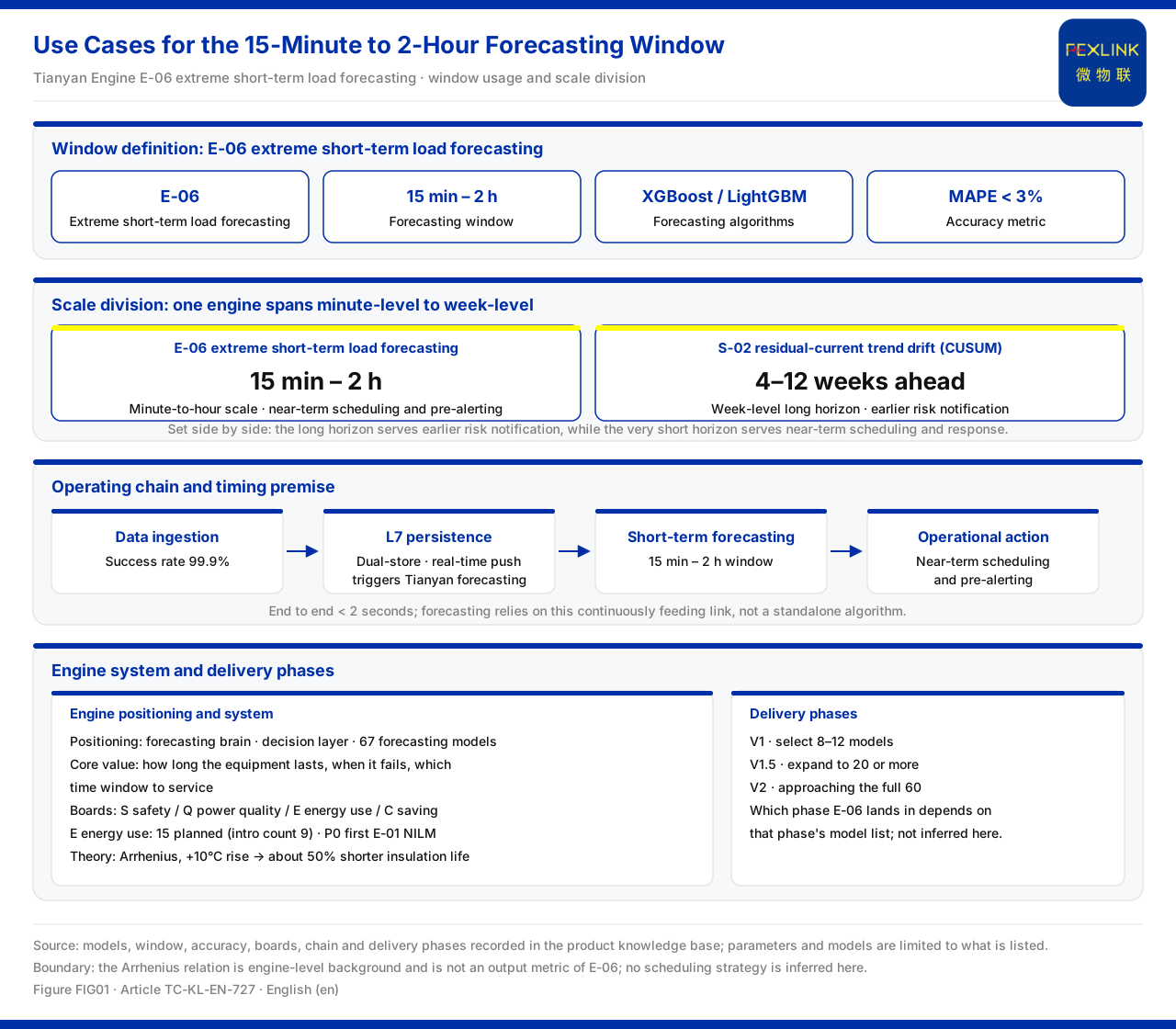
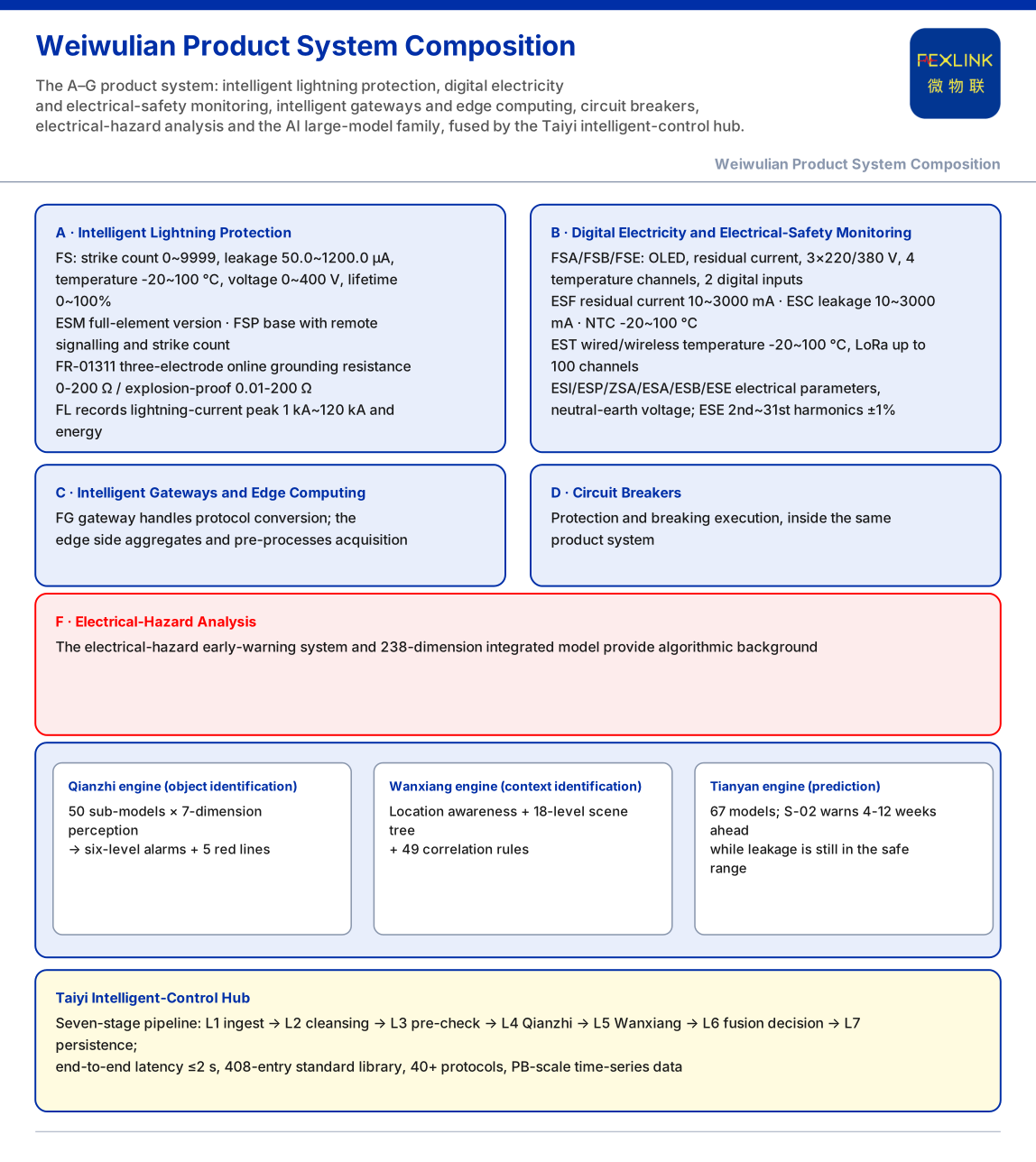
On latency, the knowledge base technical specification is about 800 ms per analysis round (L4 layer), fully parallel, covering 13 major standards including GB/T 12325, GB/T 14549 and GB/T 15543. Placed in the Taiyi seven-stage pipeline: L4 Qianzhi analysis runs 50 sub-models in parallel (~800 ms); after L5 Wanxiang assessment, L6 fusion decision (Qianzhi × Wanxiang weighted composite health) and L7 persistence, end-to-end is <2 seconds with a 99.9% data-ingestion success rate. Understanding Qianzhi's position in the chain helps separate "Qianzhi identifies the object" from "Wanxiang reads the context and Tianyan predicts".
Version Scope and What This Article Does Not Claim
The first point to make clear is the counting scope. The knowledge base explicitly records multiple scopes for the Qianzhi sub-model count: a marketing scope of "20 core / planned 50+", another scope of M01-M27, and a separate extension specification — the version must be stated when citing. The predecessor large model (V1.0/V2.0) used 27 sub-models M01-M27, grouped as core-parameter M01-M12, harmonics + three-phase M13-M18, and special + insulation M19-M27. Any statement about "how many models Qianzhi has" should therefore state its scope first; treating the planned scope as delivered capability is not rigorous.
Second, this article only explains which models and dimensions exist and how results are graded; it does not expand the internal algorithmic implementation of any sub-model. The Prophet, Holt-Winters and XGBoost references in the knowledge base belong to the Tianyan engine and are outside this article's scope; they are not used to extrapolate Qianzhi's parameters or accuracy.
Third, the quantitative value indicators in the knowledge base (electrical-hazard identification rate 95%+, alarm compression ratio 80%, early-warning lead time 4-12 weeks, fault-location time from days to 2 hours, MTTR reduced by 60%, comprehensive energy-saving potential 8-20%, etc.) are supplier self-statements that have not been independently verified. They may be cited as vendor capability claims but should not be treated as verified measurements.
Fourth, this article claims no sub-model, dimension, threshold, certification or case not present in the knowledge base.
Conclusion
The Qianzhi V4.1 sensing system can be understood as follows: 20 core sub-models (planned 50) cover the three parameter classes of vital signs, power quality and deep hidden hazards; 7 perception dimensions examine each parameter through amplitude, rate of change, trend drift, anomaly density, fluctuation amplitude, correlation validation and time-series risk score; six alarm levels output executable grades while five red lines guard the national-standard baseline; and the harmonic fingerprint library plus ~800 ms parallel analysis constitute its concrete capability on the power-quality side. For technical decision-makers, the real selection question is not "how many models does Qianzhi have" but "do the parameters I need to sense fall into an M sub-model with corresponding dimension coverage". For integrators, external communication must clearly separate the 20 core from the 50 planned. The matrix can be decomposed as needed, but the precise capability boundary remains subject to the corresponding entries in the knowledge base.