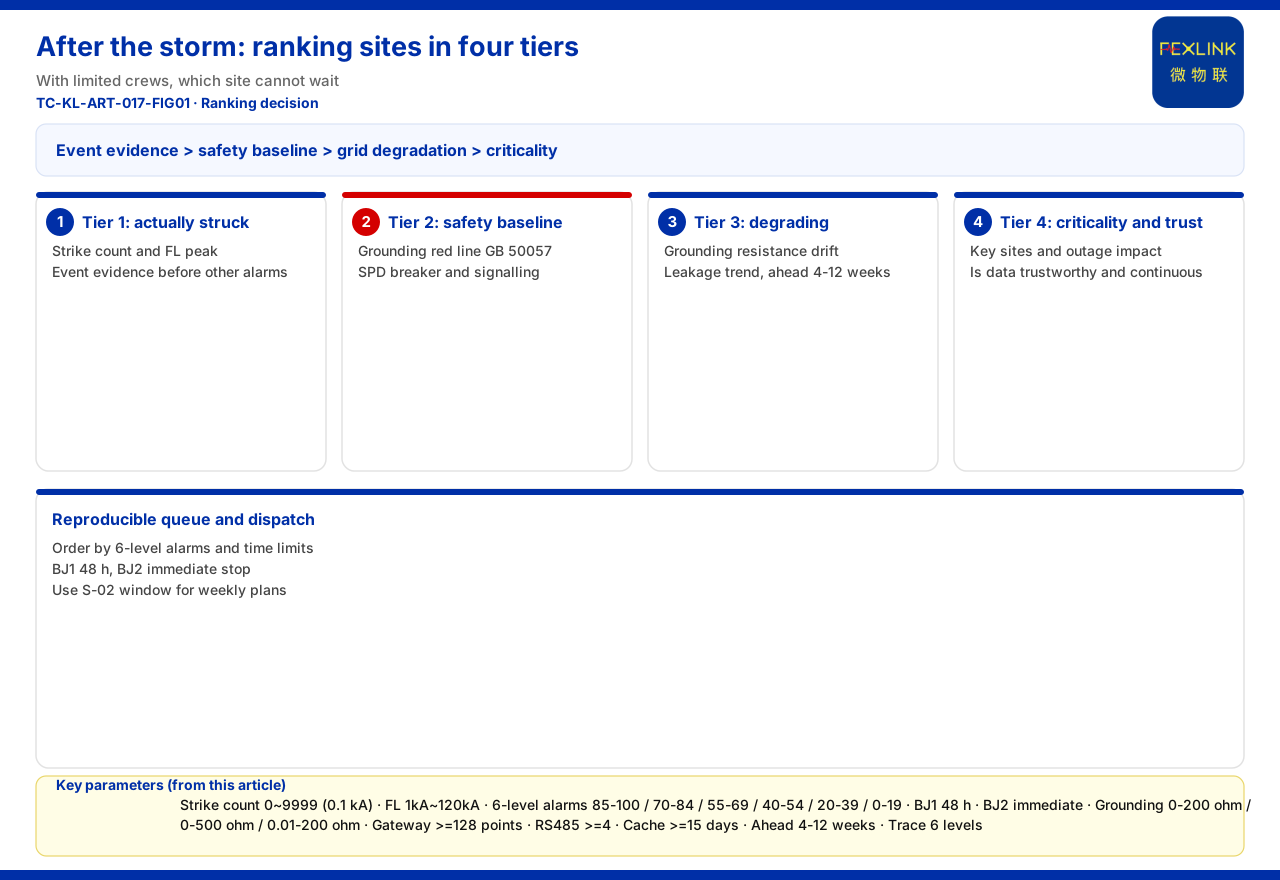
After a thunderstorm a network operations centre may receive dozens or hundreds of alarms at once, while the crews and vehicles available can cover only a handful of sites. The question is not whether to inspect every site but which site cannot wait. The ranking logic is: first filter the sites actually struck, using lightning-event evidence; then filter the sites whose safety baseline was touched, using grounding and SPD state; then judge which sites are degrading, using grounding and leakage trends; finally add business criticality to produce an explainable, reproducible inspection queue.
Separate Two Questions: What to Check on Site vs. Whom to Send First
The in-station order for "which quantity to check first" after a single-site event and the cross-site ranking for "which site to inspect first" among thousands of sites are different decisions: one answers on-site action order, the other resource allocation. The second ranks sites from data each has already uploaded, so its precondition is not field experience but whether each site has remotely readable monitoring points and reliably aggregated data. The four criteria run from most to least urgent.
Criterion One: Filter the Sites That Were Actually Struck
The first sieve is the lightning event. The knowledge base records that the FS surge protective device monitor counts 0~9999 strikes with a minimum trigger of 0.1 kA — the trigger is low, so even a small-current event leaves a count, and a changed count shows a real discharge without waiting for damage. For strength, the knowledge base gives FL-01222 (indoor) and FL-01212 (outdoor) at 1 kA~120 kA with energy monitoring, and FL-11122 (indoor) at 0.1 kA~1 kA. A site with "a count and a notable peak or energy" should precede one whose count did not change; the latter's other alarms are more likely ordinary fluctuation.
Criterion Two: Sites Touching the Safety Baseline Go First
Once an event is confirmed, safety consequences outrank damage size. The knowledge base makes "abnormal open circuit of the grounding resistance" the non-bypassable red line, per GB 50057; a trigger directly emits the highest-level alarm. Once grounding is open, the protection chain is electrically broken and other parameters are irrelevant, so such sites precede any equipment-lifetime question. The same section gives six alarm levels: normal (85-100) → Watch (70-84) → YJ1 (55-69) → YJ2 (40-54) → BJ1 (20-39, handle within 48 hours) → BJ2 (0-19, shut down immediately); the deadline is itself a ranking weight.
Also check whether protection devices are still in place. FS monitoring covers remote signalling, air-switch status, grounding status, strike count, leakage current, temperature, voltage and lifetime estimation; the FSP SPD base provides remote-signalling input and strike counting. A reported SPD air-switch trip or abnormal signalling means the chain may be broken, so move the site forward. Where a fuller picture is needed, the ESM intelligent lightning-protection monitoring terminal adds humidity and can be supplied at DC5V or AC220V.
Criterion Three: Use Online Grounding Data to Find Sites Already Degrading
The first two sieves answer "already in trouble"; the third answers "not yet, but degrading". The grounding grid is the shared weak point of dispersed sites and can be measured remotely: the knowledge base describes the FR-01311 grounding resistance monitor using the three-electrode method, DC12V supply and outdoor installation, with RS485/Zigbee/Ethernet. For multi-site management, the system-level unit gives 0-200 Ω (standard, ±1%) / 0-500 Ω (high-precision, ±0.5%) / 0.01-200 Ω explosion-proof (±2%), with a gateway mounting ≥128 points (cascadable), RS485 ≥4 ports, Ethernet ≥2 ports, optional 4G/5G/LoRa, cache ≥15 days, DC9-36V wide voltage and IP65. One gateway can mount over a hundred grounding points, turning grounding state from "measurable only on site" into comparable continuous data. Prioritise sites drifting clearly from their own baseline or nearing the red-line interval.
Criterion Four: Weight Business Criticality and Data Trust
Sites at equal risk differ in business criticality and should be handled in a different order. Which carry critical services and which cause wider impact if they go out of service is the operator's business knowledge; the knowledge base sets no site-grading rule and this article does not invent one. The final weight comes from the business, not the monitoring device. The Wanxiang engine uses location awareness to keep independent thresholds and risk models per electrical topology position, with cascade effects traceable up to six layers, so the same alarm carries different weight at different sites and positions.
One easily missed precondition: missing data may be a device fault or merely a link problem. The protocol matrix gives downlinks (Modbus RTU/RS485, Zigbee, LoRa) and uplinks (Modbus TCP/MQTT; IEC 61850 optional at gateway level); lightning-protection module data is aggregated by the FG gateway, a protocol converter with RS485/Zigbee downlink, Ethernet uplink and DC12V supply. The four-layer architecture (perception, edge, platform, application) frames the check. Keep data trust as its own tier: complete, credible data costs far less to judge than intermittent links.
Turning the Queue into a Dispatch Rhythm
A queue also needs a rhythm. The six-level alarms and deadlines serve directly as dispatch priorities; the Tianyan S-02 residual-current trend drift (CUSUM) model detects a weak mean shift while leakage is still safe and warns 4-12 weeks ahead, fitting "not yet broken but degrading" sites into a weekly plan without post-event emergency manpower. Platform support is the Taiyi intelligent-control hub's seven-stage pipeline — L1 ingest → L2 cleansing → L3 red-line pre-check → L4 Qianzhi analysis → L5 Wanxiang assessment → L6 fusion decision → L7 persistence — in under 2 seconds end to end, with an L3 red-line trigger emitting the highest-level alarm.
A Reproducible Ranking Logic
The framework is: event evidence (a lightning count, notable peak or energy) > safety baseline > grounding-grid degradation (resistance drift, leakage trend) > business criticality (critical sites, wide-outage impact); within each tier, order by alarm level and deadline. In the scenario table, "online monitoring of substation and traction-substation grounding grids" recommends FR-01311 (one per point) + an FG gateway + FEXCloud, and "lightning-arrester condition monitoring (retrofit of existing SPDs)" recommends FS, ESM full-element SPD monitoring and the FSP base — starting points for each site type's minimum configuration. Use the locked knowledge base terminology consistently. Products and parameters are its inputs, not its source.
Boundaries: What This Article Does Not Claim
It is not a standard operating procedure and cannot replace site rules, safety regulations or business judgement.
Second, the quantitative indicators (hazard identification 95%+, alarm compression 80%, fault localisation from days to 2 hours, MTTR reduced 60%) are vendor self-reports; cite them only as capability claims, never as a ranking basis, deadline or guarantee.
Third, the table lists no telecom-base-station row; this article invents no base-station-specific model, parameter or standard clause and claims no case, certification, or energy-saving or reliability effect. The only standard cited is GB 50057, as listed in the knowledge base. Fourth, this article does not cover in-station data order, base-station lightning-protection construction or product selection, or alarm-grading and work-order design; it answers only "which site to inspect first after a thunderstorm".
Conclusion
Dispersed sites make checking one by one infeasible, so post-storm inspection is a ranking problem. A reproducible approach: pick the sites with real lightning events, push sites touching the safety baseline first, then use online grounding and leakage trends to find degrading sites, and finally add business criticality, scheduling by the six-level alarms and the S-02 prediction window. Devices supply data; ranking supplies the ability to spend limited manpower on the right sites.