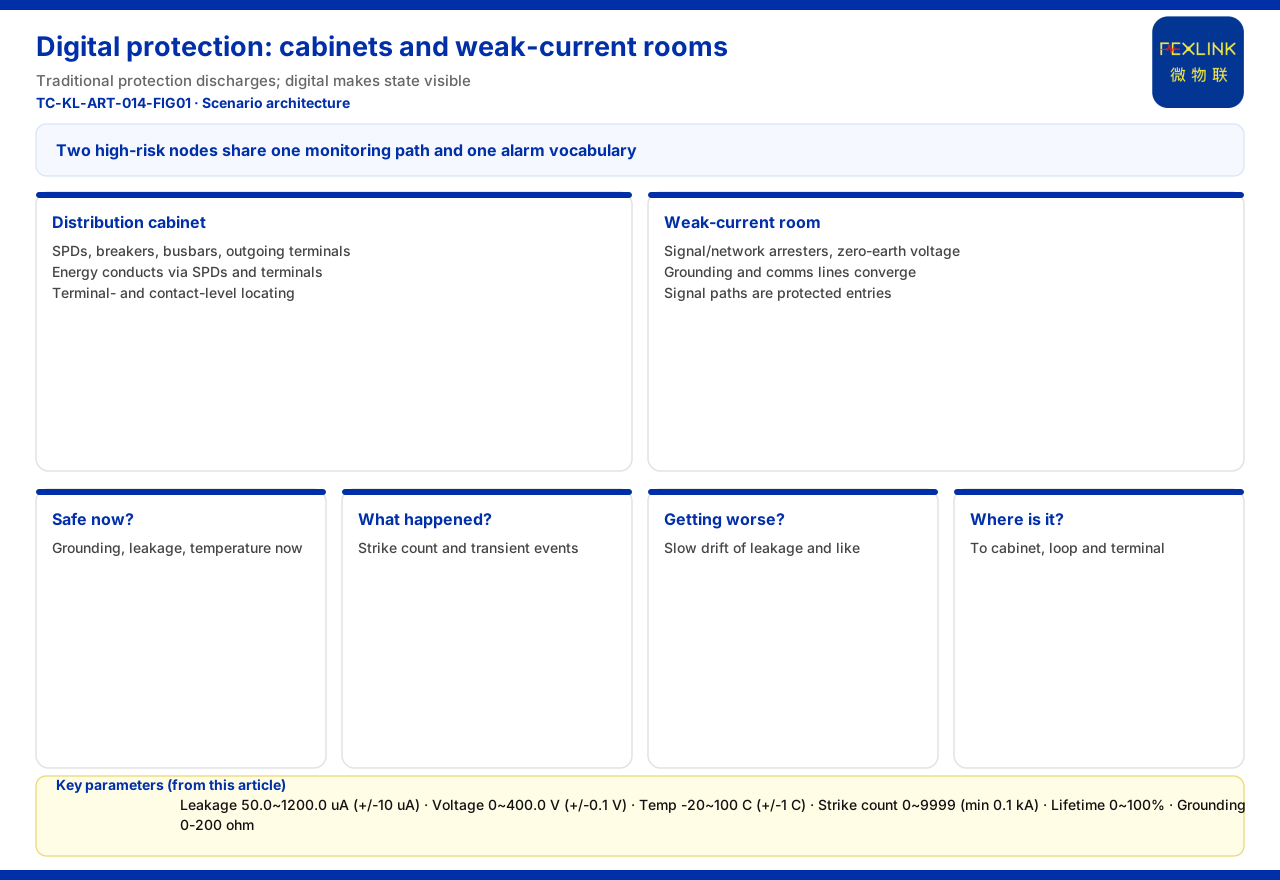
Traditional lightning protection handles discharge; digital lightning protection asks whether state is visible. A low-voltage distribution cabinet concentrates SPDs, circuit breakers, busbars and outgoing terminals; a weak-current room concentrates signal, network and communication lines and grounding. Both are nodes that most need watching once lightning energy enters a building: whether an SPD failed, grounding is reliable, an air switch tripped or a signal path breached is often found only after a fault or an inspection. Digital lightning protection layers collectable, uploadable, alarm-capable monitoring onto existing devices, making such states continuously readable.
One: Why Both Scenarios Are High-Risk Lightning Nodes
A distribution cabinet concentrates power SPDs, circuit breakers, busbars and outgoing terminals. The knowledge base lists "low-voltage distribution cabinet electrical fire early warning" as a typical scenario, recommending ESF-22110 or ESC multi-channel leakage, EST temperature and IoTBox. Cabinet hazards thus include overvoltage, leakage and temperature rise left behind, not lightning alone; lightning energy travels through the cabinet's SPDs and outgoing terminals toward equipment, and terminal and contact-point levels are the finest two of the knowledge base's 18-level Wanxiang locating tree.
A weak-current room is composed differently but equally concentrated. The knowledge base provides YSE XM series signal/network surge protectors, plus POE, 100 Mbps and gigabit network surge protectors and 220V/24V/12V two-in-one network surge protectors, so signal and network paths are themselves entries needing protection. The knowledge base lists "data centre zero-ground voltage / distribution monitoring" as a separate scenario, recommending ESP-12101, the ESA full-element smart meter and the ESX edge gateway. Signal paths and zero-ground voltage are often treated as accessories, yet they are where weak-current rooms most often fail.
Two: The Common Weakness—Protective Devices "Installed but Invisible"
Traditional protection shares one weakness: a protective action but no status output. Whether an SPD keeps protecting depends on whether the air switch tripped, leakage drifted, the strike count accumulated or lifetime remained. The FS surge protective device monitor in the knowledge base makes these readable, covering remote signalling, air-switch status, grounding status, lightning-strike count, leakage current, temperature, voltage and lifetime estimation, with leakage current 50.0~1200.0 μA (±10 μA), voltage 0~400.0 V (±0.1 V), temperature -20~100 °C (±1 °C), strike count 0~9999 (minimum trigger 0.1 kA) and lifetime estimation 0~100%. Capability is not all default: FS-00011 supports only signalling, air-switch, grounding and strike count; FS-03211 adds 3 leakage and 2 temperature channels; FS-33211 adds 3 voltage and 1 lifetime channel.
Grounding is another "installed but invisible" case. The FR-01311 grounding resistance monitor in the knowledge base uses the three-electrode method, DC12V supply and outdoor installation, with RS485/Zigbee/Ethernet; it gives reference parameters: monitoring units 0-200Ω (standard, ±1%), 0-500Ω (high-precision, ±0.5%) and 0.01-200Ω explosion-proof, rating IP65, an intelligent gateway mounting ≥128 points and caching ≥15 days. Grounding can be measured continuously, not only by an annual test.
Three: What Digital Lightning Protection Sees More Of
Added visibility falls into four classes: is it safe now (immediate grounding anomalies, leakage current, temperature), what just happened (strike count and transient-current events), will it get worse (slow drift of parameters such as leakage current) and where is the anomaly (location to cabinet, circuit, terminal). The knowledge base does not state this classification directly.
"What just happened" relies on event quantities: the FL is distinguished by environment and peak range—FL-01222 (indoor) and FL-01212 (outdoor) cover 1 kA~120 kA with energy monitoring, while FL-11122 (indoor) covers 0.1 kA~1 kA. "Will it get worse" appears in the Tianyan engine S-02 residual-current trend drift (CUSUM) model, which detects a weak mean shift while leakage is still safe and warns 4-12 weeks ahead. This is the knowledge base's model description only; no project-specific effect is promised.
Four: How Monitoring Is Integrated Into a Distribution Cabinet
A cabinet is a natural integration carrier. The FSP SPD base in the knowledge base offers a local status form: FSP-21000-R and FSP-21100-R are AC220V, digital-tube display, 1 remote-signalling input and 1 strike-count channel, temperature channels 0 or 1 by model, all RS485. For full elements, the ESM terminal includes humidity and takes DC5V or AC220V. For circuit current, voltage and temperature, the FECB2SP/SLP smart circuit breaker supports voltage/current/temperature monitoring; the SLP version adds leakage monitoring and residual-current protection, all RS485.
Data leaves the cabinet through aggregation. The FG gateway in the knowledge base is protocol-conversion with RS485/Zigbee downlink and Ethernet uplink, DC12V, models FG-0221-ER and FG-0221-EZ; the protocol matrix uses Modbus RTU (RS485), Zigbee (Modbus) and LoRa downlink and Modbus TCP/MQTT (Ethernet, 4G) uplink, with IEC 61850 optional at gateway level. The typical link is monitoring products by suffix, aggregated by an FG-class gateway and uplinked to the platform.
Five: Which Lines a Weak-Current Room Must Watch
A weak-current room focuses on signals and grounding. On signals, the knowledge base provides YSE XM series signal/network surge protectors (5V/12V/24V/48V, broadcast signal) and POE, 100 Mbps and gigabit network surge protectors, whose status also needs entry monitoring. On power, the "data centre zero-ground voltage / distribution monitoring" recommends ESP-12101, ESA and ESX. On grounding, FR-01311 applies.
A gap must be acknowledged: equipotential bonding is basic to lightning protection, but the knowledge base lists no equipotential product, parameter or measurement method, and this article asserts nothing about its specification, practice or effect. Implementation must follow design documents and site conditions.
Six: What Doing It Together Adds Over Doing It Separately
If each builds its own system, data lands in two isolated views; sharing one path aligns status, events and alarms on one platform. The knowledge base defines four layers—perception, edge, platform and application: perception collects FS/FR/FL/ES modules and sensors, the edge uses FG/ESX/CW gateways for protocol conversion and local caching, the platform is FEXCloud, and the application carries Web/App visualisation, alarm management and reports.
On alarms, the knowledge base lists "abnormal open circuit of grounding resistance" as the non-bypassable red line per GB 50057; a trigger outputs the highest-level alarm directly and bypasses weighted scoring. The same six-level scheme requires BJ1 (20-39) to be handled within 48 hours and BJ2 (0-19) to trigger immediate shutdown, each alarm carrying a standard-clause citation and four-dimensional impact tags. On locating, the Wanxiang engine keeps independent thresholds for PCC_POINT, MAIN_PANEL, DISTRIBUTION_PANEL, FEEDER_LINE and LOAD_TERMINAL, and its 18-level tree reaches L17 wiring-terminal and L18 contact-point level, locating an alarm to "the outgoing terminal of circuit 5 in the power cabinet of Workshop 3". Both sets can then be read as which cabinet, line and terminal.
Seven: Boundaries—What This Article Does Not Claim
Second, this article claims no model, parameter, certification, compatibility conclusion or case absent from the knowledge base; parameters are limited to the corresponding knowledge-base entries.
Third, it claims nothing about the specification, practice or effect of equipotential bonding, which the knowledge base does not cover.
Fourth, it claims no cost saving, payback, failure-rate reduction or effect promise from upgrades; the quantitative indicators (a 95%+ hazard identification rate, an 80% alarm compression ratio) are vendor self-reports.
Terminology follows the knowledge base's locked naming: FS = surge protective device monitor, ESM = intelligent lightning-protection terminal (SPD monitor), FSP = SPD base, FR = grounding resistance monitor, FL = lightning current / transient current monitor, FG = intelligent gateway, FECB2SP/SLP = smart circuit breaker, ESP = zero-ground voltage monitor, ESA = full-element smart meter, ESX = intelligent edge computing gateway, FEXCloud = IoT cloud platform, SPD = surge protective device.
Conclusion
Distribution cabinets and weak-current rooms need digital lightning protection not because another layer of equipment is added, but because both concentrate objects needing continuous observation: cabinets hold SPDs, breakers and outgoing terminals; weak-current rooms hold signal/network lines, zero-ground voltage and grounding. Traditional protection makes an action happen; digital protection makes the state readable—joining SPD status, grounding, lightning events and terminal-level locating into one four-layer architecture and alarm semantics turns "installed but invisible" into "anomalies discoverable, location traceable". The boundary remains: combined scope, naming, equipotential bonding and every effect indicator lie outside what the knowledge base states, so "why do it" and "what this article does not claim" must be said together.