

Many people think of lightning arresters in simple terms: a module installed in a distribution cabinet, showing normal during acceptance testing, fine as long as the green indicator window is lit. But an SPD is not a static device that remains effective forever once installed. Its status can change with every surge impulse, every discharge of lightning strike energy, and every hour of long-term power-frequency operation.
The truly important question about a lightning arrester is not whether it has been installed, but whether it remains effective after installation. If a lightning protection system exists only as an installation checklist and inspection photos, it is hard to detect operating problems such as SPD degradation, disconnection, temperature rise, rising leakage current, and declining life trend in time.
1. Why Do SPDs Degrade?
First, surge impulses cause cumulative damage. Each surge impulse forces the SPD to absorb and discharge energy. If the number of impulses is high and the energy is large, the SPD may enter a degraded state even if it does not trip immediately.
Second, lightning strike impulses can accelerate aging. Lightning strike energy is stronger and may cause SPD temperature rise, leakage current changes, varistor degradation, state changes in spark-gap components, and even affect the backup protection.
Third, sustained power-frequency voltage. An SPD stays connected in parallel with the system over the long term, and its operating state can be affected by continuous working voltage, overvoltage, harmonics, and voltage fluctuations.
Fourth, environmental factors affect service life. Temperature, humidity, dust, salt spray, vibration, and poor enclosure heat dissipation can all shorten the life of SPD components and reduce operating reliability. Fifth, backup protection and wiring conditions also affect protection performance. An SPD does not work in isolation: backup protection, terminal connections, grounding connections, installation method, cable length, and equipotential bonding all determine whether it can perform correctly.

2. What Are the Blind Spots of Traditional SPD Manual Inspection?
The first blind spot is relying only on the indicator window while ignoring internal degradation. Most on-site inspections focus on whether the window shows green (normal) or red (disconnected). But an SPD that has not turned red may still have endured surges and may still be degrading. Before obvious failure occurs, leakage current, temperature, operating count, or life trend may already have changed.
The second blind spot is the long interval between manual inspections. Many projects are inspected once a month, once a quarter, or even once a year. If an SPD trips or degrades between two inspections, the site may remain without effective protection for a long period.
The third blind spot is the absence of lightning strike and surge event records. Whether an SPD has operated, how many surges it has experienced, and whether its status changed after a particular thunderstorm are questions that cannot be answered without event data.
The fourth blind spot is knowing only about disconnection, not the degradation trend. Traditional remote signaling can usually tell the platform only whether the SPD is normal or disconnected, but Smart Lightning Protection needs to know further whether leakage current is rising, whether temperature is abnormal, whether the lightning strike count is increasing, whether the life trend is declining, and whether replacement should be arranged in advance.

3. What Does SPD Online Monitoring Actually Monitor?
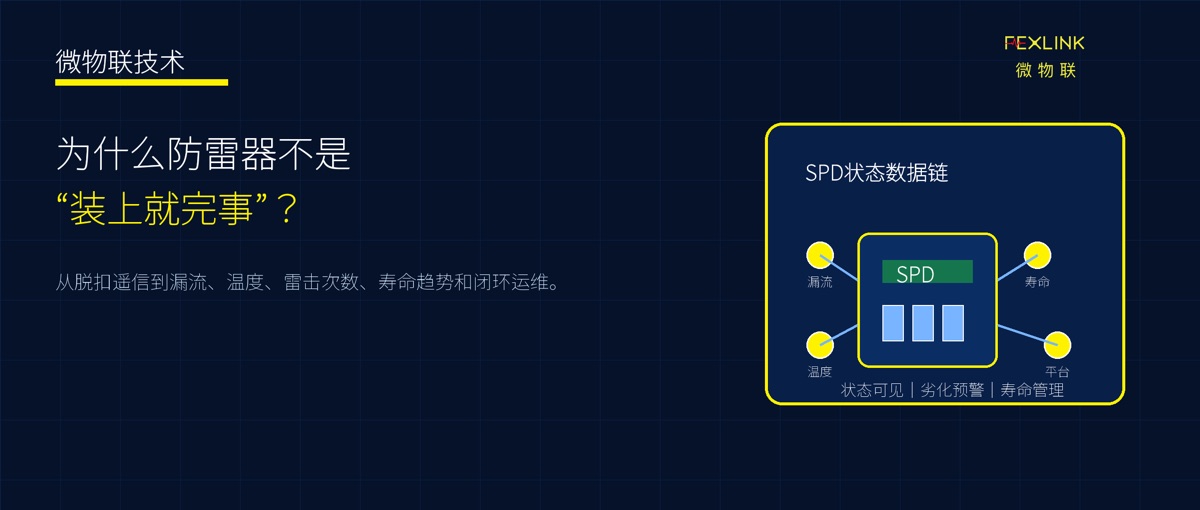
SPD online monitoring must first track the disconnection state, which is the most basic status. It indicates whether the SPD has failed, whether the SPD module needs replacement, and whether the remote signaling state is abnormal. But disconnection is only the outcome, not the whole story.
Leakage current variation is one of the key indicators of the SPD's internal state. If leakage current keeps rising, it may indicate component degradation, moisture ingress, an increasing risk of thermal runaway, or changes in insulation state. Temperature variation is also critical: SPD temperature rise can reflect local heating, abnormal wiring, component degradation, poor enclosure heat dissipation, or potential thermal hazards.
Lightning strike count and surge events are not mere counters; they are important inputs for life assessment. Their value increases when correlated with lightning current, device alarms, and grounding status. Voltage status must not be ignored either. An SPD operates in a real voltage environment, and overvoltage, voltage fluctuations, and prolonged high-voltage operation can all affect its service life.
Going further, SPD online monitoring should build life trends and degradation assessments. Monitoring that is truly valuable does not wait for failure to raise an alarm; it reveals the degradation trend before failure so that review or replacement can be scheduled in advance.

4. How Should SPD Online Monitoring Be Designed?
The first layer is on-site protection, including Type 1 SPDs, Type 2 SPDs, DC SPDs, AC SPDs, signal SPDs, communication SPDs, backup protection, grounding, and equipotential bonding. This layer addresses whether basic protection exists.
The second layer is status sensing, including disconnection remote signaling, leakage current, temperature, voltage, lightning strike count, surge events, backup protection, and grounding status. This layer addresses whether protection status is visible.
The third layer is edge data acquisition and communication, including RS485, Modbus, 4G/5G, Ethernet, edge gateways, data re-transmission, and multi-point aggregation. If SPD status monitoring is to cover distribution rooms, equipment rooms, base stations, wind-solar-storage sites, and transportation infrastructure, stable communication and high data integrity are essential.
The fourth layer is edge computing, including data cleansing, anomaly filtering, leakage current trend analysis, temperature rise trend analysis, post-strike status assessment, preliminary life trend assessment, and local alarm correlation. The fifth layer is platform diagnostics and the O&M closure loop, including an SPD status map, alarm grading, degradation trends, life estimation, remote review, work order dispatch, replacement records, recovery confirmation, and event archives.

Fig. 5A: The on-site monitoring layer of the SPD online monitoring system.

Fig. 5B: The platform diagnostics layer of the SPD online monitoring system.
5. How Should SPD Status Be Correlated with Lightning Current, Grounding, and Device Alarms?
A Smart Lightning Protection system cannot focus on the SPD alone. What is more valuable is to place SPD status in a complete risk chain: lightning current events, SPD operation or degradation, grounding status changes, device alarms, and O&M review.
For example, if SPD leakage current rises after a lightning strike event, the SPD may have entered a degraded state after absorbing the impulse and should be given priority review. If SPD temperature is abnormal while grounding status fluctuates, there may be a problem in the on-site protection loop or the grounding discharge path. If the SPD trips together with alarms from critical equipment, it must be determined whether protection has failed, and replacement and equipment review should be arranged. If repeated low-energy impulses drive the SPD life trend downward, predictive maintenance is appropriate instead of waiting until a disconnection occurs.

6. Which Scenarios Need SPD Online Monitoring the Most?
Distribution rooms and distribution cabinets need SPD online monitoring because the large number of SPDs and circuits makes manual inspection prone to omissions. Data centers and equipment rooms house sensitive equipment with strict power continuity requirements; SPD status cannot remain invisible for long.
Wind, solar, and energy storage sites are heavily exposed to the outdoors and frequent surges, and SPD status directly affects site reliability. Communication base stations are unattended and dispersed; if SPD disconnection or degradation cannot be detected remotely, long-term protection gaps will develop.
Critical infrastructure such as railways, highways, airports, and ports has dispersed sites, sensitive equipment, and high O&M costs, and requires platform-based management. Petrochemical and hazardous-chemical facilities demand strict lightning protection, static protection, and Electrical Safety; SPD status, grounding status, and alarm closure cannot remain invisible over the long term.

7. How Does FEXLINK Understand SPD Online Monitoring?
FEXLINK believes that SPD online monitoring is not about connecting a normal/fault remote signaling contact to the platform, but about turning the SPD from a passive protective component into an intelligent protection node that continuously produces status data.
SPD online monitoring requires three shifts: from disconnection alarms to degradation trends, from single-point status to the whole lightning protection chain, and from manual inspection to life prediction and closed-loop O&M. The value of FEXLINK is not merely showing whether an SPD has tripped, but placing leakage current, temperature, lightning strike count, SPD life trend, lightning current events, grounding status, and device alarms in the same risk chain, turning the lightning arrester from a device into a data node.

Conclusion: SPD Installation Is Only the Beginning; Visible Status Is What Smart Lightning Protection Is About
The SPD is one of the most critical protective devices in a Smart Lightning Protection system, but it is not permanently effective once installed. Installation is only the beginning of protection. Making status visible, trends assessable, anomalies traceable, and handling closable is what Digital Lightning Protection really needs to solve.
SPD online monitoring that is truly valuable does not simply mirror red/green status on the platform; it continuously answers four questions: Has the SPD operated? Has it degraded? Is it still effective? Does it need replacement?