
When many companies build a smart lightning protection product line, their first reaction is to turn traditional SPDs into "SPDs with communication." This direction can serve as a starting point, but if it stays at the level of a single device, the product line easily becomes "a lightning protector with more complex functions" rather than a sustainable smart lightning protection system.
Ultimately, customers do not only care whether a certain device has communication; they care whether the lightning protection system is still effective, whether lightning strikes and surges have occurred, whether the grounding status is reliable, whether anyone handles alarms, and whether the data can form reports and grounds for rectification.
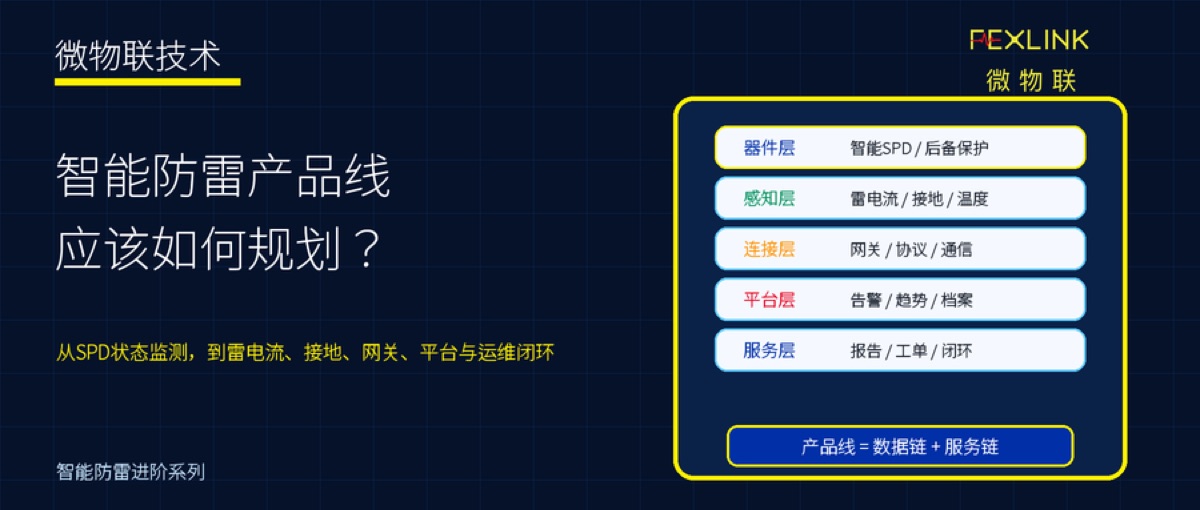
Therefore, the core of product line planning is not piling up features, but designing on-site protection, status sensing, communication connectivity, platform diagnostics, and O&M services as one continuous data chain.

1. Which Targets Should a Smart Lightning Protection Product Line Start From?
The first category is smart SPD monitoring. SPDs remain the foundation of the lightning protection product line, but smart SPDs should not focus only on disconnection remote signaling. More valuable data includes leakage current, temperature, backup protection status, operation records, surge counts, and life trends.
The second category is lightning current monitoring. Lightning current monitoring answers "what exactly happened in the lightning strike event." It should track the strike time, peak current, polarity, waveform, duration, charge, specific energy, and event location, providing a basis for incident review and equipment recheck.
The third category is online grounding monitoring. Grounding is not a one-time test report but a long-term operational state. Online grounding monitoring should track grounding resistance, trend changes, abnormal sudden changes, multi-point comparison, status changes after lightning strikes, and seasonal fluctuations.
The fourth category is smart gateways and acquisition terminals. As long as points are scattered, device types are numerous, and communication environments are complex, the gateway must handle acquisition, aggregation, caching, protocol conversion, interrupted-connection resume, and remote configuration.
The fifth category is platforms and services. The platform should not just display normal and fault statuses; it should complete alarm grading, trend analysis, event archives, risk ranking, work order closure, and report output.

2. Product Line Planning Must Move from Device Features to Customer Value
Many product line plans easily fall into one problem: the feature list is long, but customers still do not know what management problems these features solve. For a smart lightning protection product line to move from device features to customer value, the key is to turn data into judgments, and judgments into actions.
The first step is device status data. This includes SPD status, leakage current, temperature, lightning current, grounding resistance, enclosure environment, and communication status. These data answer whether the site is visible.
The second step is event records. These include lightning strikes, surges, disconnection, abnormal leakage current, abnormal temperature rise, sudden grounding changes, and device offline events. These records answer what happened.
The third step is risk assessment. Based on thresholds, trends, multi-point comparison, and multi-source correlation, the platform must determine alarm levels, risk locations, possible causes, and priority handling order.
The fourth step is handling actions. Smart lightning protection must not stop at dashboards; it must move into work order dispatch, on-site review, device replacement, recovery confirmation, and event archiving.
The fifth step is service output. What customers truly need are monthly health reports, post-thunderstorm special reports, SPD life trend reports, grounding status trend reports, and annual risk assessment reports.

3. Product Line Planning Should Be Implemented in Phases
Phase 1: start with SPD status monitoring. This is the easiest entry point to implement and can prioritize coverage of existing SPD remote signaling, disconnection status, device online status, and basic alarms. This phase does not pursue complete features; instead, it first lets customers see the SPD status that was previously invisible.
Phase 2: add leakage current, temperature, and gateway capabilities. Once the system has leakage current, temperature, and backup protection status, it can move from detecting faults after they occur to early warning of degradation trends. Gateway capability ensures that on-site data can be stably and continuously integrated into the platform.
Phase 3: add lightning current and online grounding monitoring. Smart lightning protection cannot focus on the SPD itself alone; it must also know whether a lightning strike event occurred, how strong the surge was, and whether the grounding path is reliable. This phase marks the formation of a complete lightning protection data chain.
Phase 4: build the platform and service system. The platform must complete alarm grading, event archives, trend analysis, work order closure, and report output; the service system must support post-thunderstorm reviews, quarterly inspection suggestions, and annual risk assessment.

4. The Product Line Must Not Be Separated from Scenario Solutions
The same set of products, without scenario-based presentation, makes it hard for customers to quickly understand the value. Equipment rooms and data centers value SPDs, grounding, UPS power supply, and platform alarms; renewable energy stations value inverters, box-type transformers, step-up stations, lightning current, and grounding status.
Transportation and communication scenarios usually have scattered points, with focus on remote communication, edge gateways, event tracing, and batch O&M. Petrochemical scenarios require attention to explosion-proofing, grounding, antistatic protection, communication methods, and security platform integration. Parks and industrial sites focus more on coordination across multiple cabinets, systems, and roles, and on work order closure.
Therefore, the product line should not be just a generic device list; it must form scenario solution packages of "product combinations + point design + communication networking + platform functions + O&M processes."

5. What Pitfalls Are Common When Planning a Smart Lightning Protection Product Line?
The first misconception is doing only smart SPDs. SPDs are very important, but without lightning current monitoring, grounding monitoring, gateways, and platform closure, the product line still stays at the level of single-point devices.
The second misconception is piling up too many features. More features do not mean more value. If data accuracy, anti-interference capability, long-term stability, and on-site verification are insufficient, more features only make delivery harder.
The third misconception is lacking gateway capability. Smart lightning protection sites often have many points, mixed protocols, long distances, and strong interference. Without stable acquisition and communication capability, even the most polished platform has no reliable data.
The fourth misconception is a platform with display only. Customers do not lack a display page; what they need is grading, diagnostics, cause explanations, handling suggestions, work order closure, and report output.
The fifth misconception is having no scenario solutions. Different scenarios have different risk targets, points, communication methods, and management processes. Without industry-specific solutions, products can hardly truly enter customers' budgets.

6. How Does FEXLINK Understand Smart Lightning Protection Product Line Planning?
FEXLINK believes that the essence of smart lightning protection product line planning is not networking traditional lightning protection products, but enabling lightning protection systems to continuously generate data, explain risks, and support O&M decisions.
What the FEXLINK system focuses on: whether SPD status can be assessed, lightning current events can be traced, grounding status can be continuously monitored, gateways can connect stably, the platform can complete diagnostics and grading, and services can produce reports, work orders, and long-term reviews.
A mature product line must at least answer four questions: whether the data is complete, the connection is stable, the diagnostics are effective, and the service is continuous.

Conclusion: A Good Product Line Moves from the Data Chain to the Service Chain
A smart lightning protection product line is not better for being more complex, nor better for having more features. A truly good product line should make it clear to customers: whether on-site status can be seen, risks can be assessed, anomalies can be handled, and data can continuously create management value.
From SPD status monitoring to lightning current monitoring, from online grounding monitoring to smart gateways, and from platform alarms to work order closure, the core of a smart lightning protection product line is upgrading one-off protection devices into continuously operating data systems.