

The biggest difference between a railway system and an ordinary building or equipment room is that it is not a concentrated point but a continuously extending infrastructure chain. A station contains a signaling room, a communication room, a power distribution room and equipment rooms; beyond the station there are section signaling equipment, trackside boxes, switch-control related equipment, communication base stations along the line, video surveillance points, and tunnel and bridge electromechanical facilities. The impact of a lightning strike or surge does not necessarily stay at one equipment point; it may propagate along power lines, signal lines, communication links, the grounding system or metal structures.
Therefore, railway lightning protection cannot only ask "does this point have an SPD installed"; it must also ask: has this point been subjected to a lightning strike or surge impact? Is the SPD still effective? Is the grounding status stable? Is a certain equipment fault related to a lightning protection event? Which sections along the line are more vulnerable to lightning strikes and surge impacts? These questions can only be answered with continuous online data.
1. Why is railway lightning protection not a single-point problem?
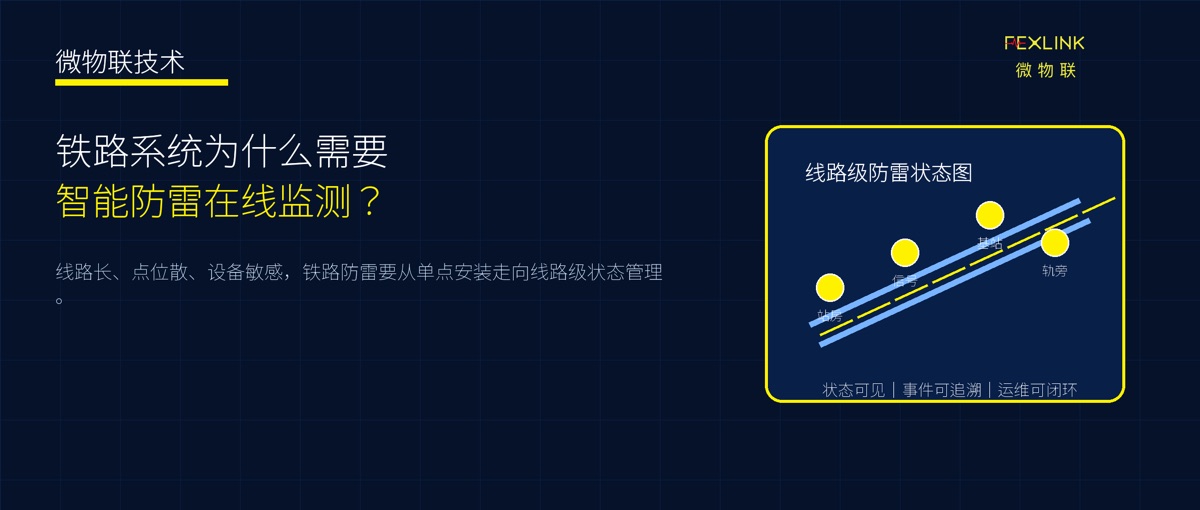
Railway systems feature long lines, scattered points, sensitive equipment and strong operational continuity. Complex coupling exists among the signaling system, communication system, power system, video surveillance system and section equipment. A surge impact at one location may show up as a local SPD operation, or as communication interruption, equipment going offline, signaling equipment anomalies or power module damage.
Traditional lightning protection is usually designed and accepted on the basis of specific points, for example equipping an equipment room with power SPDs, signal SPDs and a grounding system, and fitting a trackside device with corresponding surge protection. But railway operation management needs a line-level perspective, because what truly drives O&M decisions is not whether one device was installed correctly, but which stations, sections and devices along the whole line are exposed to higher risk.

2. What on-site pain points does traditional railway lightning protection face?
The first pain point is scattered points. Equipment along a railway may be spread across mountainous areas, bridges, tunnel portals, sections, station yards and remote base station locations. Manual inspection can find some problems, but it is periodic and cannot cover status changes in real time after thunderstorms.
The second pain point is that lightning strike events cannot be traced. After an equipment fault, the site can often only conclude that it is "possibly related to a lightning strike", but lacks concrete data. When did the impact occur? At which point? What level was the event intensity? Did the SPD operate? Did the grounding status change? Without online event records, subsequent review, responsibility assessment and rectification optimization all become difficult.
The third pain point is that the status of protective devices is invisible. After an SPD disconnects, without remote monitoring it is only discovered during an on-site inspection; an SPD that has not disconnected does not mean it has not undergone repeated impacts or entered a degraded state. For a distributed scenario like a railway, delayed detection is itself a risk.
The fourth pain point is that grounding status is strongly affected by the environment. Soil conditions, humidity, corrosion, construction disturbance and grid connection status vary greatly between sections. A grounding system is not permanently stable after a single test; especially after thunderstorms, construction, long-term corrosion and environmental changes, trends need to be observed continuously.

3. What data should railway smart lightning protection online monitoring look at?
Railway smart lightning protection cannot only collect a single remote indication contact, nor can it only show whether a given SPD has disconnected. A more complete monitoring system should include at least five categories of data: protective device status, lightning strike and surge events, grounding status, equipment operation alarms and platform closure data.
Protective device status covers power SPDs, signal SPDs, communication SPDs and backup protection status. Lightning strike and surge events include the time of occurrence, the location, the number of impacts, the event level and the devices likely affected. Grounding status includes grounding resistance or equivalent grounding status trends, abnormal jumps, changes after lightning strikes and comparison with similar points. Equipment alarms include signaling equipment anomalies, communication interruption, video surveillance going offline, power equipment alarms and room environment and power alarms. Platform closure data must record whether alarms were pushed, whether work orders were dispatched, whether on-site verification was performed, whether replacement or maintenance was carried out and whether the status was restored.
Taken individually, these data are only local clues; placed on the same timeline, they can form a judgment. For example, if a section device records a surge event during a thunderstorm period, followed by abnormal communication status and a sudden change in grounding status, then this alarm should not be handled as an ordinary offline event; it should enter a higher-priority lightning protection review process.

4. How should a railway smart lightning protection system be designed?
Railway smart lightning protection online monitoring can be divided into three basic scenarios: centralized station building monitoring, distributed section monitoring and unified platform management. Centralized station building monitoring applies to signaling rooms, communication rooms, power distribution rooms and equipment rooms, focusing on power SPDs, signal SPDs, the grounding system, surge events, room environment and equipment alarms.
Distributed section monitoring applies to trackside boxes, section signaling equipment, switch-control related equipment, wayside video surveillance points and communication base stations. These points are characterized by dispersion, complex environments and high inspection costs, so the system should focus on terminal online rate, power supply status, surge protective device status, key grounding point status and communication reliability.
Unified platform management is the key to whether the whole system truly delivers value. The platform should not only show which points are online; it should support map-based management, alarm grading, event archives, grounding trends, site risk profiles, section risk ranking and work order closure. The digital value of railway lightning protection ultimately has to be reflected in concrete questions such as "which point is more dangerous, who handles it first, and is the status restored after handling".

Fig. 5A: Field access layer of the railway smart lightning protection system.

Fig. 5B: Platform judgment and O&M closure layer of the railway smart lightning protection system.
5. An alarm is not the end; closure is the value
Many intelligent systems tend to stop at "there are alarms, pages and curves". But railway lightning protection scenarios care more about what happens after the alarm. An SPD anomaly only identifies a problem, and a surge event only records it; only when work order dispatch, handling, verification and archiving are completed does true management closure form.
Closure matters on two fronts: on one hand, it ensures on-site risks are handled in time; on the other, it builds up long-term O&M evidence. Through continuous records, the platform can learn which stations have frequent lightning events, which devices repeatedly alarm, which sections show obvious grounding status fluctuations and which points do not recover well after maintenance. These data in turn support inspection planning, spare parts configuration, retrofit prioritization and line-level risk assessment.

6. Line-level risk ranking: putting O&M resources where they matter most
Railway lines have many points but limited O&M resources, so a smart lightning protection system must not treat all anomalies as equally important. An effective platform should combine event intensity, point importance, SPD status, grounding changes, equipment alarms and historical faults into a risk ranking.
For example, if an SPD anomaly occurs at an ordinary auxiliary equipment point, the handling priority may differ; if it occurs at a critical section, important signaling equipment, a communication relay point or a location with a history of frequent lightning strikes, the risk level should be raised. The value of a smart lightning protection system is not to generate more alarms, but to make truly critical risks visible first.

7. How does FEXLINK understand railway smart lightning protection?
FEXLINK believes that the core of railway smart lightning protection is not simply connecting SPDs to a platform, but unifying the lightning protection facilities, protection status, lightning strike and surge events, grounding status and equipment operation alarms along the line into one line-level risk data system.
FEXLINK's approach is to upgrade railway lightning protection from "single-point protection" to "line-level status management", from "periodic inspection" to "online sensing", from "post-fault investigation" to "traceable events", and from "whether equipment is installed" to "whether protection remains continuously effective". Only in this way can lightning protection data truly serve the reliable operation and safe O&M of railway systems.

Conclusion: The essence of a railway lightning protection upgrade is turning line-side risk into manageable data
The difficulty of railway lightning protection does not lie in whether a single point is equipped with protective devices, but in the large number of points along the line, the complex operating environment and the long fault impact chain. Without online data, a lightning protection system easily stays at the construction and acceptance stage; with continuous monitoring, it can enter the operation management stage.
The value of smart lightning protection online monitoring is to unify the protection status of scattered points, lightning strike and surge events, grounding changes, equipment alarms and O&M handling, so that risk is visible, events can be found, status can be judged and handling leaves a trace.