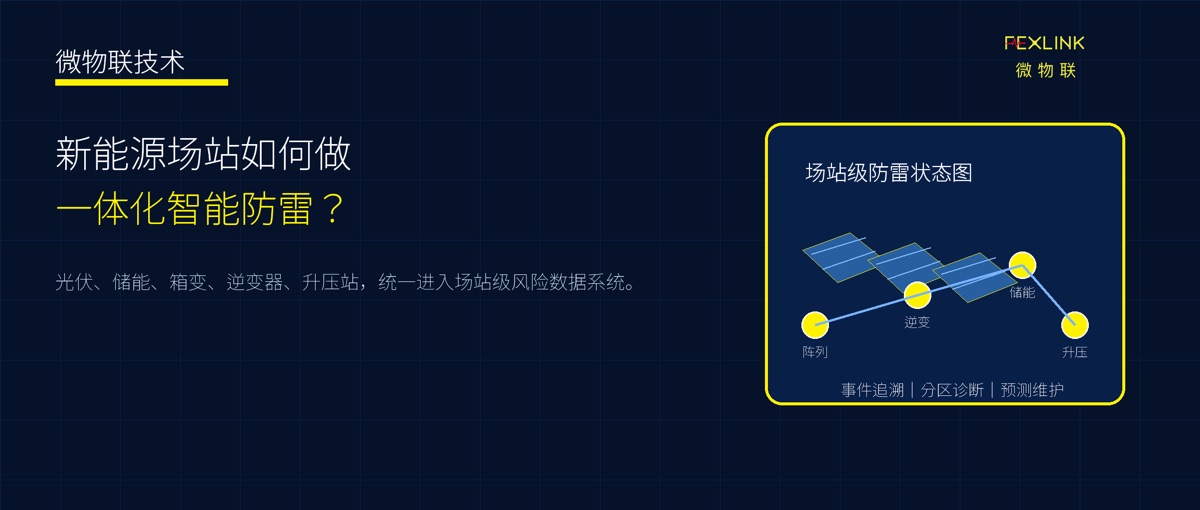


PV plants, energy storage plants and PV-wind-storage integrated stations often occupy large footprints, with scattered equipment points, long DC-side cables, high-value AC-side equipment and complex communication and control systems. A single lightning strike or induced surge may not just trip one SPD, but affect combiner boxes, inverters, box-type transformers, storage PCS, BMS, EMS, communication systems and even step-up substation equipment.
The difficulty of lightning protection at new-energy power stations is not whether SPDs are installed, but which areas have experienced surge impacts, which equipment is affected and which protection statuses are degrading. Without continuous online data, station lightning protection easily remains a configuration checklist from the construction phase and fails to enter the risk management of the operation phase.
1. Why Do New-Energy Power Stations Face More Complex Lightning Protection Risks?
First, new-energy power stations are large with wide exposure. PV arrays, racks, combiner boxes, inverters, box-type transformers, storage cabins and step-up substations are scattered across a large area. Lightning strikes or induced surges may affect a local area, or may propagate to multiple devices through cables, the grounding system and communication links.
Second, DC-side lines are long. There are large quantities of DC cables between PV modules and combiner boxes, and between combiner boxes and inverters. Long lines are more likely to induce surges, and DC-side equipment is more sensitive to overvoltage, insulation status changes and surge processes.
Third, equipment is high-value with obvious downtime losses. If inverters, box-type transformers, storage PCS, BMS, EMS and step-up substation protection equipment are damaged, this creates not only repair costs but also generation losses, abnormal grid connection or O&M downtime.
Fourth, there are many communication and control systems. New-energy power stations rely on communication systems, monitoring systems, dispatching systems, EMS, BMS and SCADA for operation management. Surges may not only damage power equipment, but also affect communication links, control systems or data acquisition equipment.

2. What Blind Spots Exist in Traditional New-Energy Power Station Lightning Protection?
The first blind spot of traditional new-energy power station lightning protection is only looking at whether SPDs are installed. Many projects configure power SPDs, DC SPDs, AC SPDs and signal SPDs during construction, but after commissioning, whether the SPDs have operated, whether they have degraded, whether they have disconnected, whether they need replacement and whether the backup protection is normal are hard to know in time without online monitoring.
The second blind spot is that lightning strike surge events cannot be traced. After inverter faults, box-type transformer anomalies, communication interruptions or storage PCS alarms occur, it is often difficult to determine whether they are related to lightning strike surges, which area the event occurred in, which devices were affected, whether adjacent devices need to be checked and whether the grounding system needs to be re-verified.
The third blind spot is that grounding status changes are easily overlooked. The grounding system of a new-energy power station is affected by soil moisture, corrosion, construction, cable connections and grounding grid aging. A single test value cannot represent the long-term operating status.
The fourth blind spot is that equipment alarms and lightning protection events are disconnected. Many stations have inverter alarms, box-type transformer alarms, storage alarms and communication alarms, but lightning protection system data is not associated with these alarms, so post-event analysis lacks a complete timeline.

3. What Should Smart Lightning Protection for New-Energy Power Stations Monitor?
In the PV array area, priority should be given to monitoring DC-side SPD status, combiner box lightning protection status, surge events, alarms related to abnormal insulation and the grounding status of the array area. The array area is large with long lines, so zone-level monitoring is more meaningful than a single plant-wide status.
Combiner boxes should focus on DC lightning protection device status, power circuit status, communication status, enclosure environment and surge impact records. Combiner boxes both connect many module circuits and act as convergence points of DC-side risk.
Inverters should focus on DC input-side SPDs, AC output-side SPDs, equipment alarms, communication links, and the time correlation between equipment alarms and surge events. The inverter is the core of power conversion, and faults are directly reflected in generation capability.
Box-type transformers should focus on low-voltage-side SPDs, relevant protection status on the high-voltage side, grounding status, temperature and operation alarms, and status re-verification after lightning strikes. Energy storage systems should focus on PCS input/output-side SPDs, BMS/EMS communication protection, storage cabin grounding status, fire protection and temperature-control interlocking alarms, and the correlation between lightning strike surge events and storage alarms. Step-up substations and communication systems should also focus on in-station SPD status, communication equipment lightning protection status, grounding grid status, monitoring system alarms and dispatching communication link status.

4. How Should an Integrated Smart Lightning Protection System Be Designed?
An integrated smart lightning protection system cannot just list equipment, but must be designed in layers. The first layer is the on-site protection layer, including PV DC-side SPDs, AC-side SPDs, signal SPDs, communication lightning protection, storage PCS lightning protection, box-type transformer/step-up substation lightning protection, and grounding and equipotential bonding. It solves the basic protection problem.
The second layer is the status sensing layer, including SPD disconnection status, SPD degradation status, surge event records, lightning current monitoring, grounding resistance or grounding status, enclosure environment and key equipment alarm acquisition. It solves the problem of whether status is visible.
The third layer is the station communication layer. Communication conditions at new-energy power stations are complex, so RS485, Ethernet, fiber optics, 4G/5G, LoRa, edge gateways, local platforms or cloud platforms can be selected according to the point location. It solves the problem of whether data can be transmitted stably.
The fourth and fifth layers are the platform diagnosis layer and the O&M closure layer. The platform should form a device map, zone division, alarm grading, lightning strike surge event archives, SPD health trends, grounding trends, equipment alarm correlation and high-risk area ranking; the O&M closure should include alarm push, work order dispatch, on-site re-verification, SPD replacement, grounding checks, re-test confirmation, event archiving and risk reports.

Fig. 5A: On-site protection and status sensing of the new-energy smart lightning protection system.

Fig. 5B: Platform diagnosis and O&M closure of the new-energy smart lightning protection system.
5. What Is the Core Value of Digital Lightning Protection for New-Energy Power Stations?
First, lightning strike impact becomes traceable. After a lightning strike surge, it is possible to view the time of occurrence, the affected area, the affected points, SPD operation status, grounding changes and whether equipment alarms appeared at the same time.
Second, lightning protection status becomes manageable. Smart lightning protection does not wait until an SPD fails to find out, but sees degradation, disconnection, temperature rise, impact history and trend changes in advance.
Third, O&M shifts from plant-wide inspection to risk-based inspection. The platform can tell O&M personnel which array area is high-risk, which inverter is near many events, which box-type transformer has abnormal grounding status, which storage units need re-verification and which points can be inspected on a planned schedule.
Fourth, lightning protection data serves generation reliability. Lightning protection is not just a safety system; it also affects equipment availability, generation continuity, fault downtime, O&M costs, asset life and station reliability assessment.


6. How Does FEXLINK Understand Smart Lightning Protection for New-Energy Power Stations?
FEXLINK believes that the core of smart lightning protection for new-energy power stations is not simply connecting SPDs to a platform, but making the lightning protection system part of the station's operational data. New-energy power stations need three transformations: from single-point protection to zone-based status management; from post-failure repair to event tracing and predictive maintenance; and from lightning protection silos to electrical safety data integration across the station.
The FEXLINK digital lightning protection architecture aims to continuously collect lightning current, SPD, grounding, surge event and electrical equipment alarm data, so that lightning protection devices continuously produce trustworthy data and lightning protection data is incorporated into the generation reliability and electrical safety early warning system. For new-energy power stations, lightning protection should not only be a construction acceptance item, but should become part of long-term operation management.

Conclusion: Lightning Protection Upgrades for New Energy Are Part of Reliable Station Operation
The lightning protection upgrade for new-energy power stations is not just to reduce lightning strike damage, but to keep the risk status of PV arrays, energy storage, box-type transformers, inverters, communication systems and grounding systems visible over the long term. For stations with large footprints, many points, high-value equipment and high requirements for operational continuity, the lightning protection system should not remain a configuration checklist from the construction phase, but should become a status data system in the operation phase.
The significance of integrated smart lightning protection is to unify scattered protection devices, lightning strike surge events, grounding status, equipment alarms and O&M handling, so that stations move from 'equipment is protected' to 'risk is assessable and handling can form a closure loop'.