
The problem with many electrical monitoring systems is not a lack of sensors, but having only a single point of view. Looking only at temperature, you may not know whether it is overload or poor contact; looking only at leakage current, you may not know whether it is moisture or insulation aging; looking only at current, you may not be able to tell a normal start-up from an abnormal surge.
Complex hazards are by nature the result of multiple factors acting together. If judgment relies on a single signal, the system easily falls into a state of "many alarms, but weak explanations."

1. Complex Hazards Often Have Multiple Correlated Signals
Poor contact may appear as a temperature rise without an obvious increase in current; insulation degradation may appear as a rising leakage trend while being affected by ambient humidity; arc risk may manifest as abnormal waveforms, high-frequency pulses, and intermittent changes; overload problems may simultaneously cause current, temperature, and voltage disturbances.
Therefore, true early warning cannot look at just one point; it must look at whether multiple signals change together within the same time period.

2. Where Are the Limitations of a Single Sensor?
A single sensor easily sees the local picture but struggles to explain the system. A temperature sensor can detect heat but cannot directly explain why the heat is generated; a leakage sensor can record leakage changes but cannot independently assess the influence of environment, insulation, and load; a current sensor can see fluctuations but does not necessarily know whether the fluctuation is dangerous.
Without correlation analysis, the system is prone to false alarms or missed detections. False alarms consume O&M effort, while missed detections allow genuinely risky situations to slip by.

3. What Should Multi-Dimensional Fusion Look At?
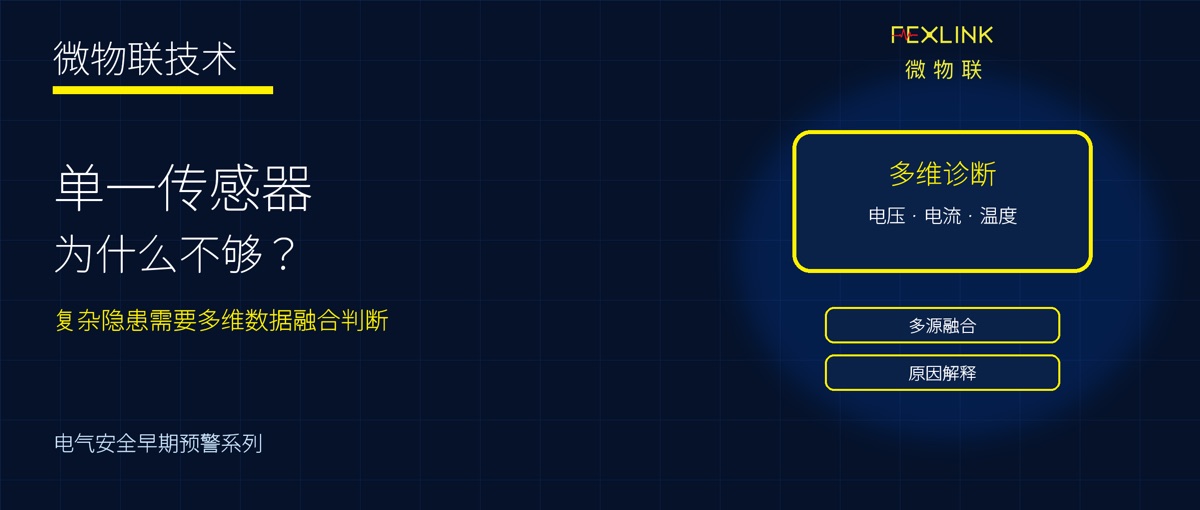
Multi-dimensional diagnosis should include at least voltage, current, leakage current, temperature, high-frequency signals, harmonics, grounding status, environmental conditions, and equipment alarms. Different data answer different questions: voltage indicates power supply quality, current indicates load status, leakage indicates insulation and environment, temperature indicates connections and heat accumulation, and arc characteristics indicate dangerous discharge.
Only when these data are placed on the same timeline can the system determine whether anomalies share a common source and whether the risk is escalating.

4. Fusion Is Not Simple Overlay
Connecting multiple sensors to a platform is not the same as multi-dimensional diagnosis. True fusion requires time alignment, scenario recognition, trend judgment, anomaly combination, and filtering of normal disturbances.
For example, the current surge and voltage sag during motor start-up may be normal; but if they are accompanied by an abnormal temperature rise and repeated high-frequency pulses, further assessment is needed. The key to data fusion is interpreting data within the scenario.

5. How Does FEXLINK Approach Multi-Dimensional Diagnosis?
FEXLINK believes that the core of electrical safety early warning is multi-dimensional dynamic diagnosis. FEXLINK extracts both explicit and implicit features from electrical signals, and through fast edge-side computation combined with cloud-side trend analysis, outputs risk levels, cause explanations, and handling recommendations.
A single sensor can only provide clues; multi-dimensional fusion is what forms a judgment.
Conclusion: Complex Hazards Require System-Level Judgment
Electrical hazards do not occur in isolation, and early warning cannot rely on a single signal. Only by fusing multi-source data can we move from simple alarms to a true hazard profile.