
Many lightning protection projects look complete at delivery: on-site survey, solution design, equipment procurement, engineering installation, inspection and acceptance, and documentation archiving. This process is very important for the construction phase, but the real test of a lightning protection system does not happen on the day of acceptance.
Once a lightning protection system is commissioned, the site experiences lightning strikes, surges, equipment aging, grounding changes, line modification, and environmental corrosion. After a severe thunderstorm, is the SPD still effective? After multiple surges, has the arrester degraded? After on-site modification, have the grounding and equipotential bonding been compromised? None of these questions can be answered by acceptance documents alone.
Therefore, passing acceptance only shows that the lightning protection system met requirements at a particular point in time; proving that it remains effective in the long term must rely on data, diagnosis, and maintenance from the operation phase.

1. Why Do Traditional Lightning Protection Projects Tend to Stop at the Acceptance Stage?
Traditional lightning protection engineering is usually project-based business. Signing a contract, executing the project, passing acceptance, collecting payment, and entering after-sales service is the basic path for many projects. Project-based business naturally ends at delivery, and a company's organizational focus is usually placed on construction and acceptance.
In the past, many lightning protection devices rarely produced data continuously. Traditional SPDs, lightning protection boxes, and grounding systems were mostly silent devices: they said nothing during normal operation and were only noticed after problems occurred. Nobody knew when an SPD disconnected, when leakage current rose, or when grounding gradually degraded, and no event records were left after lightning strikes, all of which left follow-up services without supporting evidence.
Customers in the past also cared more about whether devices were installed, whether grounding was in place, whether inspection reports passed, and whether acceptance documents were complete. But as digital O&M and safety management requirements rise, customers have begun to care more about whether protection status is visible, whether anomalies can be detected remotely, whether risks can be explained, and whether handling can leave a trace.
2. Why Do Real Lightning Protection Risks Occur in the Operation Phase?
Lightning strikes and surges are events that occur during operation. A lightning protection system is not static after acceptance: direct lightning strikes, induced lightning, switching surges, grid disturbances, repeated impacts, and correlated equipment faults continuously test the protection chain after commissioning.
An SPD is not a permanently effective device either. It may experience rising leakage current, abnormal temperature, reduced lifetime, disconnection, abnormal backup protection, and performance degradation after multiple surges. Without online monitoring, many degradation processes are hard to detect before disconnection occurs.
The grounding system also changes. Soil moisture, corrosion, loose connections, construction disturbance, aging of grounding electrodes, and local changes after lightning strikes can all cause a grounding system that once passed inspection to gradually drift away from a safe state.
On-site modification can also break the original protection chain. Added equipment, line modification, enclosure replacement, extended communication lines, relocated grounding conductors, and bypassed or removed SPDs can all create new weak points in the original lightning protection design.

3. What Should Long-Term Smart Lightning Protection O&M Services Include?
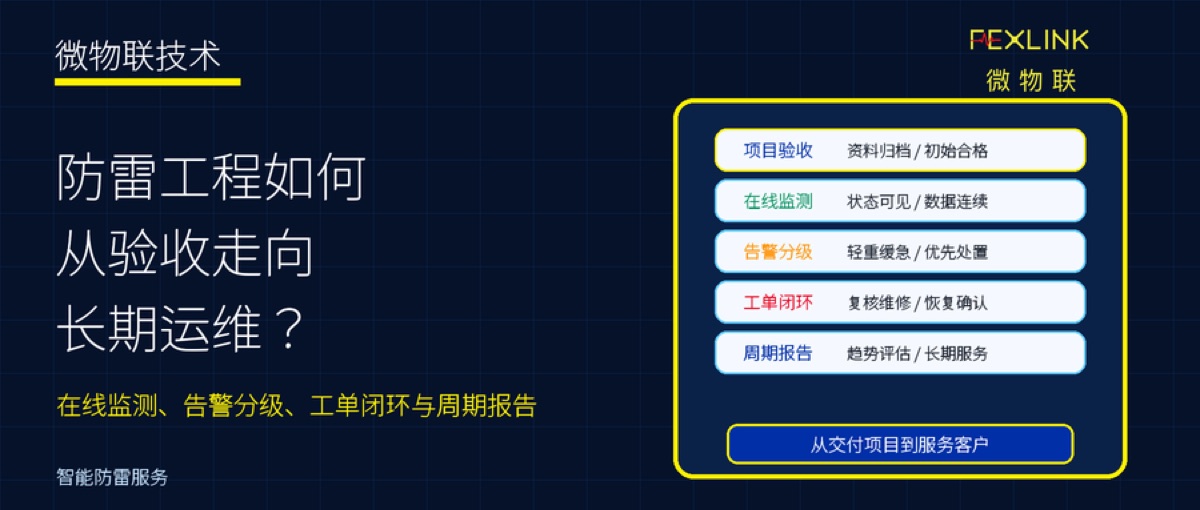
First, online status monitoring services. SPD status, leakage current, temperature, backup protection, grounding resistance, lightning current events, device online status, and enclosure environment should be continuously monitored, turning the lightning protection system from a silent device into visible status.
Second, alarm grading services. Not every anomaly should be handled the same way. A short offline period of a terminal can be treated as a notice, an abnormal SPD remote signal requires a planned recheck, an abnormal SPD after a lightning strike should be dispatched with priority, and a grounding change after a severe strike requires a rapid on-site recheck.
Third, work order closure services. An alarm must be handled by someone; the complete flow includes alarm generation, risk grading, work order dispatch, on-site recheck, repair or replacement, recovery confirmation, and event archiving.
Fourth, post-storm special recheck services. After a thunderstorm, the platform can automatically filter sites with lightning current events, points with SPD status changes, areas with grounding changes, and systems with simultaneous device alarms to form recheck recommendations.
Fifth, periodic report services. Monthly lightning protection health reports, quarterly risk trend reports, thunderstorm season special reports, annual lightning protection status assessment reports, and rectification recommendation reports are important vehicles for converting online monitoring into management outcomes for customers.

4. How Can Online Monitoring Data Become a Service Product?
Data collection itself is not a service; data interpretation is. Customers do not necessarily need to see a lot of data; what they really need to know is where the risk is, why it exists, how severe it is, whether it must be handled, who will handle it, and whether it has recovered after handling.
Online monitoring data can first be converted into event identification, such as lightning strikes, surges, disconnection, abnormal leakage current, abnormal temperature rise, grounding changes, and device offline. After event identification, the platform combines thresholds, trends, multi-point comparison, and multi-source correlation for risk interpretation.
After risk interpretation, the system should provide executable handling recommendations, such as on-site recheck, SPD replacement, backup protection check, grounding connection re-test, gateway maintenance, or solution upgrade. Finally, these processes should be consolidated into monthly reports, special reports, and annual assessments.

5. How Can Smart Lightning Protection Services Be Designed in Tiers?
Basic services suit customers just starting with online monitoring, focusing on device online status, alarm push, basic trends, and monthly briefings. They answer whether customers can see status remotely.
Standard services suit customers with certain O&M requirements, focusing on alarm grading, work order closure, post-storm rechecks, quarterly reports, and maintenance recommendations. They answer whether alarms can actually be handled.
Advanced services suit key scenarios and high-value customers, focusing on annual risk assessment, special rectification plans, multi-system correlation analysis, remote support for key scenarios, and long-term data asset accumulation. They answer whether data can support customers' ongoing safety management.

6. How Can Lightning Protection Contractors Build Long-Term O&M Service Capabilities?
First stage, retain the online connection after project delivery. Do not cut the connection after delivery; at least keep the equipment ledger, point list, platform accounts, basic alarms, and contact mechanism.
Second stage, establish an alarm response mechanism. Clarify who reviews alarms, how quickly they respond, which alarms need work orders, which alarms are only observed, and how handling results are recorded. A platform without a response mechanism easily degenerates into a display page.
Third stage, build report output capability. Establish fixed templates for monthly reports, quarterly reports, post-storm special reports, annual assessment reports, and rectification recommendations so that services have deliverables.
Fourth stage, build a spare parts and maintenance service package, including SPD replacement, grounding re-test, line check, backup protection check, gateway maintenance, and platform configuration. The clearer the service package, the easier it is for customers to understand the value of long-term services.
Fifth stage, form long-term service contracts. Finally, evolve from one-off engineering contracts to annual O&M service contracts, platform service contracts, equipment maintenance contracts, risk assessment service contracts, and special rectification service contracts.

7. How Does FEXLINK Understand Smart Lightning Protection Services?
FEXLINK believes that smart lightning protection services do not end when lightning protection equipment is connected to a platform; rather, the lightning protection system should continuously produce data that is explainable, traceable, and actionable.
What FEXLINK focuses on is: whether status is visible, whether events are traceable, whether risks are explainable, whether alarms can be graded, whether handling can be closed loop, and whether reports can be delivered continuously.
This can be summarized as three shifts: from project acceptance to operation status management; from repair after failure to risk trend early warning; and from one-off engineering to long-term data services.

Conclusion: The End Point of Lightning Protection Engineering Should Not Merely Be Passing Acceptance
Lightning protection contractors will not lose value because of intelligence. On the contrary, contractors who truly understand sites, construction, inspection, and customer management have the best chance of deepening smart lightning protection services.
But the premise is that contractors cannot simply understand intelligence as device connectivity or platform display. Real long-term service comes from continuous data, professional judgment, timely handling, and periodic reporting.
The end point of lightning protection engineering should not merely be passing acceptance, but long-term effectiveness, continuous visibility, and controlled risk.