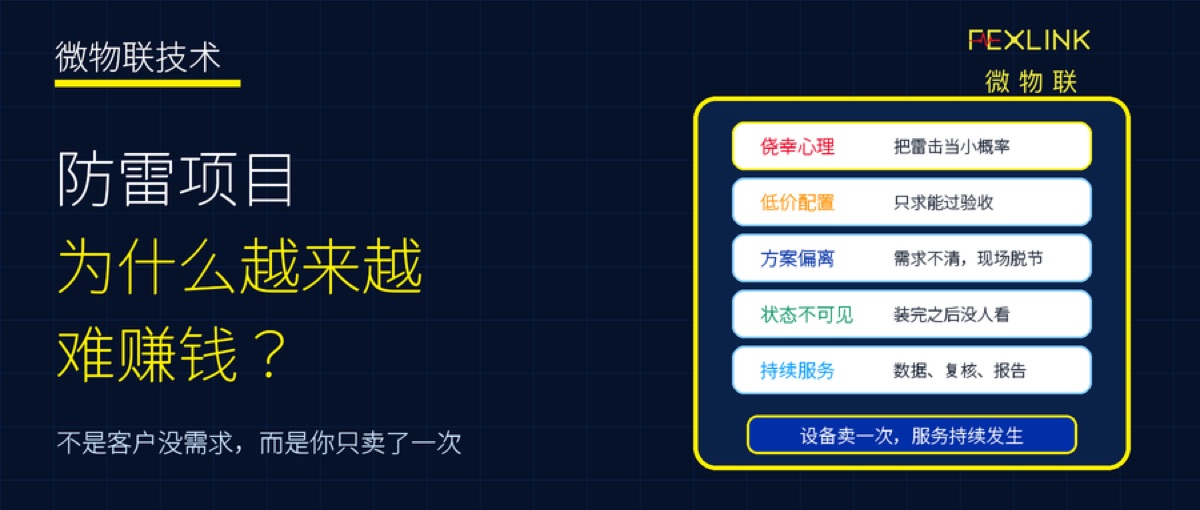

Many lightning protection projects are not short of demand - they are just getting harder to make money from. Customers do not refuse to install lightning protection; they often only care about whether it can pass acceptance, whose price is lower, and whether documentation can be delivered completely. After the project is finished, customers rarely look at the lightning protection system again, and service providers find it hard to naturally generate the next purchase.
For companies, the result is thinner margins on equipment, more cutthroat competition on engineering, after-sales that gets harder to explain, and customer relationships that weaken quickly after acceptance. The lightning protection industry is not without long-term value - many companies just complete the first delivery without designing the entry point for the second, third, and long-term service.
More critically, many people treat lightning protection as a low-probability event, treat lightning protection products as acceptance appendages, and treat lightning protection designs as paper configurations. The project seems done, but the real risk is never managed continuously, and customers never see the follow-up value.

1. Why Do Traditional Lightning Protection Projects Easily End After a Single Delivery?
The typical flow of a traditional lightning protection project is site survey, solution design, equipment procurement, construction and installation, inspection and acceptance, documentation archiving, and project settlement. There is nothing wrong with this flow itself, but it naturally takes "passing acceptance" as the end point. The problem is that the real value of a lightning protection system occurs during the operation phase.
Most traditional SPDs, lightning protection boxes, and grounding systems are silent devices. In normal times, customers cannot see whether an SPD has degraded, whether leakage current has risen, whether temperature is abnormal, whether grounding has changed, whether a lightning strike has occurred, or whether alarms have been handled. Without visible data, there is no visible value; without visible value, it is hard to sustain payment.
Lightning protection systems also have an awkward point: when they work, customers may not notice; when nothing goes wrong, customers think they are unnecessary; when something does go wrong, customers think they were not protected. So companies must make the hidden safety value explicit.
2. Many Lightning Protection Projects Plant the Seed of Low Value from the Start
First, there is a gambler's mentality. Many customers and project parties are not completely free of lightning protection needs, but they think: nothing has gone wrong before, lightning strikes should be rare here, an installed SPD is enough to pass acceptance, and a real incident is only a small probability. So budgets are squeezed, solutions are simplified, and follow-up O&M is weakened.
But a small probability is not the same as low risk. Lightning strikes, surges, grounding anomalies, and SPD degradation may not be visible on ordinary days, but once they occur, they can bring equipment damage, communication interruptions, system downtime, data loss, safety accidents, and liability disputes. Many Electrical Safety risks are worth managing precisely because they are low-frequency but high-loss.
Second, there is an "install it and done" mindset. Many projects understand lightning protection as: present on the drawings, installed in the cabinet, passing inspection, and archived in documentation. But a truly effective lightning protection system is not a single-point product; it is a complete chain of risk identification, lightning protection zoning, air-termination and down-conductor systems, grounding and equipotential bonding, power SPDs, signal SPDs, communication line protection, installation workmanship, post-installation inspection, online monitoring, and post-thunderstorm review.
Third, product quality and configuration may not match the actual scenario. Many projects appear configured on paper, but problems may include: product ratings that do not match on-site risk, discharge capacity judged by parameters alone without considering application limits, power SPDs only while signal and communication lines are ignored, unreasonable back-up protection configuration, product status that cannot be monitored remotely, and low-spec solutions still used in critical scenarios. Lightning protection products are not "the cheaper the better" - the less they match the risk, the higher the later explanation costs.
Fourth, the demand side does not really understand its own needs. Many clients state their needs only as "we need lightning protection", "we need to meet acceptance", "we need a few SPDs", or "we need an inspection report". But what should really be analyzed is: what is the protected object, how valuable is the equipment, how large are the downtime losses, whether lines are brought in from outdoors, whether low-voltage communication and control lines need protection, whether the grounding system is stable, how strong local thunderstorm activity is, and whether follow-up O&M capability exists.
Many lightning protection solutions are not poorly designed - the requirements were simplified at the very beginning. The customer says "I want to install an SPD", but the real need may be "I want to ensure continuous equipment operation, reduce downtime risk in the thunderstorm season, and trace the cause after an incident". If the requirements are not re-translated into risk language, the solution tends to become a checklist of products rather than a system designed for the scenario.

3. Why Are Customers Unwilling to Keep Investing?
Customers usually are not without safety needs - they just do not see continuous change. What customers see is "installed, inspected, accepted, documentation complete", but they rarely see the state changes before and after the thunderstorm season, SPD life changes, grounding trend changes, risk changes at key points, and the relationship between equipment anomalies and lightning protection events.
Customers also do not know what the next payment actually buys. If a company only says "add another monitoring device, add another platform, do another upgrade", customers can easily ask: why? what is it for? what happens if we do not? what problems will it solve? So products must be turned into service outcomes.
Another important reason is that customers receive no continuous reports. After many projects are installed, customers never see periodic results again. Without monthly status reports, post-thunderstorm review reports, quarterly risk trends, annual health assessments, and rectification recommendation lists, customers will naturally conclude that the lightning protection project is over.

4. How to Turn a One-off Lightning Protection Project into a Recurring One?
First, turn the equipment ledger into a long-term asset. Record not only what equipment was installed, where it is located, when it was installed, who performed the installation, and whether it passed acceptance, but also equipment status, alarm history, replacement records, lightning strike events, review records, and rectification records. The ledger is not documentation archiving - it is the entry point for long-term service.
Second, turn online monitoring into a service entry point. Online monitoring is not just about showing customers a page; it is about continuously discovering SPD status anomalies, grounding changes, offline devices, lightning current events, temperature anomalies, and recurring alarms. Monitoring data itself is not the end point - the judgments and services based on the data are.
Third, make post-thunderstorm review a fixed service. After a thunderstorm, what customers need most is to know which points experienced lightning strikes, which SPDs changed status, which grounding states changed sharply, which devices went abnormal at the same time, and which points need on-site review. This kind of service is very easy for customers to perceive as valuable.
Fourth, turn reports into outcomes customers can understand. Do not just export data tables; output management conclusions: what is the overall status this month, which points show rising risk, which devices need replacement, which alarms have been handled, which problems recur, and what to do next. Reports are the visible deliverables of service.
Fifth, turn rectification recommendations into the entry point for the next business. Recurring services will naturally lead to SPD replacement, grounding optimization, new monitoring points, signal lightning protection reinforcement, lightning protection box or distribution cabinet upgrades, platform service renewal, and annual maintenance contracts. This is not pushy selling; it is the natural extension driven by data and risk.

5. How Can Smart Lightning Protection Services Be Packaged?
The basic service package aims to let customers see the status. It suits customers with limited budgets or those just starting their digital transformation. Contents can include basic online monitoring, device online status, SPD status indication, basic alarm push notifications, and monthly briefings - moving from "installed but unknown status" to "visible remotely".
The standard service package aims to let customers manage risk. It suits distribution rooms, data rooms, industrial parks, schools, hospitals, communication sites, and renewable energy stations. Contents can include SPD status monitoring, grounding trend monitoring, post-thunderstorm review recommendations, alarm grading, work order closure, and quarterly risk reports - moving from "finding anomalies" to "handling anomalies".
The premium service package aims to build long-term safety management. It suits oil, gas, and petrochemical facilities, wind farms, PV and energy storage plants, data centers, transportation facilities, and large industrial parks. Contents can include lightning current monitoring, multi-point grounding monitoring, SPD life trends, multi-source data correlation, annual risk assessment, special rectification recommendations, and expert review services - moving from "single-point monitoring" to "a risk management system".

6. How Should Different Companies Find Their Own Service Entry Points?
Lightning protection manufacturers can upgrade from selling SPDs to SPD status monitoring, life trend assessment, post-strike review recommendations, and spare parts replacement services. In this way the product is not just installed - it continuously participates in the customer's safety management.
Distribution equipment manufacturers can upgrade from selling cabinets to the safety status of smart distribution cabinets, combining in-cabinet SPD monitoring, temperature monitoring, communication gateways, remote alarms, and platform integration into a distribution safety capability.
Engineering companies can upgrade from construction and acceptance to annual maintenance contracts, post-thunderstorm manual inspection, anomaly troubleshooting, rectification construction, and report delivery. Project acceptance is not the end of the relationship; it should be the beginning of long-term service.
Testing companies can upgrade from annual inspection to "inspection + online monitoring + review of abnormal points + annual health assessment + rectification re-testing". Inspection reports settle whether a given point in time was compliant; online monitoring settles whether the operation process stays continuously stable.
Clients and managers should also upgrade from purchasing equipment to purchasing continuous safety services - buying risk visibility, documented accountability, and O&M efficiency, rather than looking only at the price of a single product.

7. How Does FEXLINK Understand the Long-term Value of Lightning Protection Projects?
FEXLINK believes that lightning protection projects should not stop at the installation and acceptance stages; they should become long-term systems that continuously produce safety data, continuously support O&M decisions, and continuously deliver service reports.
What FEXLINK cares about is not whether the customer bought one more device, but whether status stays visible, risk stays judgeable, alarms stay closed in a loop, reports keep being delivered, and services keep occurring.
A truly sustainable smart lightning protection project should form a closed loop of "equipment delivery → status monitoring → risk diagnosis → review and rectification → report assessment → recurring services". In this way lightning protection is no longer just an acceptance cost, but a part of the customer's long-term safety management.

Conclusion: Lightning Protection Is Not Short of Demand - It Must Not Be Delivered Only Once
Lightning protection projects are getting harder to profit from, not because customers lack safety needs, but because many companies are still stuck in the one-off delivery model. Equipment can be sold once and engineering can be done once, but risk always exists. Thunderstorms come every year, SPDs age, grounding changes, sites are renovated, and customers' safety management requirements keep rising.
More importantly, a gambler's mentality, low-price configuration, unclear requirements, and solutions detached from on-site reality will strip a lightning protection project of its long-term value from the very beginning. Whoever can turn these long-term changes into data, judgments, reviews, rectifications, and reports stands a better chance of escaping low-price competition.
The smart lightning protection of the future is not just installing products; it is a system where status stays continuously visible, risks stay continuously explainable, alarms stay continuously closable, and reports stay continuously deliverable.