
After a thunderstorm, two situations commonly occur on site: one is that equipment is damaged immediately and the problem is obvious; the other is that the site appears normal, but the lightning protection system has actually endured an impact. It is the second situation that is truly easy to overlook.
Traditional practice is often to ignore equipment that is not broken, consider an SPD normal if its indicator window has not changed color, assume grounding is qualified if it has not been re-measured, and assume there is no risk if no one has reported an alarm. But the reality may be that an SPD has already endured an impact and its lifespan has been reduced, grounding connection points have changed locally, communication equipment recovered after a brief anomaly, or a distribution cabinet experienced a surge event that was never recorded.
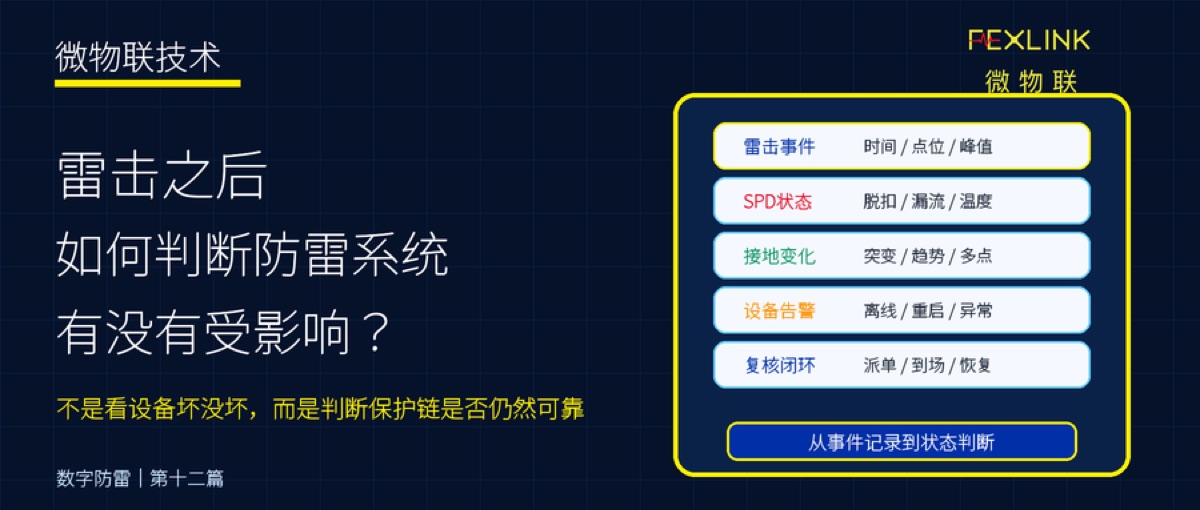
Therefore, after a lightning strike, digital lightning protection must answer not "is anything broken" but "is the lightning protection system still reliable."

1. What Impacts May a Lightning Protection System Suffer After a Strike?
First, SPDs may operate or degrade. After a lightning strike or surge, an SPD may show disconnection, increased leakage current, abnormal temperature, reduced lifespan, abnormal backup protection, or degraded performance after repeated surges. In many cases, an SPD does not fail completely at once, but gradually degrades after repeated surges.
Second, grounding status may change. The lightning current must eventually be dissipated through the grounding system. After a strike, loose connection points, heating at local corrosion points, changes in grounding resistance, local damage to the grounding grid, and abnormal equipotential bonding can all affect the dissipation of the next lightning current.
Third, power and communication systems may be impacted. Lightning does not always dissipate only through the air termination system and down-conductors; it can also affect downstream equipment through power lines, signal lines, communication lines, control lines, instrumentation lines, and video lines. Therefore, after a strike, attention should be paid to power equipment alarms, communication interruption records, control system anomalies, restarts of low-voltage equipment, offline video equipment, and sensor anomalies.
Fourth, the impact may not be exposed immediately. Some effects are delayed: an SPD may still work in the short term but degrade faster, grounding status may be temporarily normal but the trend starts to fluctuate, communication equipment may return online but then drop off frequently, and certain insulation weaknesses may only be exposed during the next surge.

2. Judging Whether the System Was Affected Cannot Rely on a Single Metric
Do not rely only on the strike count. The strike count only shows how many events occurred; it does not show how strong the impact was, which path it took, whether it affected SPDs, whether it affected grounding, or whether it is related to equipment anomalies. Therefore, the strike count is only an entry point, not a conclusion.
Do not rely only on whether SPDs have tripped. An SPD that has not tripped does not mean it was unaffected. You must also check whether leakage current has risen, whether temperature is abnormal, whether operation records have increased, whether the lifespan trend has changed, and whether backup protection is normal.
Do not rely only on a single grounding resistance reading. Grounding assessment should not depend on a single reading; it must compare before and after the strike, examine trend changes, differences among multiple points, abrupt changes, and whether the system returns to normal. For large substations, server rooms, base stations, PV plants, and petrochemical sites, multi-point trends are more meaningful than single-point instantaneous values.
Do not rely only on whether equipment is broken. Equipment that is not damaged immediately does not mean the system is risk-free. You must also check whether restarts, short offline periods, communication packet loss, and power alarms occurred, and whether these anomalies coincide with the time of the strike.

3. What Data Should Be Prioritized After a Lightning Strike?
First, look at lightning current event data, including time of occurrence, location, peak current, polarity, waveform, duration, multiple surges, and event intensity level. This data is used to determine how strong the impact itself was and whether a higher-level review process is required.
Second, look at SPD status data, including tripping status, leakage current changes, temperature changes, operation records, backup protection status, and lifespan trend. This data is used to determine whether protection devices endured the impact, whether they degraded faster, and whether they still provide protection capability.
Third, look at grounding status data, including grounding resistance, grounding trend, changes before and after the strike, abnormal abrupt changes, multi-point comparison, and recovery status. This data is used to determine whether the dissipation path remains reliable.
Fourth, look at associated equipment alarms, including distribution cabinet alarms, UPS alarms, offline communication equipment, offline cameras, PLC/DCS communication anomalies, sensor anomalies, and restarts of low-voltage equipment. This data is used to determine whether the strike has affected business systems.
Fifth, look at O&M action records, including whether the event was acknowledged, whether a work order was dispatched, whether personnel arrived on site, whether SPDs were inspected, whether grounding was re-measured, whether equipment was replaced, and whether the record was filed and closed. This data is used to determine whether the risk has truly achieved closure.

4. How to Judge the Impact Level After a Lightning Strike?
Minor impact typically shows lightning current event records, but normal SPD status, no grounding abrupt changes, and no equipment alarms. In this case, the platform can record the event first and continue observation.
Moderate impact typically shows lightning current events, increased SPD operation records, brief offline periods for individual equipment, and slight fluctuations in the grounding trend. In this case, remote review is recommended, with on-site confirmation arranged if necessary.
Significant impact typically shows high peak lightning current, abnormal SPD leakage current or temperature, abrupt grounding changes, and associated equipment alarms. In this case, a work order should be dispatched to inspect the SPDs, grounding, and related equipment on site.
Emergency impact typically shows severe lightning strike events, SPD tripping or abnormal backup protection, clearly abnormal grounding, critical equipment faults, or communication interruptions at multiple points. In this case, on-site review should be performed immediately, and high-risk equipment should be de-energized or isolated if necessary.

5. Which Scenarios Require Mandatory Re-Review After a Lightning Strike?
Communication base stations, low-voltage equipment rooms, and data centers are typical scenarios with a high concentration of power, communication, low-voltage, and control equipment. After a strike, even if equipment is not damaged immediately, attention must be paid to communication interruptions, equipment restarts, SPD degradation, and grounding status changes.
PV plants and wind farms often have dispersed sites, long cable runs, large exposure areas, and complex lightning paths. In addition to equipment status, attention must be paid to the DC side, AC side, box-type transformers, inverters, tower, blades, down-conductors, and grounding system.
Expressway electromechanical systems, railway signaling systems, and industrial control systems have high requirements for continuity and reliability. After a strike, do not just check whether local equipment is online; also check whether stations along the route, control links, communication links, and critical equipment show associated anomalies.
Petrochemical storage tank areas, hazardous locations, and critical distribution cabinets also involve requirements for grounding, anti-static, explosion protection, equipotential bonding, and safety monitoring. After a strike, lightning current events, grounding status, anti-static grounding, SPD status, and work safety management must be considered together.

6. How Does FEXLINK Understand Post-Strike Condition Assessment?
FEXLINK believes that post-strike assessment must not stop at "is anything broken," "did a breaker trip," or "is there an alarm"; instead, it must establish a correlation chain among lightning strike events, SPD status, grounding status, equipment alarms, and O&M actions.
What the FEXLINK system focuses on is: whether the lightning current occurred, whether the impact intensity can be assessed, whether the SPDs remain effective, whether the grounding dissipation path is stable, whether equipment has associated anomalies, and whether O&M has achieved closure.
This can be summarized as three shifts: from post-event guessing to traceable events; from single-point checks to multi-source correlation assessment; and from "equipment is not broken" to "the system remains reliable."

Conclusion: The Real Question After a Lightning Strike Is Whether the Lightning Protection System Remains Reliable
After a lightning strike, the fact that equipment is not damaged is only a surface result. For the lightning protection system, what matters more is to determine whether the protection chain endured the impact, whether degradation has occurred, and whether it still has the capability to protect against the next strike.
The value of digital lightning protection is to turn post-strike assessment from experience-based guessing into data-based review. Only by placing lightning current, SPD, grounding, equipment alarms, and work order actions on the same chain can we truly determine whether the lightning protection system was affected.