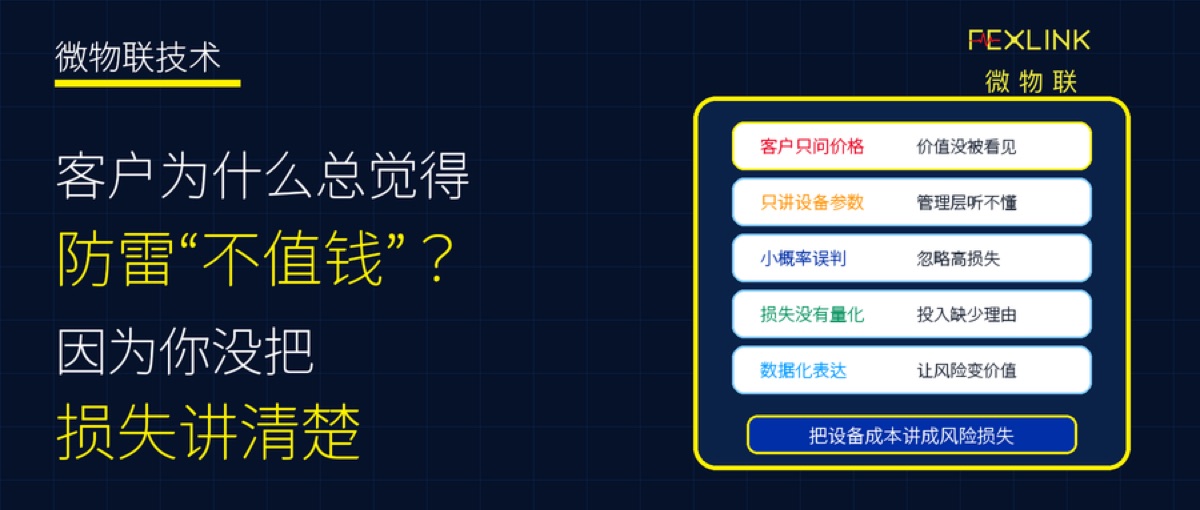

When customers think lightning protection is "not worth the money", it is not necessarily because they do not value safety. Often, it is because lightning protection companies are saying the wrong things. We are used to talking about SPD discharge capacity, voltage protection level, response time, platform features, and monitoring points, but what customers really care about is: if we do not do it, what will we lose? If we do it, can we avoid one more downtime, one fewer batch of damaged equipment, one fewer liability dispute, and a little less O&M hassle?
The hardest thing to express about lightning protection is that its value usually lies in "no accidents happened". No damage, no downtime, no communication interruption, no liability dispute - all of these are value, but without data and reports, customers can hardly perceive them. When customers cannot perceive value, they naturally focus only on price.
So Article 51 needs to make one core point clear: lightning protection must talk not only about equipment, but more about losses; not only about parameters, but more about the customer's business risk; not only about one-off delivery, but more about the status, reviews, reports, and services throughout long-term operation.

1. Why Do Customers Always Think Lightning Protection Is "Not Worth the Money"?
First, customers see cost, not loss. In many projects, lightning protection sits in the procurement list, the project budget, and the acceptance documentation. What customers see at first glance is how much an SPD costs, how much a lightning protection box costs, and how much a platform costs. But they do not simultaneously see how much downtime, repair, replacement, troubleshooting, and liability communication would cost if critical equipment were damaged by a lightning surge.
Second, customers hear parameters, not outcomes. Maximum discharge current, voltage protection level, response time, telemetry status, and sampling period matter a lot to engineers, but for managers they must be translated into outcome language: what equipment is protected? Can anomalies be detected in advance? Can a post-thunderstorm review be conducted? Can a problem be explained clearly? Can an annual assessment report be produced?
Third, lightning protection is often treated as an acceptance item. Many clients do not raise lightning protection needs proactively from a business continuity and safety management perspective; instead, the project requires this configuration, acceptance requires these documents, and inspection requires this report. When lightning protection is understood only as a compliance cost, it is hard for it to be seen as "worth the money".
Fourth, many people misjudge lightning protection as a low-probability event. Lightning strikes, surges, and grounding anomalies do not happen every day, but a small probability is not the same as low risk. On the contrary, low-frequency, high-loss risks need managing even more. A single thunderstorm season with batch equipment damage, communication interruptions, or system downtime can far exceed the lightning protection budget saved earlier.
Fifth, the lack of data prevents the value from staying visible. After traditional lightning protection equipment is installed, customers cannot see in normal times whether an SPD has degraded, whether grounding has changed, whether a lightning strike occurred, or whether alarms were handled. Without status data, event data, handling data, and report data, customers can hardly build the willingness to keep investing.

2. What Happens When the Losses Are Not Explained Clearly?
First, it pushes the project into a price war. When customers cannot see technical differences or loss differences, they can only compare prices: choose the cheaper one, choose the one that passes acceptance, and choose the one that delivers documentation fastest. In the end, the more a company talks parameters, the more the customer looks at the quotation.
Second, it gradually downgrades the solution. Once the budget is squeezed, product ratings, graded protection, signal line protection, grounding monitoring, and online status monitoring can all be simplified. It looks like money saved, but it actually plants future risk.
Third, it shortens the partnership. One-off delivery only settles the question of "is it installed", not "does it stay effective in operation". When customers cannot see long-term value, engineering companies, manufacturers, and testing companies can hardly build recurring services either.
Fourth, it makes responsibility harder to determine. After a problem occurs, the customer asks whether lightning protection was done poorly, the manufacturer asks whether the site conditions were the issue, the engineering company asks whether later renovations caused the damage, and the testing company can only state whether a given point in time was compliant. Without data evidence, many disputes can only be settled by experience-based judgment.

3. The Value of Lightning Protection Must Be Translated from "Equipment Language" into "Loss Language"
Talking only about equipment easily makes customers feel it is adding cost; explaining the losses makes it possible for customers to understand this is a risk management investment. For example, saying "this point needs additional SPD monitoring" is not as good as saying "this point protects the core controller; if the anomaly after a thunderstorm is not detected in time, the entire production line may shut down for troubleshooting".
Talking only about platform features also struggles to convince customers. Customers do not need one more complex page; they need to know where the anomaly is, how serious it is, why it happened, who handles it, whether it was restored after handling, and whether a report can be produced at the end of the month. The value of a platform is not the number of pages, but the management conclusions.
Talking only about a bigger budget is even easier to reject. A better way of putting it: what risks does this investment reduce, what losses does it make controllable, what accountability does it leave traceable, and what O&M work does it cut? Customers are not against investment; they are against not seeing what the investment delivers.

4. Lightning Protection Value Can Be Told as Five Types of Losses
The first type is downtime loss. For data centers, communication base stations, PV power plants, wind farms, factory production lines, and transportation electromechanical systems, even short downtime can bring business interruption, manual troubleshooting, and customer complaints. The price of lightning protection equipment is often only a small fraction of downtime losses.
The second type is equipment loss. Lightning strikes and surges can affect power modules, communication modules, controllers, sensors, cameras, gateways, PLCs, inverters, and other devices. What customers really need to compare is not the SPD price, but the repair and replacement cost of critical equipment after damage.
The third type is data and communication loss. Many on-site device failures do not necessarily originate from the power side; they can also come from signal lines, communication lines, control lines, and network lines. Communication interruption, offline monitoring, and control anomalies leave managers unable to see the on-site status at the very moment they need information most.
The fourth type is liability loss. After an accident, without lightning strike records, SPD status, grounding trends, device alarms, and work order records, it is hard to judge whether the problem was related to a lightning strike or whether maintenance was timely. Unclear responsibility is itself a management cost.
The fifth type is O&M loss. Without online status and alarm grading, the only option after a thunderstorm is manual inspection and experience-based troubleshooting. With too many points, too few people, and recurring problems, it easily leads to ineffective inspections and repeated communication. Smart Lightning Protection can turn O&M from passive troubleshooting into targeted review.

5. How to Make Customers Feel Lightning Protection Is "Worth the Money"?
First, identify the protected object first. Do not start with a product list; first ask: what type of equipment is to be protected? How valuable is the equipment? How big is the impact of downtime? Are any lines brought in from outdoors? Are there low-voltage, communication, control, and sensor lines? Is there follow-up O&M capability?
Second, make the loss scenario specific. If customers only hear "lightning protection is very important", it is hard for them to decide to invest; if they hear "if the communication of this control cabinet is interrupted after a thunderstorm, the on-site equipment cannot be remotely supervised, and troubleshooting at least requires personnel to arrive on site", their understanding will be completely different.
Third, use data to prove the risk. Smart Lightning Protection is not about networking devices for the sake of it; it connects lightning strike events, SPD status, grounding changes, temperature anomalies, offline devices, and alarm handling, so that risks have data, time, location, and handling records.
Fourth, use reports as visible deliverables. The premise for customers to keep paying is that they keep seeing results. Monthly status reports, post-thunderstorm review reports, quarterly risk trends, annual health assessments, and rectification recommendation lists are all important ways to make lightning protection value explicit.
Fifth, turn service into a long-term relationship. Lightning protection does not end with installation. Thunderstorm seasons return, SPDs age, grounding changes, sites are renovated, and customers' safety management requirements rise. Monitoring, review, rectification, assessment, and reporting are the real entry points for long-term cooperation.

6. How Does FEXLINK Understand the Customer Value of Lightning Protection?
FEXLINK believes that what customers truly buy is not an isolated lightning protection device, but risk visibility, controllable losses, traceable accountability, and carefree O&M. If lightning protection companies only talk about products, customers can easily focus only on price; if equipment status, lightning events, grounding trends, alarm work orders, and periodic reports are connected, what customers see is a continuously running risk management capability.
What FEXLINK cares about is not simply putting lightning protection devices online, but making the lightning protection system continuously produce status data, risk data, handling data, and report data, helping lightning protection manufacturers, distribution equipment manufacturers, engineering companies, testing companies, and clients turn lightning protection from a one-off delivery into recurring services.
For partners, FEXLINK can serve as the data foundation and service foundation for Smart Lightning Protection: status perception and monitoring terminals at the front end, communication access and platform management in the middle, and trend judgment, alarm closure, review recommendations, and report output at the back end. In this way, what customers see is not just equipment, but continuously deliverable management value.

Conclusion: Customers Do Not Lack Lightning Protection - They Need to See the Losses
When customers think lightning protection is "not worth the money", it is often not because lightning protection has no value, but because the value was never explained clearly. What customers see is the equipment cost; they do not see the downtime losses, equipment losses, communication losses, liability losses, and O&M losses.
Future lightning protection companies, distribution equipment manufacturers, engineering companies, and testing companies must do more than sell products, do engineering, and issue reports; they must explain the risks and losses behind lightning protection, turn operating status into data, turn data into judgment, turn judgment into reports, and turn reports into recurring services.
The value of lightning protection is not "what you bought", but "what was avoided, what was made visible, and what was managed". Whoever can make this clear stands a better chance of winning customers' investment, cooperation, and continuous purchasing.