
Many lightning protection companies had a very clear business logic in the past: sell SPDs, supply lightning protection boxes, complete project installation, cooperate with testing and acceptance, and then repair or replace if problems occurred later. This model worked in the traditional construction phase, but as requirements for digitalization, safety monitoring, and O&M management keep rising, customers are now raising new questions.
Is the surge protective device still effective now? Has a lightning strike occurred? Has the grounding status changed? Is the equipment anomaly related to a surge? Can the system issue remote alarms? Is there a record of subsequent maintenance? Can a risk report be generated? These are questions that an ordinary SPD alone cannot answer. They require the joint support of intelligent terminals, edge data acquisition, platform analytics, and O&M closure.
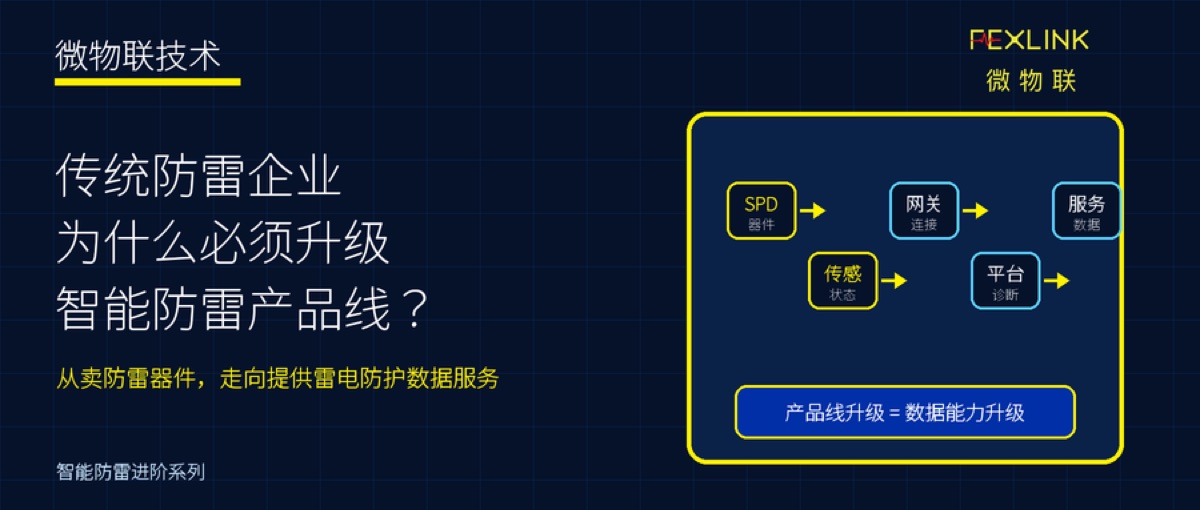
Therefore, the transformation of lightning protection companies is not about replacing ordinary SPDs with "SPDs with communication," but about upgrading from selling lightning protection devices to delivering sustainable lightning protection data capabilities.

1. Why Are Traditional Lightning Protection Companies Facing Increasing Difficulty?
The first pressure traditional lightning protection companies face is product homogenization. SPDs, lightning protection boxes, lightning protection modules, and engineering materials are becoming increasingly similar in appearance, parameters, and functions. When customers cannot see the technical differences, purchasing decisions easily become price comparisons.
The second pressure is one-off service. For many lightning protection products, the connection between the company and the customer weakens after project acceptance. But the stage when a lightning protection system truly faces risks is precisely during long-term operation: after lightning strikes, after surges, after SPD degradation, after grounding changes, and after on-site retrofits.
The third pressure is that customer demands are changing. In the past, customers cared about "whether there is an SPD, whether there is grounding, whether testing passed, and whether documentation is complete." Today, more and more customers care about "whether the protection status is visible, whether anomalies can be detected remotely, whether alarms can be graded, whether maintenance can be closed-loop, and whether data can support safety management."
If lightning protection companies still focus only on device sales and low-price competition, they can easily fall into a situation of shrinking margins. The real way out is not simply cutting prices, but building more reliable data, more stable hardware, more complete platforms, more professional solutions, and longer-term O&M service capabilities.

2. What Exactly Does a Smart Lightning Protection Product Line Include?
Many companies interpret smart lightning protection as "SPD plus communication," which is a very common misconception. A true smart lightning protection product line should at least cover protection device status, lightning strike events, grounding status, antistatic status, on-site connectivity, and platform management.
The first category is smart SPD and SPD monitoring. It should not only track disconnection status, but also leakage current changes, abnormal temperature rise, degradation trends, lightning strike counts, backup protection status, and remaining life estimation, answering the question "Is the SPD still effective?"
The second category is lightning current monitoring. It records the time of the lightning strike, peak current, polarity, waveform, duration, charge, specific energy, and event location, answering the question "What exactly happened in the lightning strike or surge event?"
The third category is online grounding resistance monitoring. It focuses on grounding status trends, abnormal sudden changes, multi-point comparison, changes after lightning strikes, and seasonal fluctuations, answering the question "Is the discharge path reliable?"
The fourth category is antistatic and equipotential status monitoring, especially suitable for scenarios such as petrochemical plants, hazardous chemical facilities, loading and unloading areas, and tank farms. It focuses on loading and unloading grounding confirmation, electrostatic clamp status, equipotential bonding, operation interlocking, and abnormal disconnection alarms.
The fifth category is smart gateways and cloud platforms. Lightning protection companies cannot just sell sensors; they also need to reliably upload on-site data and use the platform to complete alarm grading, event archives, trend analysis, health assessment, work order dispatch, handling review, and statistical reports.

3. Transformation Is Not About Adding Features, But About Replacing the Capability Structure
The capability structure of traditional lightning protection companies is usually concentrated on device selection, project installation, testing support, and after-sales replacement. Smart lightning protection companies, by contrast, need to add sensing capabilities, communication capabilities, edge computing capabilities, platform software capabilities, data diagnostic capabilities, industry solution capabilities, and continuous O&M service capabilities.
The first shift is from product delivery to data delivery. In the past, companies delivered equipment; in the future, they will deliver lightning strike event data, SPD status data, grounding trend data, alarm handling data, and risk assessment reports.
The second shift is from project acceptance to continuous O&M. In the past, the relationship weakened after project completion; in the future, companies can continuously deliver monthly reports, special review recommendations after thunderstorms, SPD life assessment, grounding anomaly analysis, and rectification suggestions through the platform.
The third shift is from single-point products to system solutions. What customers truly need is not a single smart SPD, but scenario investigation, risk identification, point design, device configuration, communication networking, platform integration, acceptance testing, and O&M closure.

4. What Pitfalls Are Lightning Protection Companies Most Likely to Fall Into During Transformation?
The first misconception is believing that "having communication" means being intelligent. Many products simply upload the remote signaling status to the platform, which is still essentially a simple on/off signal. True intelligence depends on whether there are trends, diagnostics, events, interlocking, and closure.
The second misconception is piling up product features while the data itself is not trustworthy. Customers see a rich feature list: lightning current, leakage current, temperature, grounding, counting, communication, and platform, all available. But what really matters is accuracy, real-time performance, anti-interference capability, long-term stability, and test verification. Without trustworthy data, the more features there are, the more likely customers will be misled.
The third misconception is doing only hardware and no platform. Without a platform, there is no risk ranking, alarm grading, event archive, O&M closure, customer stickiness, or continuous service.
The fourth misconception is building a platform but lacking industry solutions. Data centers, railways, highways, wind power, solar PV, petrochemical plants, and communication base stations each have different priorities. If the platform is just a generic interface without industry-specific logic, customers will hardly perceive it as professional.
The fifth misconception is neglecting O&M services. The greatest value of a smart lightning protection project lies in the operation phase. If a company only sells equipment without follow-up services, it will still fall back into the one-off sales model.

5. How Should Traditional Lightning Protection Companies Upgrade?
Step one: start with the intelligent retrofit of existing SPDs. Through remote signaling acquisition, leakage current monitoring, temperature monitoring, backup protection status, in-cabinet gateways, and platform integration, give the existing lightning protection system status visibility first.
Step two: build out lightning current and grounding monitoring capabilities. Smart lightning protection cannot focus on SPDs alone; it also needs to know whether a lightning strike occurred on site, how strong the lightning current was, whether the grounding status is stable, and whether a review is needed after a lightning strike.
Step three: build a standardized platform. The platform does not need to be extremely large from the start, but it should at least provide device management, alarm grading, historical trends, event archives, O&M work orders, and report output.
Step four: develop industry solution packages. Do not just produce a product list; build scenario-based solutions for data centers, highways, wind farms, oil and gas tank farms, solar PV and energy storage, and communication base stations.
Step five: build data service capabilities. Ultimately, the company should be able to deliver lightning protection health reports, post-thunderstorm special reports, SPD life trend reports, grounding status trend reports, annual risk assessment reports, and rectification suggestions.

6. How Does FEXLINK Understand the Intelligent Transformation of Lightning Protection Companies?
FEXLINK believes that the intelligent transformation of lightning protection companies is not about "electronifying" or "connecting" traditional products, but about turning the lightning protection system into a safety perception system that continuously generates data.
The FEXLINK system does not focus on a single function, but on whether lightning current events can be diagnosed, SPD status can be assessed, grounding status can be monitored continuously, alarms can be graded, O&M can be closed-loop, and data can serve customers' long-term safety management.
This means lightning protection companies must complete three shifts: from selling SPDs to providing lightning protection status data; from project delivery to continuous O&M services; and from price competition to competing on data quality and system solution capability.

Conclusion: The Future of Lightning Protection Companies Is Data Service Competition, Not Low-Price Competition
The traditional lightning protection industry will not lose its value because of intelligence. Quite the contrary: companies that truly understand lightning protection, on-site conditions, and engineering have the best chance of doing smart lightning protection well.
But the premise is that companies must not interpret intelligence simply as "adding a communication module" or "building a platform page." The future competition in smart lightning protection is not about how long the feature list is, but about whether the data is trustworthy, the system is stable, risks are explainable, and O&M can be closed-loop.
The key to the transformation and upgrading of lightning protection companies is moving from one-off product sales to long-term data services.