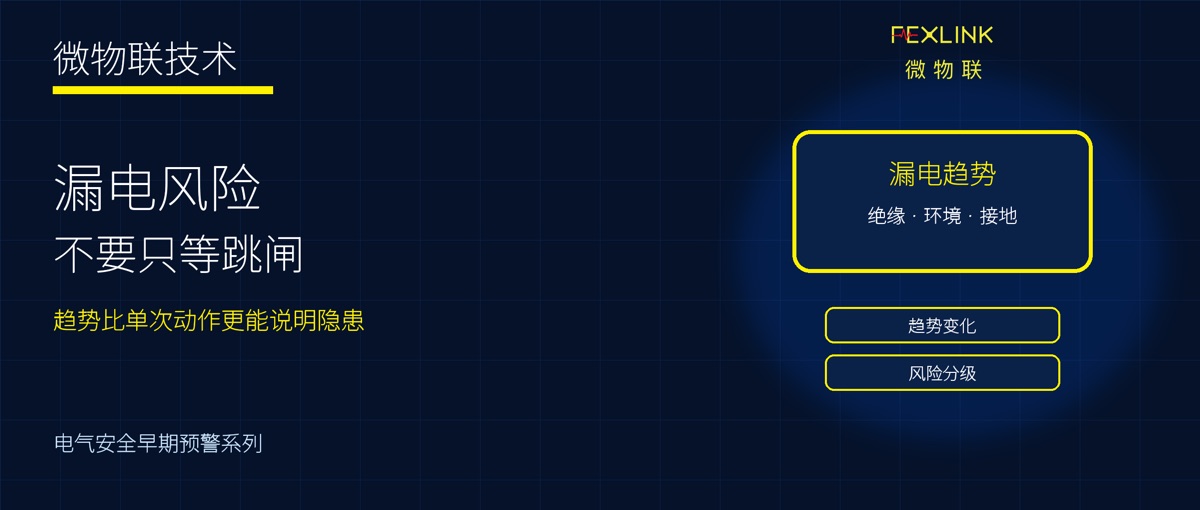

Many people equate leakage risk with whether the trip occurs. Tripping certainly deserves attention, but by the time leakage protection operates, the risk has already reached the operating condition. For early warning, what is far more valuable is seeing how the leakage trend changes before the trip.
Leakage current is not a static problem. It is affected by insulation condition, ambient humidity, equipment aging, wiring quality, and load characteristics, and it may rise slowly over a period of time.

1. A Leakage Protection Trip Is Already the End Result
The function of a leakage protection device is to cut off the power supply when leakage reaches the set condition, preventing electric shock and preventing fire risk from expanding further. It is an important protective device, but it solves the problem only after the operating condition has been reached.
If you only watch for trips, it is easy to overlook the process of change before the trip. On many circuits, before the protection actually operates, the leakage value has already gone through a process from normal fluctuation to abnormal rise, and from occasional disturbance to a sustained high level.

2. What Hidden Hazards Can the Leakage Trend Reveal?
A long-term rise in leakage current is often associated with insulation degradation, moisture ingress into equipment, aging wiring, grounding abnormalities, non-compliant temporary power use, or environmental changes. Such problems are more common in humid seasons, underground spaces, charging facilities, construction sites, and aging circuits.
Trend data helps O&M personnel distinguish occasional disturbances from real risks. If leakage only fluctuates briefly, it may come from equipment starting or stopping or from environmental interference; if it keeps rising or repeatedly stays at a high level, focused troubleshooting is required.

3. Why Instantaneous Values Alone Are Not Enough
The instantaneous leakage value is easily affected by load, environment, and measurement disturbances. A single high reading does not necessarily indicate a long-term risk, and a single normal reading cannot prove that the system is free of hidden hazards.
A more reliable way to judge is to look at the direction of change, the duration, the frequency of occurrence, and whether it correlates with weather, temperature, load, and equipment alarms. A trend explains changes in insulation condition better than a single point does.

4. Leakage Early Warning Requires Graded Assessment
Leakage risk can be classified as normal fluctuation, abnormal rise, sustained high level, sudden surge, and anomalies accompanied by other signs. Normal fluctuation can be recorded and observed, abnormal rise needs to be verified, and a sustained high level, or one accompanied by temperature, current, or equipment anomalies, should be given higher processing priority.
This grading approach reduces false alarms and unnecessary outages. The system does not simply alarm whenever a value goes high; it judges the risk level based on the trend, the scenario, and associated conditions.

5. How Does FEXLINK Understand Leakage Trend Early Warning?
FEXLINK believes that leakage monitoring should not simply wait for protection to operate, but should identify insulation and environmental risks in advance. FEXLINK focuses on the relationships among the leakage value, rate of change, duration, weather and environment, load status, and historical alarms.
Through trend diagnostics, leakage data can be upgraded from a condition that triggers a trip to an early signal that reveals hidden hazards.
Conclusion: The Key to Leakage Early Warning Is Seeing the Process of Change
Leakage protection trips are important, but they are not the whole of leakage risk management. Only by recording the leakage trend, interpreting it clearly, and handling it in grades can false outages and accident risks be truly reduced.