Direct Answer
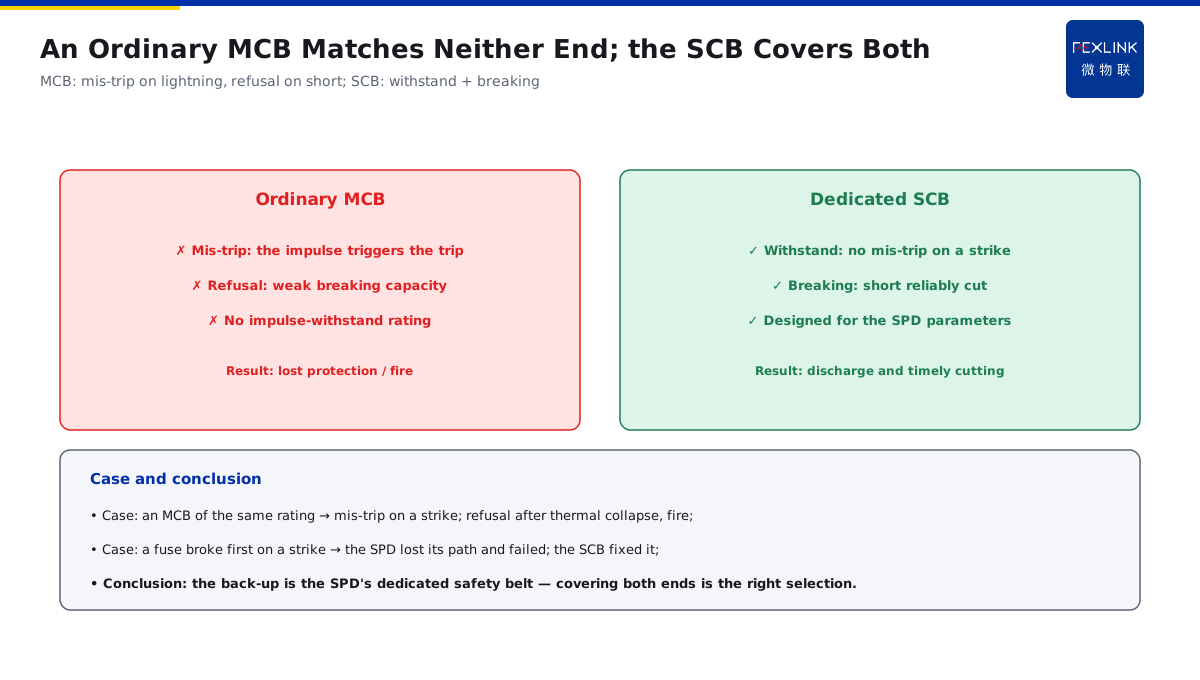
Should the front end of an SPD use an ordinary MCB, a dedicated SCB, or a fuse? The answer: SPD back-up protection must satisfy two conditions at once — it must be able to break the fault current when the SPD fails in a power-frequency short circuit (sufficient breaking capacity), and it must not trip when the SPD conducts lightning current (sufficient lightning-impulse withstand). A dedicated SCB matches these two points better than an ordinary MCB, and the selection follows the SPD's maximum continuous operating voltage (Uc) and rated discharge current (In), not an arbitrary MCB of the same current rating.
At a project, an ordinary MCB of the same current rating as the SPD was fitted at its front end: during a strike, the SPD conducted normally but the MCB tripped mistakenly and the protection link was lost. Later the SPD suffered thermal collapse (connecting to KD-0178) and formed a power-frequency follow current, but the MCB refused to trip for lack of breaking capacity, and the SPD caught fire. After replacing it with a dedicated SCB matched by Uc/In, lightning impulses no longer tripped it and short circuits were broken reliably. The key distinction: back-up protection is the SPD's safety net — "can break and does not mis-trip" is a dual-condition criterion; an ordinary MCB matches neither end, and only a dedicated SCB covers both.
Why:
- What it protects: cutting the fault current when the SPD has power-frequency follow current or a short-circuit failure; - The MCB risks: either mis-tripping on lightning current or refusing to trip on a short circuit; - The SCB features: lightning-impulse withstand plus power-frequency breaking capacity; - The matching basis: select by Uc and In, not by "the same current rating".
Key insight: "Back-up selection is a dual condition: breaking capacity covers the short circuit, impulse withstand prevents mis-tripping — an ordinary MCB matches neither end; the SCB is matched by Uc/In."
At a server room, the SPD front end used a fuse combination with overcurrent protection. During a strike the fuse acted before the SPD, the protection link was lost, and the SPD, lacking a discharge path, was damaged. After rectification to a dedicated SCB, lightning currents discharged normally and short circuits were broken reliably. Lesson: a back-up that mis-trips is more dangerous than none — selection must follow the SPD parameters, not guesswork.
1. What the Back-Up Protection Must Catch
Step one: why the SPD "needs a safety net".
The two failure forms of the SPD: - Power-frequency follow current: after MOV degradation, a continuous power-frequency current flows; - Short-circuit failure: MOV breakdown forms a low-resistance short; - Both make the SPD heat up/catch fire (connecting to KD-0178); - The back-up protection must cut them in time.
The role of the back-up protection: - Break quickly when it detects a power-frequency fault current; - Isolate the SPD from the grid; - Prevent the fault from spreading to the bus and equipment; - The last gate of SPD safety.
Why it cannot be absent: - No back-up → no one cuts an SPD fault; - The fault current persists → heating and fire; - Affecting the upstream equipment/system; - The standard requires back-up protection at the SPD front end.
Key insight: "The back-up catches power-frequency follow current and short-circuit failure — once the SPD degrades, someone must cut it off; that is the safety bottom line."
2. The Two Risks of an Ordinary MCB: Mis-Trip or Refusal
Step two: why an ordinary MCB is unsuitable.
Risk one: mis-tripping on lightning current: - Ordinary MCBs are designed for power-frequency characteristics; - The lightning-impulse waveform differs (connecting to KD-0171); - The impulse current can trigger the magnetic trip; - Tripping during a strike → the protection link is lost.
Risk two: refusing on a short circuit: - The MCB's breaking capacity is chosen for the circuit's short-circuit current; - The SPD fault-current path is special (low impedance); - Insufficient breaking capacity → refusal/arcing; - The fault cannot be cut → fire and spread.
The essential problem: - An ordinary MCB is not designed for the SPD scenario; - It lacks lightning-impulse withstand ratings; - Its breaking characteristic does not match SPD failure; - "The same current rating" is a wrong benchmark.
Key insight: "An ordinary MCB matches neither end: mis-trip on lightning, refusal on a short circuit — 'the same current rating' is a benchmark error; it is simply not designed for the SPD scenario."
3. The Lightning-Impulse Withstand of a Dedicated SCB
Step three: where the SCB is strong.
The SCB's dual capability: - Power-frequency breaking: breaks according to the SPD fault current; - Impulse withstand: conducts lightning current without tripping; - Both capabilities at once; - Designed specifically for the SPD parameters.
The key to impulse withstand: - Stays closed under lightning impulses (8/20μs, etc.); - Does not trip from the impulse current; - Lets the SPD discharge the lightning current normally; - Auto-resets/no mis-trip after the strike.
The difference from an MCB: - An ordinary MCB has no impulse-withstand design; - The SCB has explicit impulse-withstand ratings; - Its breaking curve is set by the SPD characteristics; - It is the SPD's "dedicated safety belt".
Key insight: "The SCB has both power-frequency breaking and impulse withstand — the lightning current does not mis-trip it, and the power-frequency fault is broken; an ordinary MCB cannot give that."
4. Matching the Breaking Capacity to the SPD Parameters
Step four: how to select by the parameters.
Basis one: Uc (maximum continuous operating voltage): - The SPD's continuous operating voltage level; - Decides the voltage-withstand match of the back-up; - Selected by the SPD's system voltage; - A Uc mismatch → the protection coordination fails.
Basis two: In/Imax (discharge capability): - The SPD's rated/maximum discharge current; - Decides the withstand while the impulse passes; - The discharge level affects the SCB selection; - Insufficient discharge → the SCB fails first.
Basis three: breaking capacity: - The SCB's power-frequency breaking capacity (Ics); - Evaluated by the fault current at SPD failure; - Breaking capacity ≥ the fault current; - In a system with the SPD parameters.
The selection order: - First set the SPD's Uc/In/Imax; - Then match the SCB to them; - Check the impulse withstand and breaking capacity; - The same-brand system is the best.
Key insight: "Select by Uc/In/Imax: continuous voltage matches, discharge level matches, breaking capacity catches the bottom — the SCB and SPD are one system, not separate purchases."
5. The Selection Checklist
Step five: how to check in practice.
The checklist: - ① Breaking capacity ≥ the SPD-failure fault current; - ② Impulse withstand ≥ the SPD's rated discharge (In); - ③ Uc matches the SPD/system voltage; - ④ Same-brand system with the SPD (verified compatibility); - ⑤ The state after action is monitorable (connecting to the FSS platform).
Common pitfalls: - Benchmarking by the rated current (A) — the wrong dimension; - Looking only at the breaking capacity, ignoring the impulse withstand; - Mixing MCBs/fuses without verification; - Forcing a match when the parameters do not align.
Practice verification: - Check the manufacturer's coordination table; - Inspect the SCB state after lightning events; - Monitor through the FSS intelligent SPD platform; - Replace abnormal units in time.
Key insight: "Select with a checklist: enough breaking, enough withstand, matching voltage, same system, monitorable state — only when all five pass is the selection right."
6. Product Implementation: SPD and Back-Up as One
WeiWuLian products manage the back-up protection:
- FSS Intelligent Surge Protective Device: selected together with the dedicated SCB; - SCB back-up protection: the breaking + withstand dual condition; - Platform monitoring: SCB/SPD states online; - Event correlation: the strike-discharge-protection loop.
The design principle in one sentence: "Breaking capacity covers the short circuit, impulse withstand prevents mis-trip, Uc/In decide the match — selecting the SPD and SCB as one closes the safety loop."
7. Common Misjudgments
1. "An MCB of the same current rating works": the wrong benchmark. Result: mis-trip/refusal. Correct: select the SCB by Uc/In. 2. "A fuse can also catch it": ignoring the mis-trip risk. Result: it breaks first on a strike and the SPD loses protection. Correct: use a dedicated SCB. 3. "Enough breaking capacity is all that matters": ignoring impulse withstand. Result: mis-trip on a strike. Correct: check both conditions. 4. "Mixing is fine": ignoring system compatibility. Result: coordination failure. Correct: same-brand system + verification. 5. "Done once installed": no state monitoring. Result: an abnormal SCB goes unnoticed. Correct: monitor online through the platform.
Scope and Limitations
This article explains the dual-condition criterion of SPD back-up protection (SCB) selection — breaking capacity and lightning-impulse withstand — the coordination logic with the SPD parameters (Uc/In/Imax), and a selection checklist, applicable to selecting and understanding SPD back-up protection. The exact values follow IEC 61643-11, GB/T 18802.11 and the manufacturers' coordination tables; this article explains only the selection logic and judgment basis. All cases are anonymized (a project, a server room) and do not refer to any specific customer.