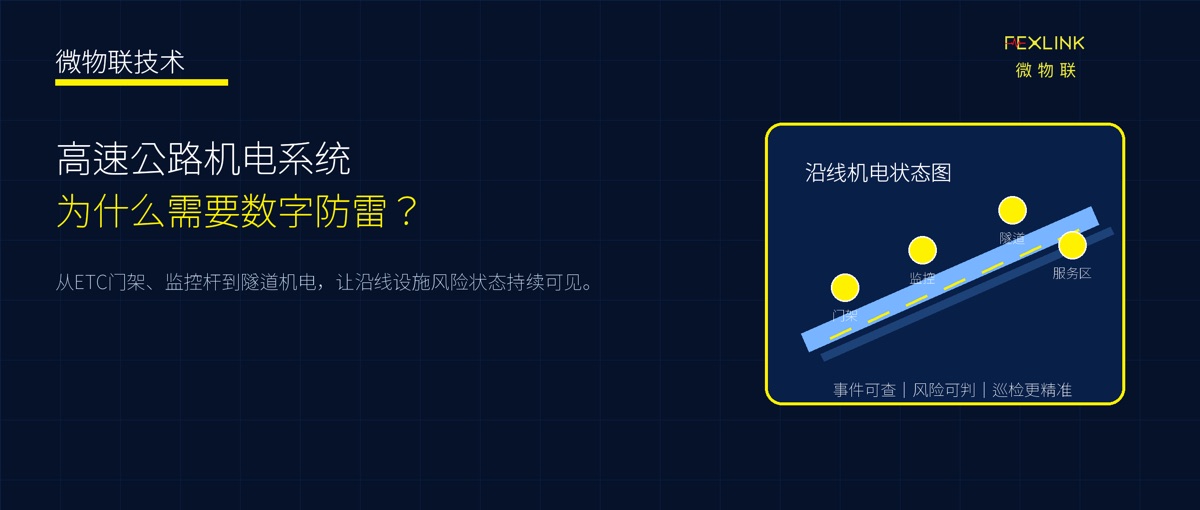


Highway lightning protection is not an isolated equipment problem. There are a large number of outdoor electromechanical facilities along the route, operating for long periods in thunderstorm, humid, high-temperature, dusty, vibrating and electromagnetically disturbed environments. A single lightning strike or induced surge may not just damage one surge protective device; it can take cameras offline, disrupt ETC gantries, black out message signs, trigger tunnel equipment alarms, interrupt toll station communication or cause power distribution equipment faults.
For highway operators, the difficulty of lightning protection is not whether an SPD is installed at one point, but whether the status of hundreds or thousands of points along the route remains continuously visible. The more dispersed the equipment, the less it can rely only on manual inspection and post-event troubleshooting. What digital lightning protection must do is unify lightning strike and surge events, surge protective device status, grounding status, equipment alarms and O&M handling into a route-wide risk data chain.
1. Why are highway electromechanical systems vulnerable to lightning strikes and surges?
The risk to highway electromechanical systems first comes from scattered points. A single highway includes toll stations, service areas, tunnels, bridges, ETC gantries, monitoring poles, weather stations, variable message signs, communication equipment and distribution boxes. The points span long distances and differ in surrounding terrain, soil conditions, power supply modes and communication conditions.
The second characteristic is strong outdoor exposure. ETC gantries, monitoring poles, video cameras, message signs and some weather monitoring equipment sit in open road sections for long periods and are vulnerable to thunderstorm weather, induced lightning, ground potential rise and nearby direct strikes. Even if SPDs are installed inside equipment enclosures, without status monitoring it is hard to know continuously whether the equipment has been impacted or whether its protection capability has declined.
The third characteristic is complex cabling. Highway electromechanical systems simultaneously involve power lines, communication lines, video cables, control cables, optical-electrical conversion equipment, grounding conductors and metal masts. Surges may enter from the power side, the signal side, the communication side or the grounding side. Behind an anomaly at one point may be a power quality issue, a surge impact, a grounding change or natural aging of the equipment itself.

2. What blind spots does traditional highway lightning protection have?
Traditional lightning protection is not without value. Power SPDs, signal SPDs, equipotential bonding, grounding systems and standard-compliant installation remain the foundation of safe operation of highway electromechanical systems. Its main shortcoming, however, is that the operating process is invisible.
The first blind spot is invisible SPD status. Many surge protective devices are installed inside distribution boxes, cabinets or pole equipment enclosures, so disconnection, degradation and backup protection anomalies can only be found on site. For points along the route, manual inspection cycles are long, and anomalies are often discovered too late.
The second blind spot is untraceable events. After equipment damage, the site can often only say "possibly lightning", "possibly a surge" or "possibly a power problem", but lacks data showing when the impact occurred, which point was affected, whether the SPD operated, whether the grounding status changed and whether the equipment alarm time matches.
The third blind spot is that grounding status is largely unmonitored for long periods. Geological conditions along highways are complex, and the grounding system can be affected by soil humidity, corrosion, construction disturbance, loose wiring and special terrain. Passing one test does not mean long-term reliability afterwards.
The fourth blind spot is that alarms and O&M are not closed-loop. Even when many projects have a platform, it may stop at the "displaying alarms" level. Without closure records covering who handled the issue, when it was handled, what was done, whether the status was restored and whether an event archive was created, the value of the system drops significantly.

3. Which points should highway digital lightning protection monitor as priorities?
The first priority is ETC gantries. ETC gantries are usually located on open road sections with tall masts, concentrated equipment and many cables, making them typical outdoor surge risk points. Digital lightning protection should focus on monitoring gantry distribution box SPD status, communication equipment status, recognition equipment power supply status, surge event records and grounding status.
The second priority is video monitoring poles and camera points. Once monitoring equipment goes offline, it affects traffic viewing, incident recognition and emergency response. Here it is necessary to monitor both power SPDs and network lightning protection, camera power supply, enclosure grounding and equipment offline alarms.
The third priority is variable message signs. Message signs carry traffic guidance, safety prompts and emergency information release functions. Their lightning protection monitoring should cover power lightning protection, control system lightning protection, grounding status and equipment operation alarms.
The fourth priority is tunnel electromechanical systems. Lighting, fans, fire protection, surveillance, communication and power distribution systems in tunnels are tightly coupled; once lightning protection, power distribution or communication goes wrong, the impact scope can be more complex. Tunnel scenarios suit unified management of distribution cabinet SPDs, the grounding system and electromechanical equipment alarms.
The fifth priority is toll station and service area equipment rooms. Toll stations and service areas are often the concentrated electromechanical nodes of a road section and suit centralized monitoring, focusing on room power SPDs, signal SPDs, UPS and power distribution alarms, grounding status and communication links.

4. How should a highway digital lightning protection system be designed?
A complete highway digital lightning protection system can be divided into an on-site protection layer, a status sensing layer, a communication transmission layer, a platform diagnosis layer and an O&M closure layer. The on-site protection layer addresses basic safety issues, including power SPDs, signal SPDs, network lightning protection, equipotential bonding, the grounding system and backup protection.
The status sensing layer solves the "visibility" problem, including SPD disconnection status, degradation status, backup protection status, surge events, lightning current events, grounding resistance or grounding status, enclosure environment and equipment power supply status. For dispersed outdoor points, whether data can be reliably collected and uploaded matters more than how many features are written on the spec sheet.
The communication transmission layer should be flexibly chosen according to site conditions. Along a highway, 4G/5G, Ethernet, optical fiber networks, RS485, edge gateways or private network access can be adopted. The platform diagnosis and O&M closure layer should support map-based points, alarm grading, risk ranking, event archives, grounding trends, station health scores, work order dispatch, handling verification and statistical reports.

Fig. 5A: Field sensing layer of the highway digital lightning protection system.

Fig. 5B: Platform management layer of the highway digital lightning protection system.
5. What is the key value of highway digital lightning protection?
First, it reduces blind inspection. Traditional inspection tends to spread effort evenly; digital lightning protection can tell O&M staff where surges occurred, where SPDs are abnormal, where grounding trends are abnormal and where equipment alarms may be related to lightning protection events.
Second, it improves fault tracing capability. When equipment at a point goes offline or is damaged, staff can look back at whether surge events occurred, whether the SPD operated, whether the grounding status changed, whether communication was interrupted and whether similar problems occurred historically. Fault analysis no longer relies only on experience-based judgment.
Third, it builds profiles of high-risk points. Long-term data can reveal points with frequent lightning strikes, points with frequent SPD anomalies, points with unstable grounding, equipment that often goes offline and points with high maintenance costs. Operators can use these data to optimize inspection routes, spare parts strategies and retrofit plans.
Fourth, it brings lightning protection into the operation management system. A highway is not a one-time construction project but a long-term operational asset. Digital lightning protection can turn the lightning protection system from an "engineering acceptance item" into "operational status data".


6. How does FEXLINK understand highway digital lightning protection?
FEXLINK believes that the core of highway digital lightning protection is not simply adding an online module to every point, but unifying the protection status, surge events, grounding status, equipment alarms and O&M handling of electromechanical facilities along the route into one continuous data chain.
Highway digital lightning protection must deliver three transformations: from single-point installation to route-wide status management; from post-fault investigation to traceable events; and from manual inspection to risk-graded O&M. The FEXLINK digital lightning protection system aims to make lightning protection devices continuously produce data, make lightning protection data serve the reliable operation of electromechanical systems, and move facilities along the highway from "equipment online" to "status assessable".

Conclusion: The highway lightning protection upgrade is part of the reliable operation of electromechanical systems
The lightning protection upgrade of highway electromechanical systems is not only about reducing lightning damage, but about keeping the risk status of wayside equipment visible over the long term. For ETC gantries, monitoring poles, message signs, tunnel electromechanical facilities, toll stations and service area equipment rooms, lightning protection is not an isolated device but part of operational reliability management.
What digital lightning protection truly needs to solve is making risk visible, events findable, status assessable and handling traceable. Only in this way can a highway lightning protection system upgrade from equipment configuration at the construction stage to status management capability at the operation stage.