

Many engineering projects carry out grounding resistance tests during acceptance. When the test report shows a passing value, the project considers the grounding system problem-free. But during long-term operation, the grounding system does not stay in the state it was in on the acceptance day.
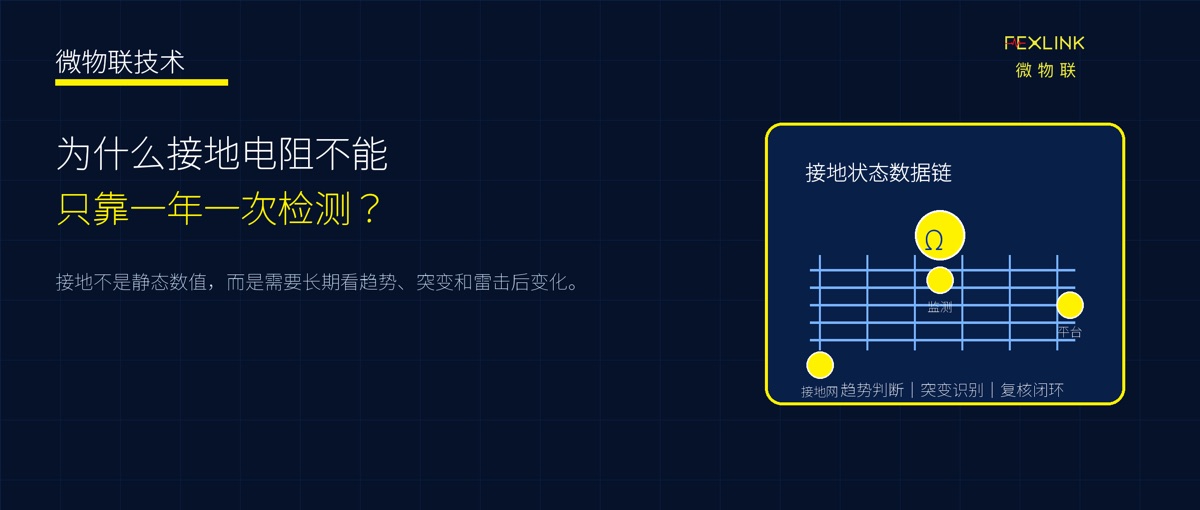
Grounding resistance is not a static number in a report, but an operating status that continuously changes with the on-site environment. Grounding resistance online monitoring is not meant to negate traditional testing, but to answer the questions traditional testing cannot: whether the grounding status changed after the test, whether the grounding system is abnormal after a lightning strike, whether grounding connections were affected by construction, and which points need priority re-verification.
1. Why Does the Grounding System Change?
First, soil moisture changes. Soil water content affects grounding resistance, and rainy seasons, dry seasons, prolonged high temperatures and freeze-thaw cycles may all cause grounding status fluctuations.
Second, grounding electrodes and connectors corrode and age. Grounding electrodes, connectors, weld points, flat steel, copper busbars and grounding conductors remain underground or outdoors for long periods and may be affected by corrosion and aging.
Third, construction disturbance affects the grounding grid. Station expansion, road construction, pipeline construction and foundation works may damage the grounding grid or change grounding connection status.
Fourth, connection points may loosen or oxidize. If grounding down conductors, equipotential bonding connections, distribution cabinet grounding points or equipment enclosure grounding points become loose, oxidized or poorly contacted, the discharge path is affected. Fifth, after a strong lightning strike, local connections of the grounding system, grounding grid status and equipotential relationships may change.

2. Why Is a Single Test Not Enough?
A grounding resistance test report reflects the result under a certain time, a certain environmental condition and a certain measurement method. It cannot prove that conditions remain unchanged far into the future. Many scenarios are tested once a year or even less frequently, but thunderstorms, construction, corrosion and equipment modifications may all occur between two tests.
For high-risk or high-reliability scenarios such as petrochemical, wind power, PV, communication base stations, rail transit, expressways and data centers, grounding anomalies may affect not only a single device but also safety, power supply, communication and O&M continuity.
Therefore, online monitoring does not replace testing but supplements it. Traditional testing addresses compliance confirmation, while online monitoring addresses long-term status visibility. Only by combining the two can the grounding system have both test evidence and operational data.

3. What Does Grounding Online Monitoring Actually Monitor?
Grounding online monitoring first focuses on grounding resistance or the equivalent grounding status. But different systems and different methods measure different objects, so one should not look only at an absolute value, but understand the measurement method and applicable scenarios.
Compared with a single value, the long-term trend matters more. Engineering personnel need to see whether the grounding status keeps rising over the long term, whether it changes abruptly after thunderstorms, whether it changes after construction, whether it fluctuates seasonally, and whether it differs significantly from other points of the same type.
Abnormal mutation is also critical. A sudden change in grounding status is often more noteworthy than slow fluctuation. Mutations may come from loose connections, construction damage, measurement circuit changes or post-strike status changes.
Multi-point comparison is equally important. For wind farms, PV plants, petrochemical tank farms, expressway corridors and communication base stations, comparison between multiple points is highly valuable. A point that stays high for a long time is often more meaningful than simply checking whether a fixed threshold is exceeded. Grounding data should also be correlated with lightning current, SPDs and equipment alarms: if lightning current events, SPD operation, grounding status mutations and equipment alarms appear together after a lightning strike, the risk judgment becomes more reliable.

4. Which Scenarios Need Grounding Online Monitoring More?
Petrochemical and storage tank areas urgently need grounding online monitoring. Scenarios such as storage tanks, loading/unloading areas and major hazard installations of hazardous chemicals impose strict requirements on lightning protection, electrostatic protection and grounding status. If grounding status remains invisible over the long term, risks tend to surface only after thunderstorms, loading operations or equipment anomalies.
Wind farms need it as well. Turbines are tall and frequently struck, and the grounding system is an important foundation of the lightning current discharge path. Changes in grounding status after lightning strikes directly affect subsequent inspection and repair judgments.
PV and energy storage stations have large footprints, wide grounding grid coverage and scattered equipment, and grounding status changes may affect PV arrays, combiner boxes, inverters, box-type transformers, storage cabins and step-up substations. Communication base stations are numerous, wide-spread and unattended, and long-term invisible grounding status creates hidden risks for power supply, communication and equipment protection. Equipment rooms, railways and expressways share the characteristics of scattered points, sensitive equipment and high O&M costs; if grounding anomalies are not detected in time, they often surface only after lightning strikes, surges or equipment faults.

5. How Should a Grounding Online Monitoring System Be Designed?
The first layer is the on-site measurement layer, including three-pole or three-line method measurement, clamp or loop method measurement, grounding voltage monitoring, grounding connection status, outdoor protection and explosion-proof adaptation. Different methods suit different scenarios, and measurement results should not all be treated as having the same meaning.
The second layer is the edge acquisition and communication layer, including RS485, Modbus, 4G/5G, Ethernet, edge gateways, store-and-forward and multi-point aggregation. If grounding online monitoring is to run over the long term, communication stability and data integrity are critical.
The third layer is the edge computing layer, including data cleaning, outlier filtering, trend feature extraction, grounding mutation identification, post-strike status judgment and multi-point comparison. Many grounding anomalies are not suitable for judgment by fixed threshold alone, but need to be combined with trends and scenarios.
The fourth layer is the cloud platform diagnosis layer, including a grounding point map, threshold alarms, trend alarms, mutation alarms, post-strike re-verification reminders, a grounding health index, maintenance records and report archiving. A truly valuable platform does not only display an ohm value, but tells engineering personnel whether the next step is re-verification, where to verify and how to close the loop.

Fig. 5A: On-site measurement and communication layers of the grounding online monitoring system.

Fig. 5B: Platform diagnosis and O&M closure layers of the grounding online monitoring system.
6. Why Should Grounding Changes Be Checked After a Lightning Strike?
Whether the grounding system remains stable after a lightning strike is a key question in smart lightning protection judgment. A strong strike may cause abnormal grounding connection points, local potential changes, grounding grid status changes or device-side alarms. At this point, judging only from the strike count or SPD status is incomplete.
A more reasonable approach is to place lightning current events, SPD status, grounding changes and equipment alarms on the same timeline: first confirm the lightning strike event, then check grounding changes, then check SPD status and equipment alarms, and finally decide whether on-site re-verification is needed. On-site re-verification can use the three-pole method, clamp method, loop method or multi-point comparison, depending on site conditions.

7. How Does FEXLINK Understand Grounding Resistance Online Monitoring?
FEXLINK believes that grounding resistance online monitoring is not for seeing a good-looking value, but for continuously judging the reliability trend of the grounding system. Grounding monitoring requires three transformations: from one-off testing to long-term trends; from single-point values to multi-point comparison; and from manual detection to active post-strike re-verification.
FEXLINK's value is not just displaying grounding resistance on a platform, but placing grounding data and lightning current, SPD status, equipment alarms and O&M work orders in the same risk chain, making the grounding system the data foundation of smart lightning protection and electrical safety early warning.

Conclusion: Grounding Online Monitoring Is the Underlying Capability of Smart Lightning Protection
The grounding system is the underlying path of lightning protection systems, electrical safety systems and electrostatic protection systems. A passing one-off test does not mean long-term reliability, especially in scenarios with frequent thunderstorms, scattered equipment, complex environments and high safety grades, where continuous visibility of grounding status matters greatly.
The value of grounding online monitoring is not replacing manual testing, but letting engineering personnel see trends, detect mutations, locate high-risk points between two tests, and quickly determine whether re-verification is needed after a lightning strike or equipment anomaly.