

After many projects deploy Smart Lightning Protection systems, the platform is flooded with statuses and alarms: abnormal remote signaling on an SPD, a rising trend at a grounding point, a surge event at a site, an offline terminal, and a communication alarm from a device.
On the surface, the system seems intelligent because it can see lots of data. But when it comes to real O&M in the field, the questions usually become: of all these alarms, which is the most severe? Which needs immediate handling? Which can be observed? Which may be a false alarm? Which is related to a lightning strike event? And after handling, has it recovered?
If the platform cannot answer these questions, more alarms just become more noise. Having data is not the same as having judgment; having alarms is not the same as having management; having a platform is not the same as forming a closure loop.
1. Why Doesn't Having Alarms Mean Having Management?
The worst situation for a Smart Lightning Protection platform is not having no alarms, but having too many alarms with unclear levels and unexplained causes. If terminal short-term offline, abnormal SPD remote signaling, grounding value fluctuations, lightning strike event records, communication timeouts, and abnormal device status are all reported in the same way, the platform will quickly shift from helping judgment to creating pressure.
Without an explanation of the cause, the field team cannot act. A plain abnormal notice only warns that something is wrong; it does not tell engineers which type of data the anomaly comes from, whether the risk persists, whether it is related to a lightning strike event, or whether it needs observation, review, or dispatch.
Without priorities, O&M resources cannot be allocated sensibly. Along a highway corridor, at a PV plant, a wind farm, a cluster of communication base stations, or a petrochemical tank farm, not every site can be handled at the same time. The platform must answer: which one first, why it comes first, and how recovery is confirmed after handling.
2. How Should Smart Lightning Protection Alarms Be Graded?
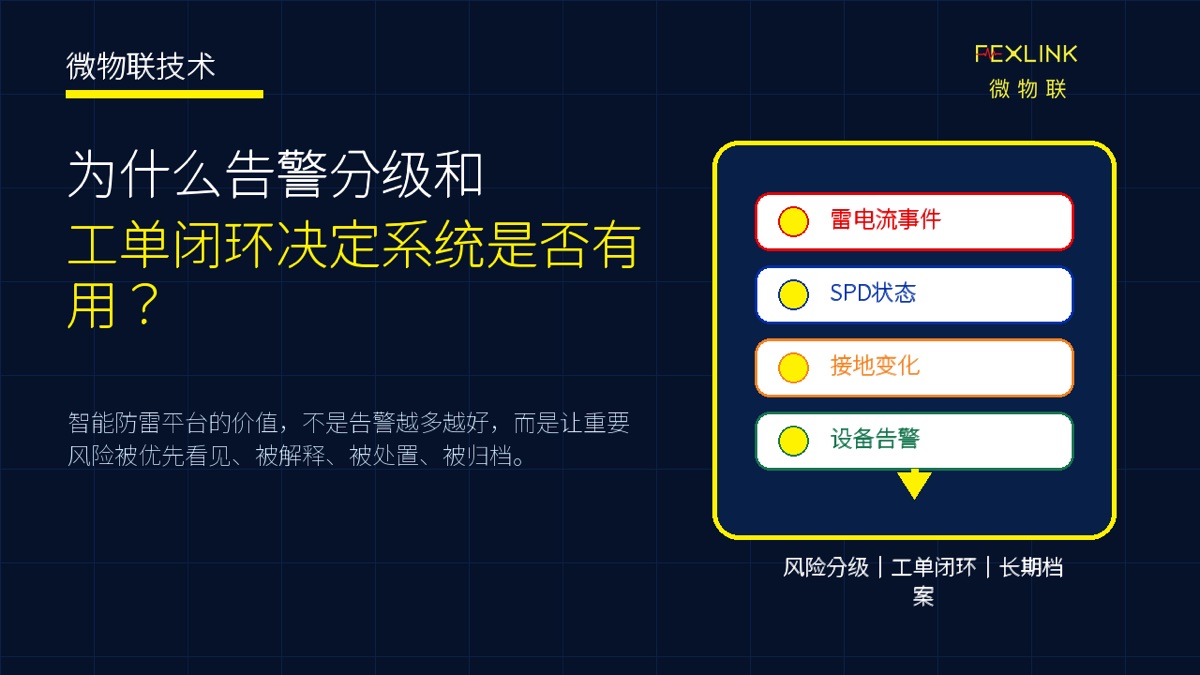
Smart Lightning Protection alarms can be divided into four levels by operational impact and urgency of handling: advisory, general, important, and emergency. The purpose of grading is not to make the interface more complex, but to make O&M actions clearer.
Advisory-level alarms cover cases such as a terminal recovering after a short offline period, minor fluctuations in grounding values, and a single low-intensity surge event. These alarms need attention but do not necessarily require immediate dispatch; they are better suited to an observation list.
General-level alarms fit issues such as continuous trend anomalies, an increasing frequency of ordinary surges, and declining device online rates, and should be incorporated into scheduled manual inspection. Important-level alarms usually mean that correlations have emerged among lightning strike events, SPD status changes, grounding changes, or device alarms; they should not be merely observed, and work orders should be created. Emergency-level alarms correspond to SPD disconnection after a strong strike, grounding anomalies combined with equipment faults, or protection chain anomalies in critical scenarios; they require rapid response, review, and archiving.

3. Alarm Grading Cannot Rely on a Single Threshold
Traditional platforms tend to implement alarms as alarm above the threshold, normal below it. But Smart Lightning Protection cannot be that simple. Lightning strikes, surges, SPD degradation, grounding status changes, and equipment anomalies are themselves the results of multiple factors acting together.
Even for the same type of lightning strike event, a low-intensity surge and a high-intensity lightning current event carry completely different risks. Even for an SPD that has not tripped, the risk level differs if leakage current rises, temperature becomes abnormal, or the life trend declines after a strike.
Even for the same grounding value change, the handling priority should be raised if the change occurs after a thunderstorm, appears at a critical site, and is accompanied by device alarms. The most valuable alarms are not single-point anomalies but combined anomalies: a lightning current event, SPD status change, grounding change, and device alarms appearing on the same timeline at the same time.

4. How Should the Closure Loop from Alarm to Work Order Work?
A complete Smart Lightning Protection closure loop should include alarm generation, risk grading, responsible dispatch, on-site review, handling records, recovery confirmation, event archiving, and trend analysis. The process may look simple, but it determines whether the platform is a display system or an O&M system.
Dispatch is not just sending a message. It must specify who handles it, when, which site to visit, which equipment to check, whether spare parts are needed, and whether shutdown or power outage is required. On-site review must not look only at the alarm point itself; it must also check SPD status, backup protection, grounding connections, communication cables, water ingress into enclosures, loose terminals, burn marks, and equipment operating status.
After handling is completed, the platform should confirm whether the alarm has cleared, whether data has returned to normal, and whether replacement, re-testing, photos, and notes are complete. Only with records in place can later review, audits, insurance, rectification, and life assessment be justified.

5. What Results Should a Smart Lightning Protection Platform Deliver?
A platform must not only output normal or abnormal. A truly valuable platform should output risk level, affected objects, cause explanation, handling recommendations, long-term trends, and review results.
For example, instead of just reporting SPD abnormal, the platform should further explain: this site experienced a high-intensity lightning current event during the thunderstorm period, after which SPD leakage current rose, grounding status changed abruptly, and the timestamps are close to device communication alarms, so priority on-site review is recommended. This kind of explanation is much closer to what engineering teams actually need than a single alarm.
In the long run, the platform should also tell managers which sites experience frequent strikes, which SPDs degrade quickly, which grounding points are chronically unstable, which work orders recur, and which areas need systematic rectification.

6. How Do Multi-Source Data Form Risk Judgments?
The key of a Smart Lightning Protection platform is not displaying each type of data in isolation, but recognizing the relationships among the data. Lightning current events tell what impulse occurred; SPD status tells whether the protective device changed; grounding status tells whether the discharge path is reliable; device alarms tell whether business equipment was affected.
If these data change around the same time on the timeline, the platform should not treat them as four independent alarms but recognize them as one risk chain. This is what distinguishes a Smart Lightning Protection platform from an ordinary monitoring platform.

7. How Does FEXLINK Understand Smart Lightning Protection Platforms?
FEXLINK believes that a Smart Lightning Protection platform is not a software interface that connects devices and displays their status, but a system that converts on-site lightning protection data into risk judgments and O&M actions.
It must complete three shifts: from data display to risk explanation, from alarm push to graded handling, and from one-off repairs to long-term risk archives. What the FEXLINK Digital Lightning Protection system cares about is not just individual data such as lightning current, SPD, and grounding, but the relationships among them.
Only by combining event data, status data, trend data, and work-order data can the platform truly answer: Where is the risk? Why is there risk? Does it need handling? Who handles it? Has it recovered after handling?

Conclusion: A Platform Is Not for Displaying Data but for Reducing Risk
The true value of a Smart Lightning Protection platform is not more alarms or more complex pages. A truly valuable platform should make important risks visible first, make anomaly causes explainable, make O&M actions closable, and let historical events settle into long-term risk archives.
A lightning protection system is ultimately not about displaying data, but about guiding maintenance, reducing risk, and supporting management. Only when alarms can be graded, causes explained, work orders closed, and events archived can a Smart Lightning Protection platform truly move from devices online to risks online.