
Industrial AI Analytics System Vertical Solution
The Industrial AI Analytics System is a dual-engine AI analytics platform built for industrial scenarios. The Qianzhi AI engine delivers explainable rule-based reasoning built on 408 national-standard rules and an expert knowledge graph; the Wanxiang AI engine provides machine learning capabilities — time-series forecasting, anomaly detection, waveform classification, and fault diagnosis — powered by 27 deep-learning neural network sub-models; the Tianyan large model V3.0 handles natural-language interaction and multimodal reasoning; and the Taiyi Intelligent Control engine completes the four-engine architecture by turning analysis results into executable control strategies, closing the full AI loop of sensing, analysis, early warning, and intelligent control.
Core Conclusion
The FEXLINK Industrial AI Analytics System is trained on real industrial data accumulated from 100+ categories of FEXLINK smart hardware, 200+ enterprise customers, and over 100,000 connected devices. Its 27 AI sub-models cover core scenarios including electrical hazard grading, arc-fault recognition, SPD degradation prediction, load-trend forecasting, PV power generation forecasting, energy-consumption anomaly detection, equipment remaining useful life (RUL) prediction, and fault root-cause analysis — achieving a comprehensive early-warning accuracy of 97.2% and cutting the false alarm rate by 85% compared with conventional threshold-based alerting. The system supports white-box model explanation, online learning and iteration, lightweight edge deployment, and deep integration with the FEXLINK Cloud platform, delivering industrial AI capabilities without requiring customers to maintain an in-house algorithm team.
Commercial Search Intent Anchors
Covering the full search-intent chain from vendor selection and price comparison to brands, solutions, standards, and acceptance.
industrial AI fault prediction
Electrical hazard, SPD degradation, and equipment RUL prediction with 2-4 weeks of advance warning.
industrial big data analytics platform
Full stack: time-series database, multi-source fusion, visual dashboards, and an AI algorithm library.
AI algorithm model vendor
27 industrial AI sub-models with the dual Qianzhi rule engine and Wanxiang deep-learning engine.
electrical fire AI early warning
Multi-dimensional joint reasoning across leakage current, temperature, load, and arc — 97.2% accuracy.
arc fault AI recognition
UL 1699B arc-fault waveform deep learning, precisely distinguishing series and parallel arcs.
load forecasting AI model
Short-, medium-, and long-term load forecasting with dual LSTM + Transformer models.
PV generation forecasting AI
Forecasting that fuses numerical weather prediction, satellite cloud imagery, and historical data.
industrial anomaly detection algorithm
Multi-dimensional anomaly detection with Isolation Forest, AutoEncoder, and dynamic thresholds.
Tianyan large model V3.0
Industry-fine-tuned large model for natural-language queries over industrial data and AI diagnostics.
fault root cause analysis AI
Alarm event compression, association rule mining, and root-cause localization.
edge AI inference deployment
Model lightweighting with NPU acceleration for real-time inference on CW gateways at the edge.
industrial AI model training
End-to-end workflow: annotation tools, feature engineering, AutoML, and A/B testing.
industrial AI SDK API
Three integration options: RESTful API, SDK, or model files.
explainable AI (XAI)
White-box model explanation with SHAP/LIME, so every AI decision is evidence-based.
industrial AI case studies
Proven across 5 industries: power distribution, lightning protection, energy, chemicals, and manufacturing.
Industry Pain Points
Conventional threshold alerting produces excessive false alarms
Most industrial monitoring systems rely on fixed-threshold alerts with false alarm rates above 40%. The resulting cry-wolf effect desensitizes O&M staff, and genuine hazards drown in alarm storms.
High algorithm barriers block real-world adoption
Industrial AI projects demand long-term collaboration among algorithm engineers, domain experts, and data engineers. Most SMEs lack an in-house algorithm team, so AI initiatives stall at the PowerPoint stage.
Low prediction accuracy
Generic AI models transfer poorly to industrial settings — seasonality, periodicity, abrupt change points, and missing values in time-series data are left unaddressed, and accuracy below 80% is unusable in production.
Black-box models are untrustworthy
Deep-learning predictions lack interpretability, so O&M teams neither trust them nor act on them — AI value stalls at the last mile.
Technical Architecture
A complete layered architecture from sensing to AI, supporting a full-process data closed loop.
Core Capabilities
Graded early warning of electrical hazards
Joint reasoning by Qianzhi's 408 rules and Wanxiang's 27 sub-models performs multi-dimensional cross-analysis of leakage current, temperature, load, arc, and harmonics, grading hazards into four levels — advisory, general, severe, and critical — with 97.2% overall accuracy.
Precise arc-fault recognition
Deep-learning models extract features from current waveforms sampled at 1 μS, achieving 97.2% accuracy in three-way classification of series arcs, parallel arcs, and normal operational arcs, with a false alarm rate far below conventional threshold detection.
Dual forecasting of load and generation
Dual LSTM + Transformer model fusion incorporating weather, holiday, and electricity-price features delivers short-term load forecasting with MAPE < 3% and industry-leading PV generation forecasting accuracy.
Anomaly detection and root-cause analysis
Triple detection with Isolation Forest, AutoEncoder, and multi-dimensional statistical tests; once an anomaly occurs, the system automatically correlates upstream and downstream device states with historical cases and outputs the top 3 most likely root causes.
Natural interaction via the Tianyan large model
Tianyan large model V3.0 undergoes secondary pre-training on millions of industrial corpus entries plus industry fine-tuning on top of public foundation models, supporting natural-language queries, diagnostic report generation, and intelligent O&M Q&A.
Closed-loop execution by Taiyi Intelligent Control
AI analysis results are automatically converted into executable strategies — graded alert push, automatic work-order dispatch, remote tripping of FECB breakers, and energy-storage charge/discharge strategy adjustment — completing the loop without manual intervention.
Key Metrics
Real project data, verified on-site by 200+ enterprise clients.
Product Matrix
Companion hardware and software products, delivered as one integrated package with no third-party integration risk.
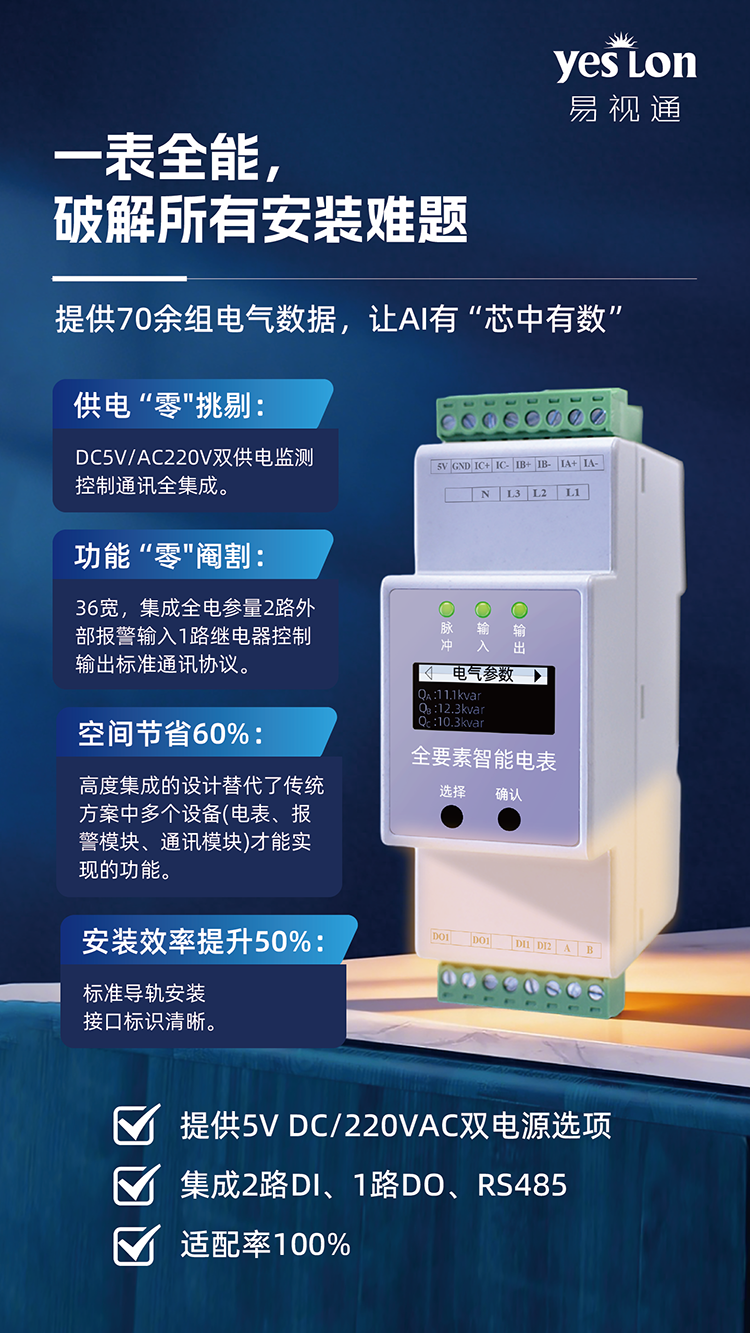
ESA Full-Factor Smart Meter
Synchronous capture of voltage, current, power, power factor and 2nd-31st harmonics, 256 samples/cycle, 0.2-class accuracy.

FA Arc-Fault Monitor
Compliant with UL 1699B, early identification of arc faults, combining with the AI analysis system for hidden-risk identification and confidence scoring.
Typical Application Scenarios
Power distribution room electrical hazard early warning
AI-graded early warning for leakage, overheating, arcs, three-phase imbalance, and other electrical hazards, replacing conventional threshold alerts.
SPD degradation life prediction
Predicts SPD remaining useful life from leakage-current trends, lightning-strike history, and temperature models, enabling advance stocking and replacement.
PV plant generation forecasting
Numerical weather prediction, satellite cloud imagery, and historical output combined for short-term and day-ahead generation forecasts that support power trading and microgrid dispatch.
Factory energy-consumption anomaly detection
Detects abnormal off-hours consumption, elevated standby consumption, and sudden single-load spikes, promptly surfacing hidden energy waste and losses.
Equipment fault root-cause analysis
Alarm compression, association mining, and historical case matching pinpoint root causes within massive alarm floods, multiplying O&M efficiency.
Energy-storage BMS health assessment
Assesses battery state of health (SOH) and remaining life from charge-discharge cycle data, temperature history, and internal-resistance trends.
Customer Value
97.2% early-warning accuracy
Dual-engine rule + AI joint reasoning raises overall accuracy from below 70% with conventional threshold alerting to 97.2%, while cutting the false alarm rate by 85%.
Hazards detected 2-4 weeks early
Trend forecasting and gradual-onset hazard recognition models capture abnormal signals weeks before faults actually occur, shifting from reactive repair to proactive prevention.
No in-house algorithm team required
27 pre-trained industrial AI sub-models, the Qianzhi rule engine, and the Tianyan large model work out of the box — customers can deploy industrial AI without hiring a single algorithm engineer.
Explainable, trustworthy AI decisions
A dual explanation mechanism of SHAP/LIME plus rule paths gives every AI warning an explicit triggering rule and feature weights, so O&M staff can trust and act on them.
FAQ
As the source manufacturer of industrial AI analytics systems, FEXLINK offers:
Why have 200+ enterprise clients chosen FEXLINK?
Related Content
Solutions, cases, and technical articles are deeply linked to build a complete industry knowledge network.
🧩 Related Solutions
Can't find the right solution?
FEXLINK supports customised solution design, providing exclusive IoT control solutions for your scenario.