Industrial equipment retrofit projects seldom fail because sensors cannot be bought. They fail because no one has defined what question the retrofit is supposed to answer. A common start is to decide which sensor categories to purchase and how many points to install, then write the retrofit objective afterward. By the time the hardware is mounted and data begins to flow, the interface carries many measured values yet still cannot answer the one question that motivated the project. A more reliable order is to settle three questions first: is this retrofit about safety, lifetime, or energy efficiency? The answer determines what must be sensed, whether control is required, and where the logic lives; only then does product selection follow. This article follows the sequence "define the question, then the capability, then the product." Product and parameter statements are limited to entries listed in the knowledge base, while the "question before product" sequence is the methodological frame used here to organize a retrofit path and must still be reviewed against site survey and project boundaries during engineering execution.
1. Why Buying Sensors First Often Fails to Land
A sensor is a means, not the starting point of a retrofit. Reversing the order typically produces two concrete consequences. First, the selection list gets organized by model or price rather than by the relative urgency of the problems; the list looks comprehensive yet cannot answer which few locations matter most. Second, once sensing points are fixed early, problem analysis later often reveals that some judgment lacks a corresponding measurement, forcing a rebuild and expensive rework. Both consequences point to the same thing: a retrofit must clarify the judgment logic first, then decide what to sense, what to compute, and what to actuate.
2. Define the Question: Safety, Lifetime, or Energy Efficiency
The first step of a retrofit is not selecting equipment but writing the question to be answered in one sentence. Retrofit demands for industrial equipment usually fall into three categories. Safety concerns whether the equipment is in an abnormal or dangerous state. Lifetime concerns whether equipment performance degrades over time. Energy efficiency concerns how efficiently the equipment runs per unit of output. The three categories require different measurements and different response modes: some only need continuous observation, while others require an on-site judgment that triggers an action. Once the question is written clearly, sensing, control, and logic have a basis for trade-offs.
Writing the question in one sentence also requires distinguishing two cases. One is "knowing is enough": whether a value fluctuates within a normal range needs only continuous observation, logging, and traceability. The other is "knowing means acting": once the state crosses a judgment condition, an action must be produced on site. The former mainly tests whether sensing is adequate; the latter also tests whether control and logic are reliable. Separating the two prevents expanding points that only need observation into a full control system, and equally prevents a scenario that should trigger coordinated handling from being reduced to a report that can only be reviewed after the fact.
3. Translating the Question into "Equipment Brain" Capabilities
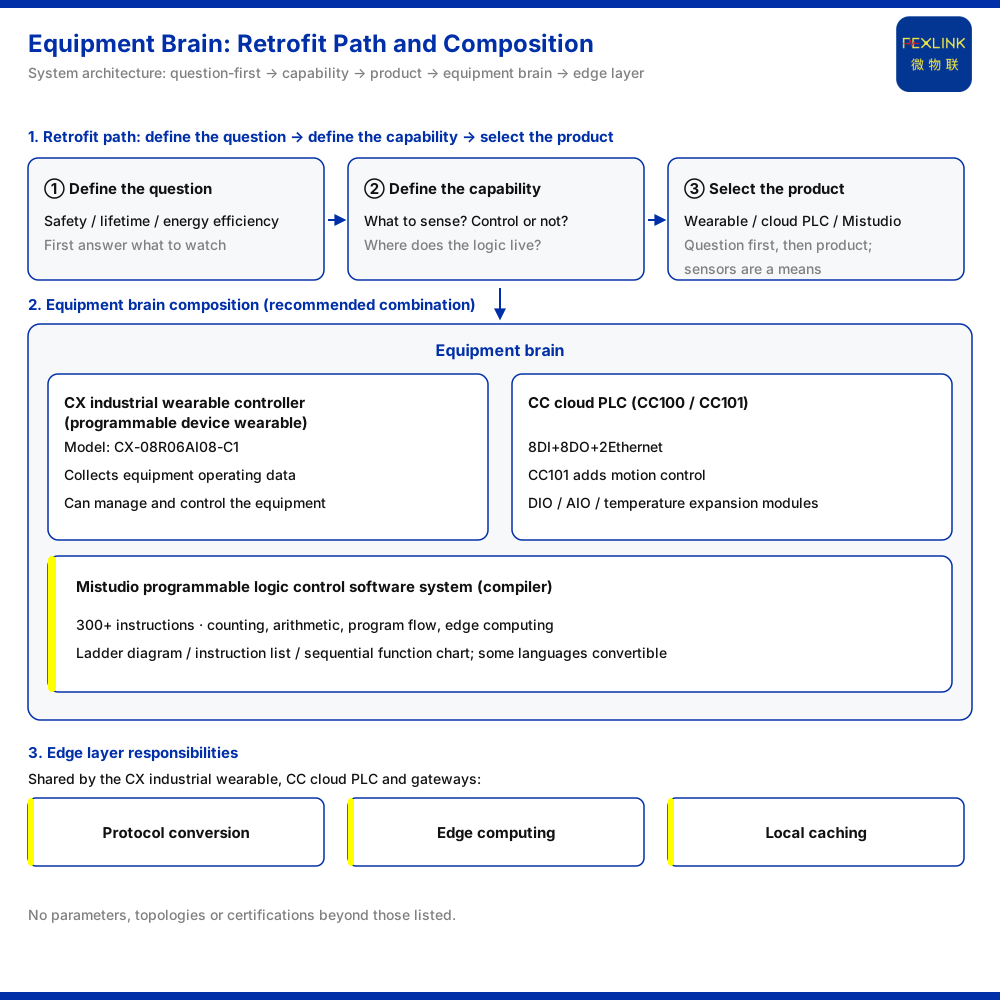
Once the question is fixed, the next step is deciding what carries it. The knowledge base maps the "industrial equipment retrofit" scenario to the "equipment brain": the recommended combination is CX industrial wearable controller / CC cloud PLC (with expansion modules) plus Mistudio. This is a scenario-to-recommended-combination mapping rather than an isolated model listing; the combination is credible only if it can answer the question raised earlier, not because the list contains many devices. The CX industrial wearable controller (programmable device wearable, e.g. CX-08R06AI08-C1) is positioned as a kind of "smartwatch" for equipment: while collecting equipment operating data it can also manage and control the equipment, so it can play both a "seeing" role and part of a "managing" role. For questions centered on observation and trend judgment, this kind of on-site acquisition and control device is usually enough to start.
4. When More Interfaces and Control Are Needed, Turn to the CC Cloud PLC
When a question requires more digital, analog, or temperature inputs, or requires a clearer control action, the retrofit focus shifts to the CC cloud PLC. The knowledge base gives two host configurations, both providing 8DI+8DO+2Ethernet, with one adding motion control on top of that base (the model correspondence between host and wearable is shown in the table). It can also fill in channels through expansion modules: DIO expansion handles digital input and output, AIO expansion handles analog input and output, and temperature expansion supports RTD and thermocouple measurement. In other words, the question comes first, then you decide whether a PLC is needed and which expansion type; an expansion module is configured because a capability is missing, not simply stocked in advance.
| Role | Model | Key capability | |:--|:--|:--| | Industrial wearable | CX-08R06AI08-C1 | Collects equipment operating data and can manage and control the equipment | | Cloud PLC host | CC100 | 8DI+8DO+2Ethernet | | Cloud PLC host | CC101 | 8DI+8DO+2Ethernet + motion control |
The models in the table only illustrate the capability correspondence between hosts and wearable; actual selection should be determined by the question list and point-count statistics, and no unlisted models or unsupplied parameters should be inferred from the table.
5. Using Mistudio to Write the Question as Logic the Equipment Can Execute
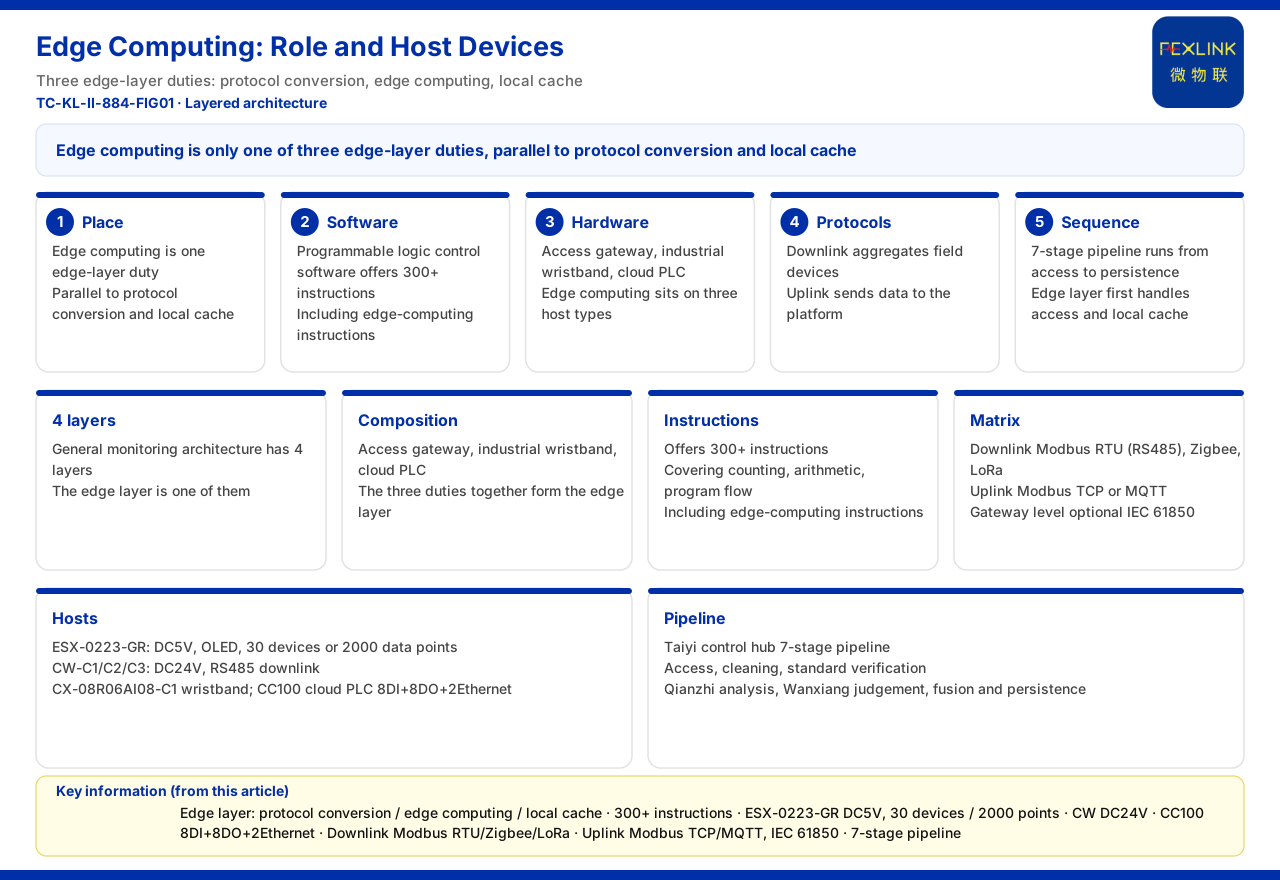
Acquiring measurements and connecting control points only establishes the conditions; what truly lets the equipment "make judgments" is writing the question as logic. Mistudio programmable logic control software system (compiler) holds self-owned intellectual property, supports ladder diagram, instruction list, and sequential function chart languages familiar to electrical engineers, provides 300+ instructions covering counting, arithmetic operations, program flow control, and edge-computing instructions, and allows some programming languages to be converted freely among one another. The knowledge base describes it as "the brain of the equipment," used for intelligent retrofit, electrical system control, data acquisition management, and remote management. For a retrofit project this means the same question can be implemented in an expression engineers already know, without being tied to a single programming form.
6. Placing the Retrofit Within a Layered Architecture
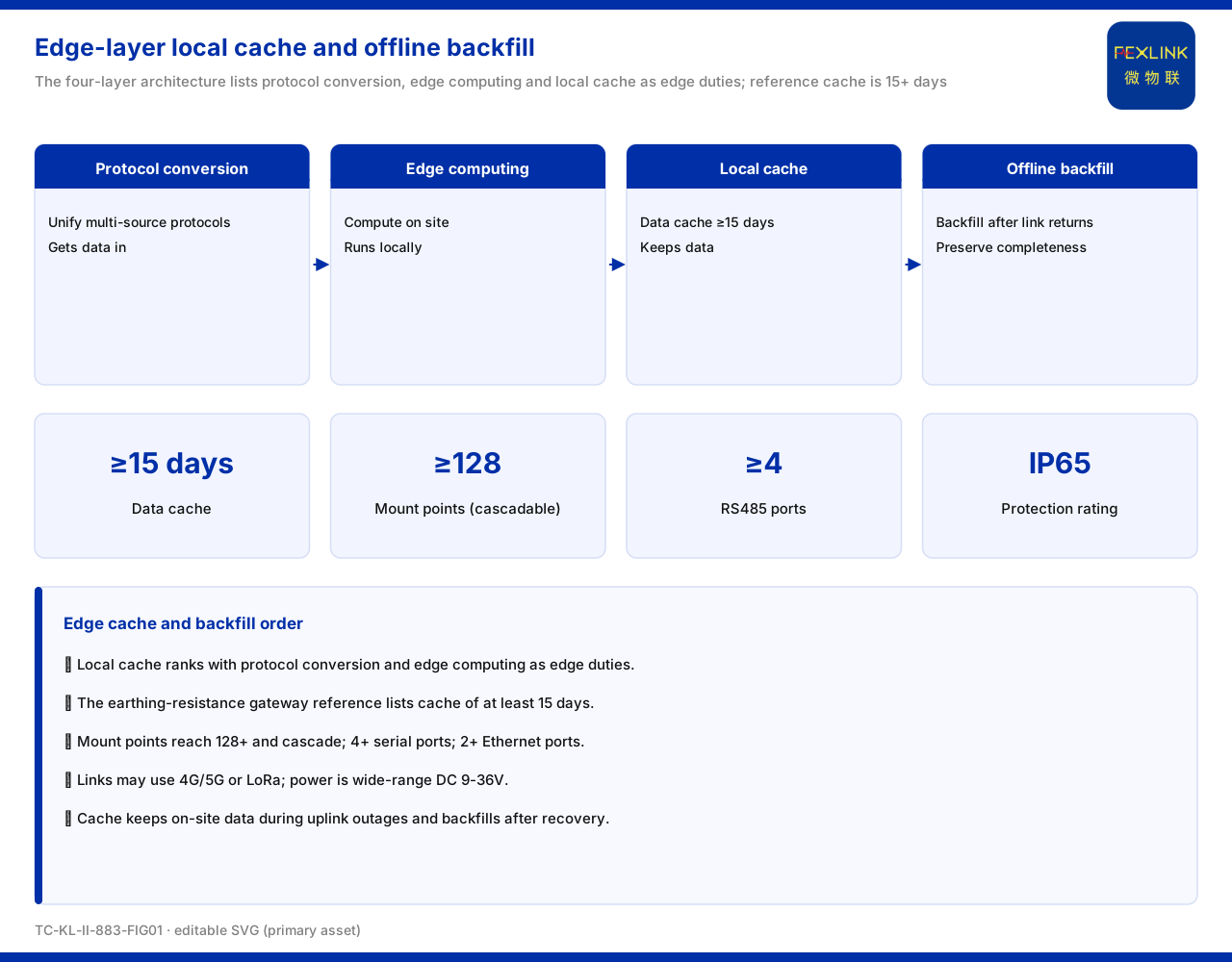
Products are not used in isolation. The knowledge base describes the monitoring system as a layered architecture, in which the edge layer is shared by various gateway devices together with the CX industrial wearable controller and the CC cloud PLC, with responsibilities for protocol conversion, edge computing, and local caching. Placing a retrofit scheme at this position answers an often-overlooked question: where data is converted, where it is computed, and where it is cached when the network drops. Clarify first that the retrofit goal is "able to sense, able to compute, able to control," then decide which device combination occupies the edge layer, and the scheme is less likely to stall as a mere equipment list.
Put another way, the layered architecture provides a "position map": first confirm which layer the retrofit lands on and which layer carries computation and caching, then return to specific devices. Once the order is clear, "which sensors to install" degrades into the last technical detail rather than the starting point of the retrofit.
7. Applicability and Limitations
First, this article discusses an orchestration method for industrial equipment retrofit, namely the sequence of "question first, product later"; that sequence is the methodological claim of this article, not a factual proposition stated directly by the knowledge base, and engineering execution still requires review against site survey and applicable standards. Second, the products, capabilities, and configurations cited are limited to those explicitly listed in the knowledge base; no unlisted models, unsupplied parameter ranges, certifications, cases, or effects may be inferred from them. Third, when a retrofit involves specific point counts, communication methods, and control logic, these should be implemented after project-level confirmation; the same set of questions may require different sensing and control combinations at different sites. Fourth, this article does not cover platform-side function extension or dedicated argumentation of system safety operation. Product naming and model correspondence follow the terminology of the knowledge base; models appear only in the capability comparison table, while the body text uses full product names or clear short names.