 YESLON Knowledge Base
Direct Answer
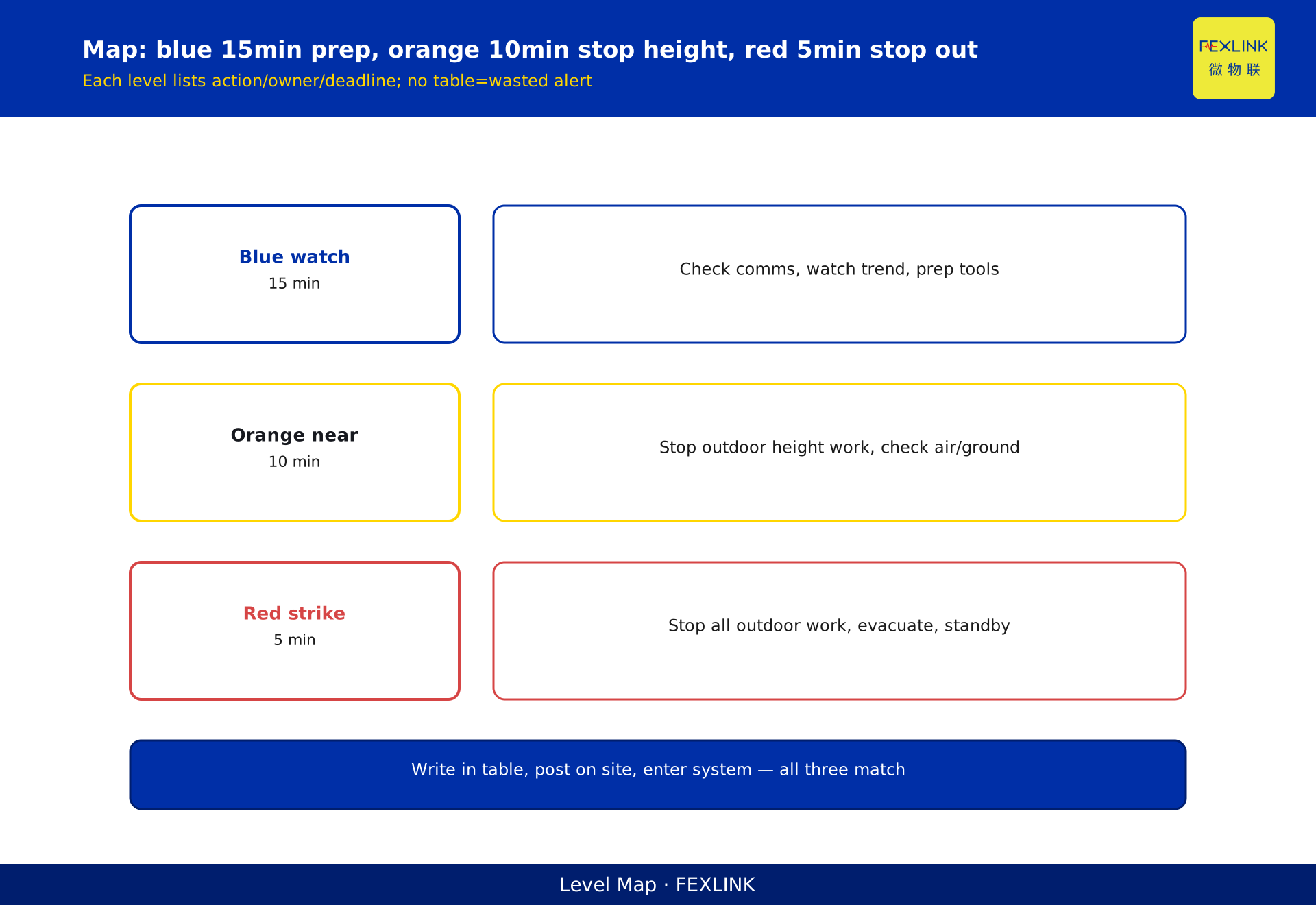
A lightning early-warning system is installed, the alarms come but nobody knows what to do — how do you make the system actually work? The answer: the value of lightning early warning lies in mapping the graded alarms to concrete actions — blue for preparation, orange for suspending outdoor work at height and checking air termination and earthing, red for stopping outdoor work with SPD/bonding on standby and post-warning re-checks; fix the warning level, responsible person, action deadline and post-review into a workflow, and the warning goes from "seen" to "closed-loop".
At a park, the lightning early-warning system was installed and alarms sounded several times in the storm season, but nobody acted — blue was ignored, orange work continued as usual. Redesign: map the warning levels to an action table, each level with its responsible person, action and deadline, and re-check SPDs and earthing uniformly after the warning. The key distinction: the warning is not "a flash on the screen" but a closed loop of "level → action → responsible person → deadline → review" — the graded warning maps to concrete actions, the actions are fixed into a workflow, and the post-review closes the loop.
Why:
- Grading mapping: blue/orange/red warnings correspond to different actions;
- Scenario differences: outdoor work/unmanned stations/hazardous areas differ;
- Review points: how to check the SPDs/earthing after the warning;
- Closed-loop design: roles, deadlines, notification channels, records.
Key insight: "The warning goes from 'seen' to 'closed-loop' — blue for preparation, orange for stopping work at height, red for stopping outdoor work; the graded mapping to actions, responsible person + deadline + post-review fixed into the workflow."
At a wind farm, the lightning warning was never responded to until a strike damaged the equipment — no graded action table, no responsible person. After adding the action table and the review workflow, the warning was actually used. Lesson: a warning without a loop is as good as not installed — the level, action, responsible person and review are all four required.
Overview: run "warning—action—review" as an executable closed loop. The lightning early-warning system solves only "knowing in advance", not "what to do after knowing" — the latter depends on workflow design. The workflow has four elements: one, the grading mapping (each warning level corresponds to a set of actions); two, the scenario differences (the same level differs across scenarios); three, the review points (how to check the SPDs/earthing after the warning); four, the closed-loop records (who did what within what deadline, how to review after). With all four, the warning goes from "seen" to "closed-loop". The five steps below expand: the grading-to-action mapping table, the scenario differences, the post-warning SPD/earthing review points, the roles/deadlines/notification channels, and the warning—action—record loop.
Why "the alarm sounds but nobody moves": the root cause of a failed warning system is usually not inaccurate alarms but missing workflows. Three typical breaks: one, "level without action" — the alarm only labels the level without stating what to do, so the field can only wait; two, "action without a responsible person" — nobody is assigned, everyone assumes someone else will handle it, and in the end nobody does; three, "action without review" — the storm passes and the SPD degradation and earthing looseness are unchecked, so the next strike damages again. The order of fixing is also these three: build the graded action table first, then assign the responsible persons and deadlines, and finally add the post-review. The three breaks behind "the alarm sounds but nobody moves" are no action, no responsible person and no review — fix in that order, a table first, people then, and a loop last.
1. Step One: The Grading-to-Action Mapping Table
Step one: turn the alarm into actions.
The mapping principle:
- Each warning level corresponds to a set of actions;
- The actions concrete and executable;
- The responsible person and deadline stated;
- Avoiding "I know but I don't know what to do".
The blue/orange/red mapping:
- Blue (warning): prepare — check communications, ready the tools, follow the trend;
- Orange (approaching): suspend outdoor work at height, check air termination and earthing;
- Red (imminent): stop outdoor work, SPD/bonding on standby, re-check after the warning.
The mapping-table example:
- One row per level: level/action/responsible person/deadline;
- The scenario differences inside the actions;
- The table is the skeleton of the workflow;
- No mapping table = the warning is not used.
How to write the mapping table: the action mapping table must be specific to "who, what, within how long", not a vague "be careful". One row per level, four columns: level, action (per scenario), responsible person, deadline. Blue example: the duty confirms communications, watches the radar trend, prepares the review tools, within 15 minutes. Orange example: suspend outdoor work at height, check the air-termination and earthing connections, notify the work crew to withdraw, within 10 minutes. Red example: stop all outdoor work, the personnel withdraw to the safe zone, the SPD/bonding on standby, the review started after the warning clears, within 5 minutes. Write the actions into the table, post them on site and enter them into the system — the three stay consistent. The mapping table has four columns: level/action/responsible person/deadline — actions specific to "who does what within how long", written into the table, posted on site and entered into the system, all three consistent.
Key insight: "The grading mapping is the skeleton of the workflow — blue for preparation, orange for stopping at height, red for stopping outdoor; every level with action/responsible person/deadline; avoiding 'I know but I don't know what to do'."
2. Step Two: The Scenario Differences
Step two: the same level, different actions across scenarios.
The outdoor-work scenario:
- Orange: suspend work at height;
- Red: stop all outdoor work;
- The personnel withdraw to the safe zone;
- The work permits linked.
The unmanned-station/far-point scenario:
- The unmanned station links automatically (remote off/load reduction);
- The dispersed points warn automatically;
- No personnel on site;
- The system handles it automatically.
The hazardous/flammable scenario:
- Warning means stopping hot work/loading;
- Stop the hazardous work before the storm;
- Stricter and earlier;
- Safety first.
The meaning of the scenario differences:
- The scenario decides the strictness of the actions;
- The same level, different scenarios, different handling;
- Safe zones/work zones distinguished;
- The actions follow the scenario.
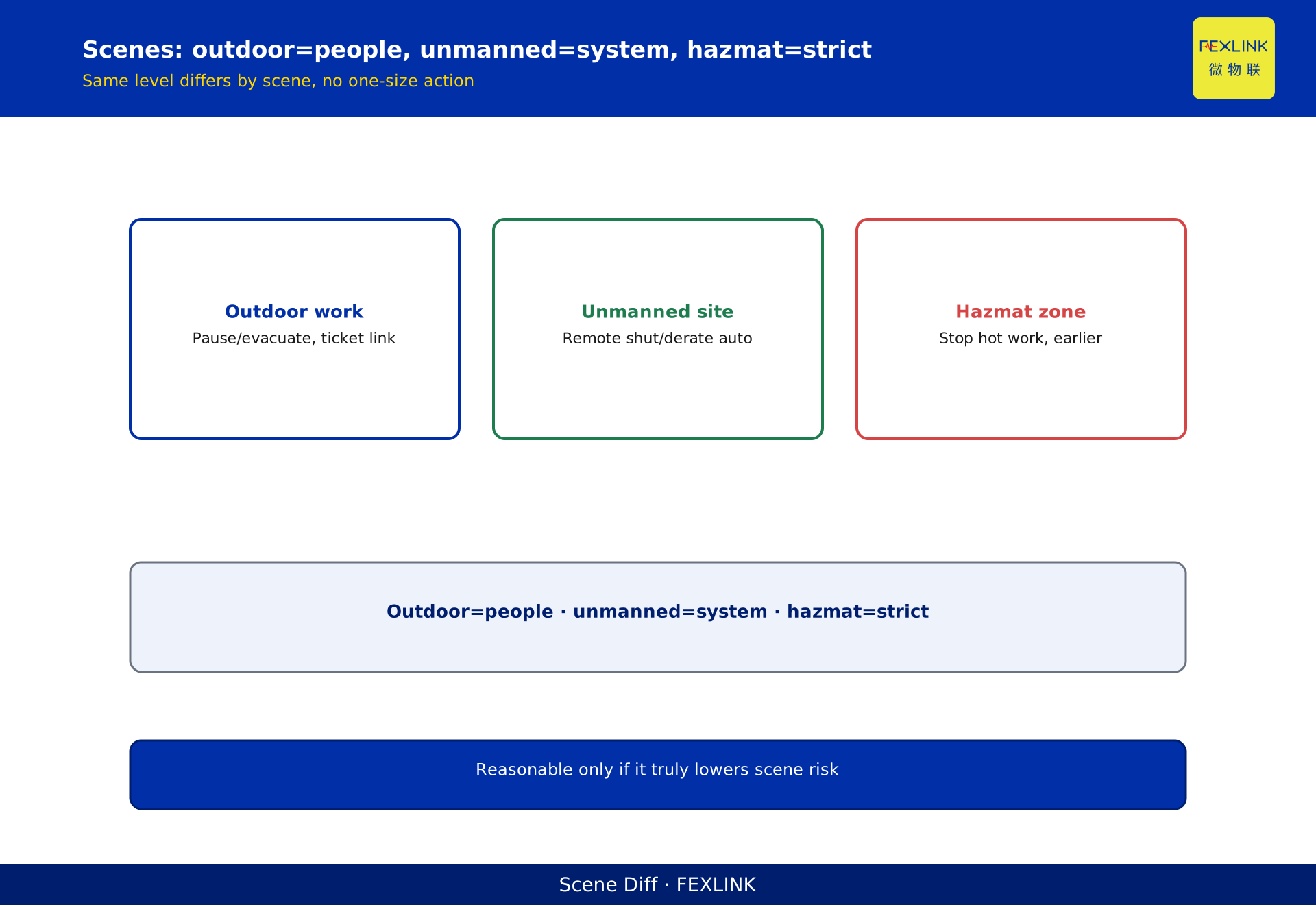
How the scenario differences land: the scenario differences are not a second table but the applicable scenario marked in the action column. The outdoor-work scenario focuses on "people" — suspending work, withdrawing personnel, work permits linked, the actions around personnel safety. The unmanned-station scenario focuses on "systems" — remote off/load reduction automatically, no personnel needed, the actions around automatic handling. The hazardous-area scenario focuses on "stricter" — warning means stopping hot work/loading, responding one level earlier than normal scenarios, the actions around hazard control. The standard for a reasonable action: does it actually reduce the risk of that scenario. The scenario differences land in the action column — outdoor manages people, unmanned stations manage systems, hazardous areas stricter; an action is reasonable only if it reduces that scenario's risk.
Key insight: "The scenario decides the strictness — outdoor work pauses by level, unmanned stations link automatically, hazardous areas stricter and earlier; the actions follow the scenario, not 'one size fits all'."
3. Step Three: The Post-Warning SPD/Earthing Review Points
Step three: what to check after the storm.
The SPD review points:
- The SPD states of every stage (leakage/temperature/telemetry);
- The operation records (which stage discharged);
- Degradation found early (relating to KD-0161);
- The FS SPD monitor online.
The earthing review points:
- The earthing resistance/connection states;
- The bonding connections loose or not;
- Review the priority points after the storm (relating to KD-0190);
- The FR monitor online.
The review timing:
- Review immediately after the warning clears;
- The key points first after the storm;
- The high-current events must be checked;
- The results into the records.
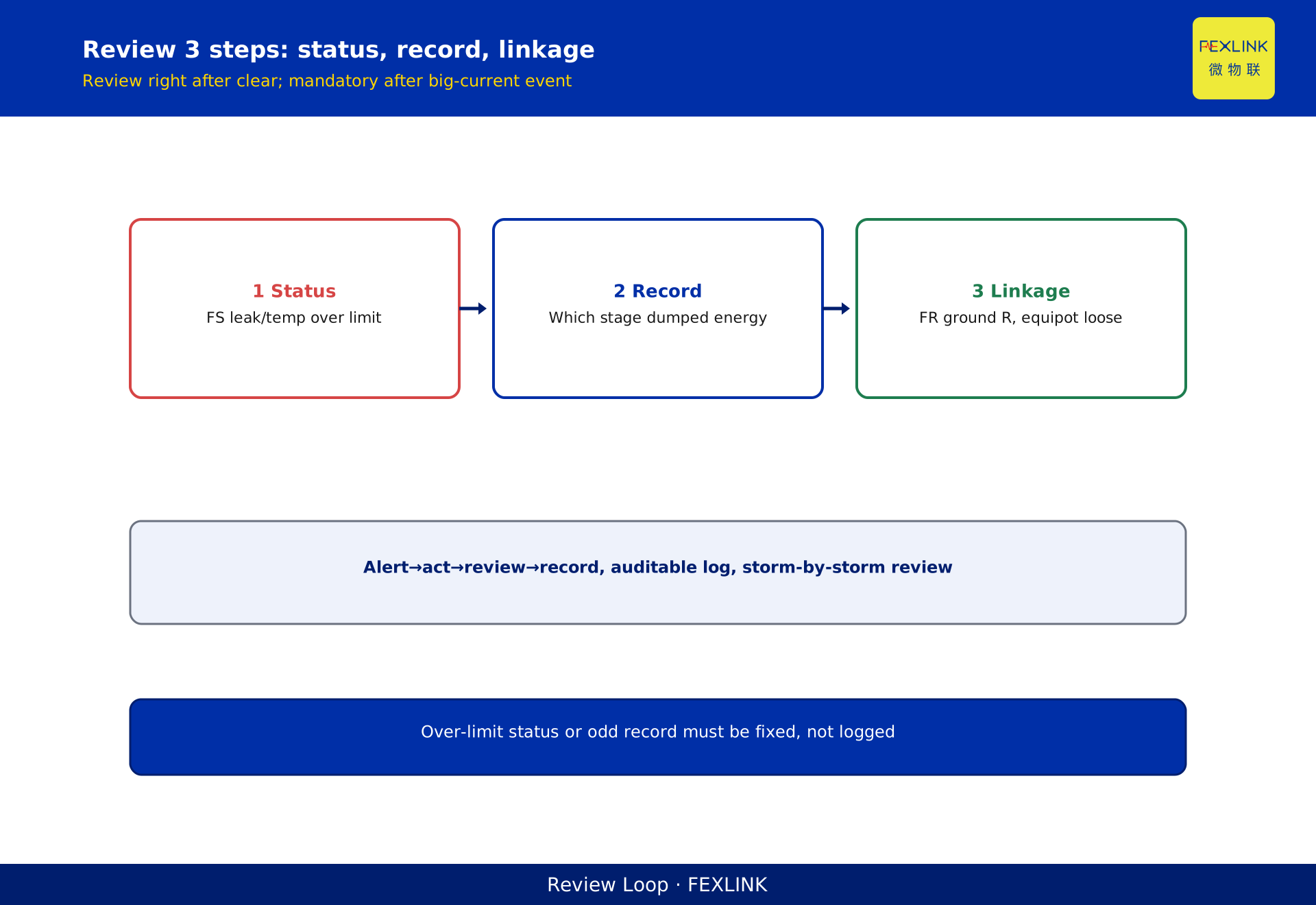
The review order and judgment: the review goes "state first, then records, then linkage". Step one, the states — FS/ESM for the leakage, temperature and telemetry of every SPD stage (relating to KD-0162). Step two, the records — which stage took the main discharge, which path the current took (relating to the surge-record reading of KD-0128). Step three, the linkage — the earth resistance (FR online) and the bonding connections loose or not (relating to KD-0193). The standard for the results: an abnormal state or record means arranging replacement/rectification, not just recording. Review in three steps: states first (FS leakage/temperature), records next (which stage discharged), linkage last (FR earthing/bonding); anomalies must be rectified, not just recorded.
Key insight: "After the storm check the SPDs and earthing first — FS for the states/operation records, FR for the earthing resistance; degradation known early; review immediately after the warning clears and after high-current events."
4. Step Four: Roles, Deadlines and Notification Channels
Step four: who does it, how long, how to be notified.
The role design:
- Every level names its responsible person;
- The actions have owners;
- The review has an owner;
- Responsibility to the person.
The deadline design:
- Every level action states its deadline;
- The orange/red response deadlines short;
- The review deadline clear;
- Overdue prompts.
The notification channels:
- Graded notification (SMS/phone/screen);
- The responsible person notified first;
- The duty/safety officers in sync;
- Reliable, no omission.
The meaning of the loop:
- Roles + deadlines + channels, the three-piece set;
- Actions done by someone, within a deadline, notifiable;
- Overdue traceable;
- The warning truly lands.
The reliability design of the notification channels: the channels must be "graded + redundant + confirmed". Graded: blue SMS, orange SMS+phone, red SMS+phone+on-site sound/light. Redundant: the main channel (platform push) plus the backup (phone duty), the backup taking over when the main fails. Confirmed: the action confirmed on the platform after completion, overdue without confirmation escalates the notification. Three questions for reliable channels: can the responsible person always receive it (redundancy)? Do they know what to do after receiving (the action table)? Is there a record after doing it (confirmation)? All three "yes" means the channel is reliable. The three elements of the notification channels: graded (blue SMS/orange phone/red sound+light) + redundant (main and backup) + confirmed (overdue escalation) — all three questions "yes" means reliable.
Key insight: "The three-piece set of roles + deadlines + channels — every level action has a responsible person, a response deadline and reliable notification without omission; overdue traceable; the warning truly lands."
5. Step Five: The Warning—Action—Record Loop
Step five: record the process and review it.
What to record:
- The warning time/level;
- The actions/responsible persons/completion times;
- The review results (SPD/earthing);
- The anomalies and rectifications.
How to record:
- The system records the warnings and actions automatically;
- The review results entered manually/automatically;
- The records stay on the platform;
- The loop auditable.
How to review:
- Review every storm event;
- Whether the actions were timely and effective;
- Whether the found anomalies were rectified;
- The workflow continuously optimized.
Key insight: "The warning—action—record loop — warnings/actions/reviews all leave traces; review every storm, follow up the rectifications; the workflow runs smoother."
6. Product Implementation: From the Warning to the Loop
WeiWuLian products manage the lightning-warning loop:
- FG Lightning-Protection Intelligent Gateway: the graded warnings in, reliable channels;
- FS SPD Monitor: the SPD states reviewed online after the storm;
- FR Earth-Resistance Monitor: the earthing state reviewed online;
- The closed-loop workflow: level → action → responsible person → review → record.
The design principle in one sentence: "Blue for preparation, orange for stopping at height, red for stopping outdoor — FG brings the warnings in, FS/FR manage the reviews; level/action/responsible person/deadline/record all closed-loop; the warning goes from 'seen' to 'closed-loop'."
7. Common Workflow Misjudgments
- "Installed without a workflow": the warning only flashes on the screen. Result: nobody responds. Correct: map the grades to actions.
- "One-size-fits-all actions": ignoring the scenario differences. Result: not strict where it should be. Correct: set the actions per scenario.
- "No review after the storm": ignoring the SPDs/earthing. Result: degradation unknown. Correct: review after every warning.
- "No responsible person": ignoring the roles/deadlines. Result: nobody does the action. Correct: responsibility + deadline.
- "The process unrecorded": ignoring the review. Result: problems not rectified. Correct: records kept + review optimizing.
Scope and Limitations
This article gives the workflow design linking lightning early warning to work suspension and SPD inspection (grading mapping, scenario differences, review points, roles/deadlines/channels, closed-loop records), applicable to the warning workflows of outdoor work/unmanned stations/hazardous areas. The exact grading and requirements follow the on-site safety specifications and the manufacturers' data; this article explains only the workflow design logic and points. All cases are anonymized (a park, a wind farm) and do not refer to any specific customer.
Frequently Asked Questions
Linking Lightning Early Warning to Work Suspension and
the value of lightning early warning lies in mapping the graded alarms to concrete actions — blue for preparation