 YESLON Knowledge Base
Direct Answer
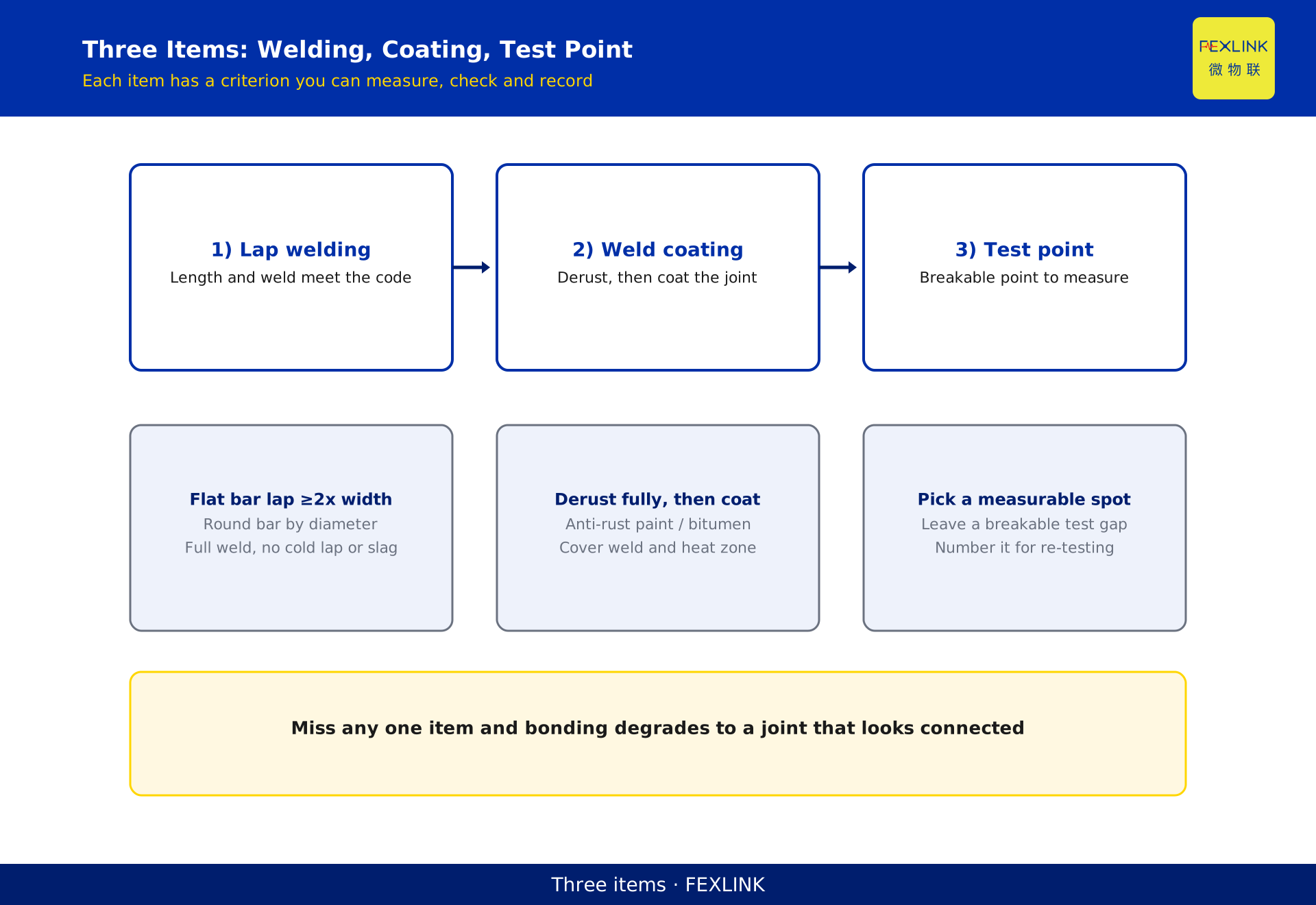
The bonding and earth-main drawings look good, but how are the on-site welding, anti-corrosion and test points done to be qualified? The answer: the field work on bonding bars and earth mains must implement three points — the lap-weld length and a full weld, anti-corrosion treatment on the welds, and earth test points reserved where easy to measure; unreliable connections are the main on-site cause of bonding failure, and the acceptance should check these three points item by item rather than looking only at the drawing.
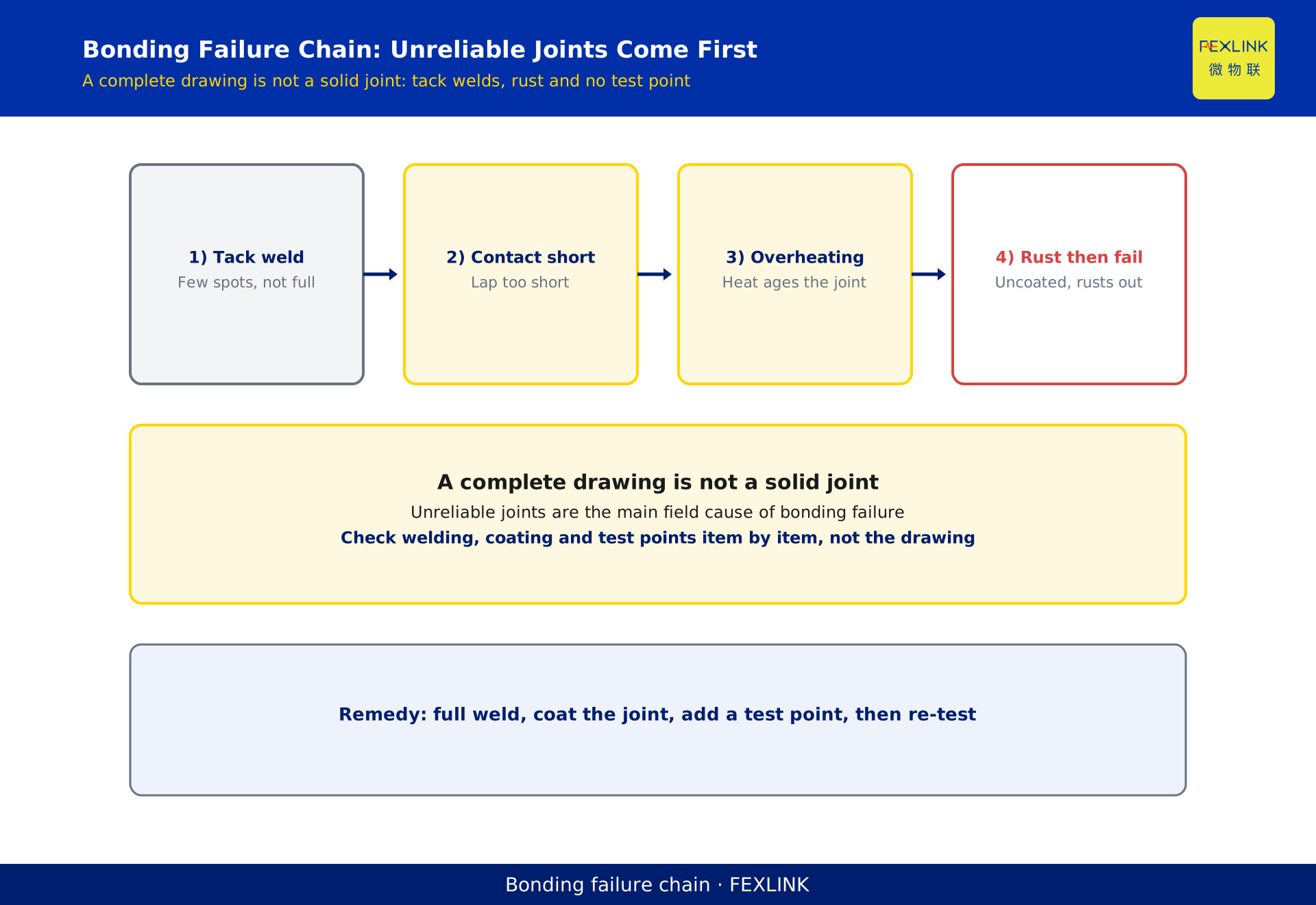
On a project the bonding drawings were complete, but on site the lap welds were only tacked in two or three spots with cold welds, and no anti-corrosion was applied to the welds; a year later the connection points rusted, the bonding was "visually connected but not actually connected", and on a strike the potential difference between equipment hurt someone. After the rectification — full welds + anti-corrosion + reserved test points — the re-measurement passed. The key distinction: the main on-site cause of bonding failure is an unreliable connection — the lap-weld length and weld, the anti-corrosion on the welds, and the reserved test points directly decide "connected or not"; the acceptance checks these three item by item, not just the drawing.
Why:
- The lap weld: the length and the weld meet the standard, no cold welds;
- Anti-corrosion: rust on the welds is the long-term failure source;
- The test points: reserved where easy to measure, re-measurable and acceptable;
- The on-site spot checks: the connection reliability proven by measurement.
Key insight: "An unreliable connection is the main on-site cause of bonding failure — the lap-weld length/weld, the weld anti-corrosion and the reserved test points checked one by one; not just the drawing."
At a park the earth-main welds had no anti-corrosion; three years later the welds rusted over a large area and the earth-resistance readings rose year by year. Lesson: anti-corrosion is not an option — without it on the welds, the connection eventually fails, and the bonding goes from "connected" to "not connected".
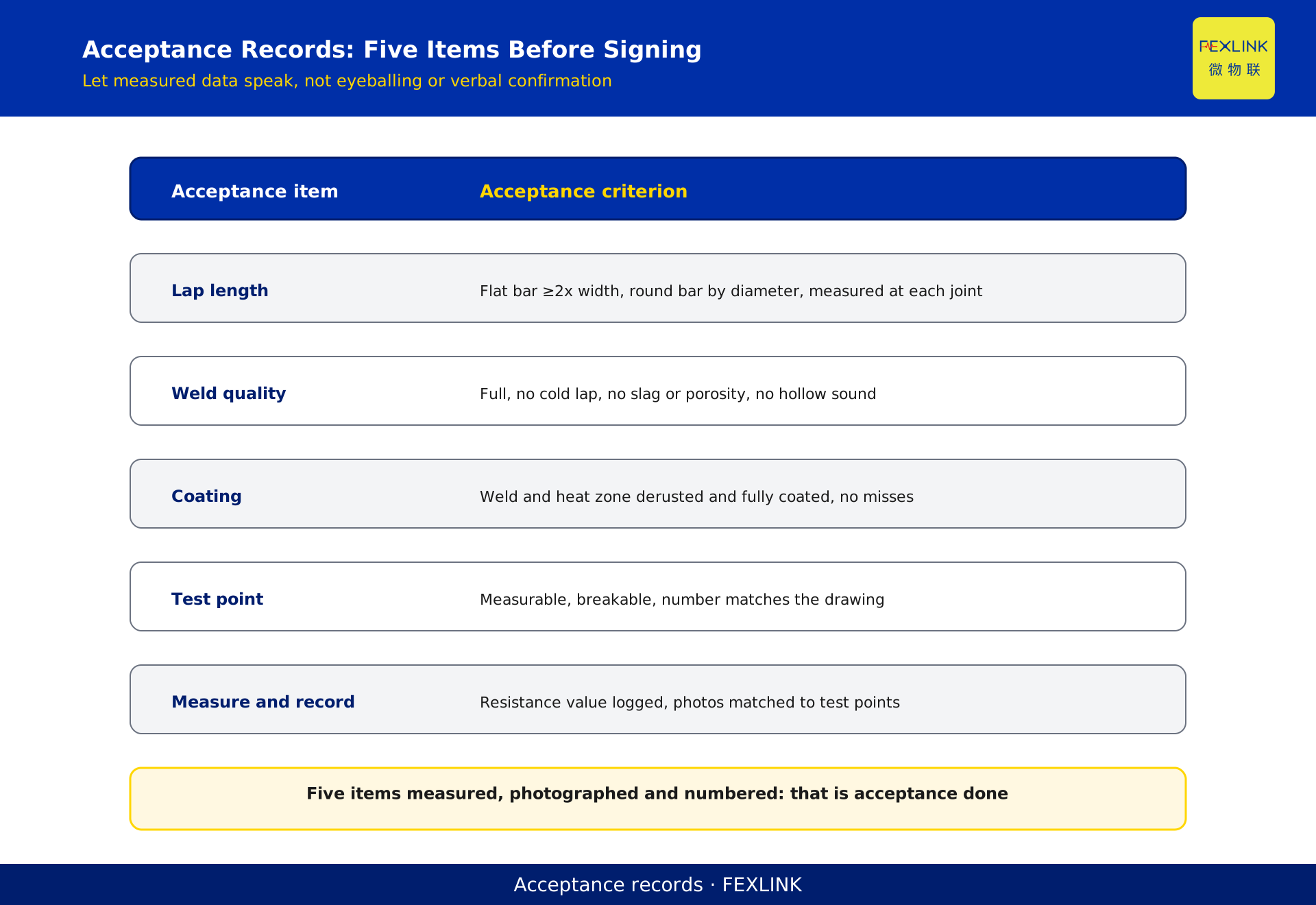
Overview: run "lap weld → anti-corrosion → test points → spot checks → acceptance evidence" as one executable acceptance sheet. For bonding bars and earth mains, the drawing is only the beginning; the on-site connection quality decides everything. An unreliable connection — cold welds, rust, no test points — is the most common on-site cause of bonding failure, and it often only exposes itself at a strike or a fault. The work and acceptance watch five points: the lap-weld length and a full weld, anti-corrosion on the welds, the reserved positions of the test points, the on-site spot checks of the connection reliability, and the measured acceptance with evidence. The five steps below expand: the lap-weld length and weld requirements, anti-corrosion on the welds and connections, the reserved positions of the test points, the on-site spot checks of the connection reliability, and the measured acceptance with evidence.
The material and tool checks before construction: check three things before starting to avoid rework. One, the material — the flat/round steel specifications, the galvanized layer, the length consistent with the design, the strip width and thickness meeting the standard; two, the welding conditions — the welder current adjustable, the electrode type matched, the operator certified, no welding in bad weather (rain/snow/wind); three, the measuring tools — an earth-resistance tester, a multimeter and a tape on site, measuring while welding. A bonding bar with unqualified material is an ineffective project even when welded well. The three pre-construction checks: the material specifications and the galvanized layer, the welding conditions and the certified operator, the measuring tools on site — with unqualified material, even good welding is an ineffective project.
1. The Lap-Weld Length and Weld Requirements
Step one: the weld is the "lifeline" of the bonding.
The lap-weld length:
- The flat-steel lap length per the standard (≥ twice the width, etc.);
- The round-steel lap by the diameter multiple;
- Insufficient length = insufficient connection area;
- The current path restricted.
The weld requirements:
- A full weld, no cold welds;
- Three-side/two-side welding per the standard;
- No slag, no pores;
- A smooth transition at the weld.
Why tack welding is not acceptable:
- A small contact area;
- Local overheating under the lightning current;
- Insufficient mechanical strength;
- The bonding is as good as not done.
Key insight: "The weld is the lifeline — the lap length per the standard (each multiple for flat/round), a full weld without cold welds; a tack weld has a small contact area and overheats under the lightning current — as good as not done."
The routing and fixing of the strip: besides the weld itself, the routing of the bonding strip also affects the effect. One, the strip follows the shortest path connecting the equipment/metal members, no detours (a detour = more impedance, a larger potential difference under the lightning current); two, the strip is fixed firmly, with even spacing, not hanging or shaking (a hanging strip may swing and loosen under the electrodynamic force of the lightning current); three, protective conduits at the wall/floor penetrations to avoid mechanical damage. The routing and fixing affect "connected or not" just as much as the weld. Routing and fixing are equally important: the strip on the shortest path, firmly fixed without hanging, conduits at the penetrations — a detour and hanging both make the connection nominal.
2. Anti-Corrosion on the Welds and Connections
Step two: anti-corrosion decides the long-term reliability.
Why anti-corrosion:
- The welds are the corrosion weak points;
- Rust → contact resistance rising;
- The connection failing gradually;
- The bonding going from "connected" to "not connected".
The anti-corrosion practice:
- Derusting after welding;
- Anti-corrosion paint/bituminous paint;
- Enhanced anti-corrosion for the buried parts;
- Anti-rust on the connecting bolts.
The acceptance checks:
- The anti-corrosion coverage complete on the welds;
- No bare rust points;
- The buried connections treated in place;
- Periodic re-coating.
Key insight: "Anti-corrosion decides the long-term reliability — the welds are the corrosion weak points and rust raises the contact resistance; derust and coat after welding, strengthen the buried parts, check the coverage complete at the acceptance."
The handling of bolted connections and detachable points: not every connection must be welded — positions that need to be opened for testing or maintenance later (e.g. test points, disconnecting clamps) use bolts, but three things must be handled: one, derust the contact surfaces and apply a conductive paste for a low contact resistance; two, add spring washers against loosening, the bolt torque up to the standard; three, the bolted connections are also protected against corrosion. The bolted-connection checks: cannot be turned by hand, the contact surface bright and rust-free, the pressed surfaces fitting. Three treatments for the bolted connections: derust the surfaces and apply a conductive paste, spring washers against loosening, anti-corrosion at the connections — cannot be turned by hand, the surface bright and rust-free to be qualified.
3. The Reserved Positions of the Test Points
Step three: what cannot be measured cannot be verified.
Why test points:
- Bonding/earthing must be measurable;
- Without a test point, re-measurement is impossible;
- No measured basis for the acceptance;
- No entry point for later maintenance.
The test-point requirements:
- Reserved where easy to measure;
- A visible position with labels;
- The earth resistance measurable (relating to FR);
- The disconnecting/test clamp per the standard.
The position selection:
- Both ends of the mains and the branches;
- At the building entrances;
- Near important equipment;
- Reachable by the measuring tools.
Key insight: "What cannot be measured cannot be verified — test points reserved where easy to measure, labelled, the earth resistance measurable (relating to FR); set at both ends of the mains, the building entrances and near important equipment."
4. The On-Site Spot Checks of the Connection Reliability
Step four: proven by measurement.
The spot-check methods:
- Hand pull/tap check of the welds;
- A multimeter for the connection resistance;
- An earth-resistance tester for the reading;
- The connection points gone through one by one.
The common disqualifications:
- Cold welds/slag;
- Missing anti-corrosion and rust;
- Missing test points;
- Loose connecting bolts.
The spot-check priorities:
- All main connection points covered;
- The branch points sampled;
- The hidden work verified before covering;
- Disqualifications reworked on the spot.
The four specific actions of the spot check: a spot check is not "a glance" but four repeatable actions. One, the tap — tap the weld lightly with a small hammer, judging a cold weld by the sound (a cold weld sounds dull, a solid one crisp); two, the pull — apply a moderate pull to the strip and the terminals, looking for looseness and displacement; three, the measure — measure the connection-point resistance with a multimeter/earth-resistance tester against the qualified value; four, the look — visually check the rust and the coverage. Go through the four actions in the "tap → pull → measure → look" order, every main point, the branch points sampled by ratio. The four spot-check actions: tap (the cold-weld sound) → pull (the looseness) → measure (against the qualified value) → look (the rust) — all main points, the branches sampled by ratio.
Key insight: "Proven by measurement — tap/pull check the welds, a multimeter measures the connection resistance, an earth-resistance tester takes the reading; cold welds, rust, missing test points and loose bolts are all disqualifications."
5. The Measured Acceptance with Evidence
Step five: the acceptance must leave evidence.
The measured contents:
- The lap lengths measured against the standard;
- The welds by sight and tap;
- The anti-corrosion coverage checked;
- The earth resistance measured and recorded.
The evidence requirements:
- The measured data recorded;
- Photos kept (welds/anti-corrosion/test points);
- Photos of the hidden work before covering;
- The test report archived.
The monitoring support:
- The FR earth-resistance monitor online;
- The earth changes with a trend;
- Degradation found early;
- Cross-verified with the off-line readings.
The "verify first, then cover" of the hidden work: earth mains are mostly buried or cast into concrete, and once hidden they cannot be seen — so the hidden work must be verified with evidence before covering, the easiest step to miss and the most costly. The principle is "verify first, then cover": before backfilling/pouring, photograph the welds, the anti-corrosion layer and the strip routing, measure and record, and only after the supervisor/owner confirms may it be covered. Missing this step, a buried bonding strip with a problem can only be dug out — at a high cost. The hidden work is verified first and covered after: photos + measurement + confirmation before backfilling, covered only when qualified — missing this step, buried problems mean digging it out and redoing.
Key insight: "The acceptance measured with evidence — the lap length/weld/anti-corrosion/earth resistance measured item by item, the data and photos archived; the FR online cross-verified with the off-line readings."
6. Product Implementation: Connection Qualified + Online
WeiWuLian products land the bonding work effect into verifiable monitoring:
- FR Earth-Resistance Monitor: the earth resistance online;
- Test-point integration: the monitor connected to the reserved test points;
- The construction standard landed: the weld/anti-corrosion/test point into the acceptance sheet;
- The data traceable: the trend cross-verified with the off-line.
The design principle in one sentence: "An unreliable connection is the main cause of bonding failure — the lap weld, anti-corrosion and test points accepted one by one; the FR online keeps the earthing always visible and verifiable."
7. Common Understanding Misjudgments
- "The drawing right is enough": ignoring the field. Result: cold welds/rust unknown. Correct: check the three item by item.
- "Tack welding is convenient": ignoring the area. Result: the connection nominal. Correct: full welds.
- "Anti-corrosion can be skipped": ignoring the rust. Result: connected becomes not. Correct: coat after welding.
- "No test points": ignoring the measurement. Result: no re-measurement. Correct: reserve where easy to measure.
- "Installed, done, no monitoring": ignoring the degradation. Result: failure unknown. Correct: the FR online.
Scope and Limitations
This article gives the acceptance points for the field work on bonding bars and earth mains (the lap-weld length and weld, the weld anti-corrosion, the reserved test points, the spot checks, the acceptance evidence), applicable to bonding work acceptance and checks. The specific values (lap lengths/anti-corrosion materials) follow GB 50057-2010 and the related standards; this article explains only the work-acceptance logic and the check actions. All cases are anonymized (a project, a park) and do not refer to any specific customer.
Frequently Asked Questions
Field Work on Bonding Bars and Earth Mains
the field work on bonding bars and earth mains must implement three points — the lap-weld length and a full weld, anti-corrosion treatment on the welds