 YESLON Knowledge Base
Direct Answer
Residual current is rising, but the insulation-resistance test still passes — whom do you trust? The answer: the two indicators measure insulation health at different scales — residual current is continuous leakage at operating voltage, sensitive to moisture and distributed capacitance; insulation resistance is overall resistance under low-voltage DC, stable but insensitive. When leakage rises while insulation resistance still passes, that is usually early localized deterioration — watch the leakage trend, do not wait for insulation resistance to fall below its threshold.
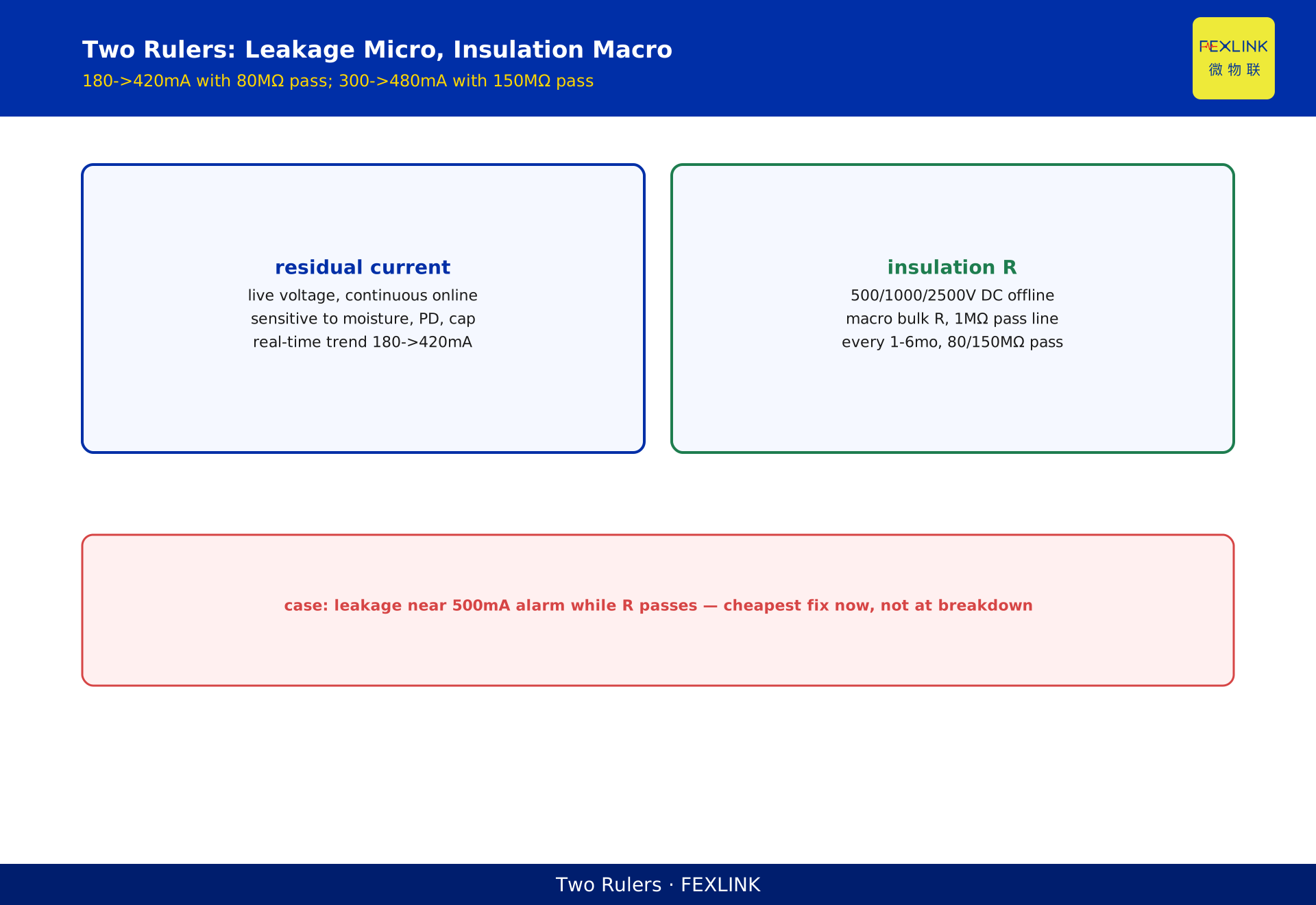
A distribution room's cable circuit drifted from 180 mA to 420 mA residual current, near the 500 mA alarm line. An insulation-resistance test with a 2500 V megger read 80 MΩ — "fully qualified" (the standard asks for ≥1 MΩ). Operations were confused: leakage rising this far while the insulation test passes — is there a problem or not? A leakage-trend analysis answered it: the rise started with the rainy season and continued for 6 weeks, with daily variation strongly correlated to humidity — an early signal of a moist cable termination. Insulation resistance cannot see it while "the bulk is still hard," but leakage catches it. Conclusion: a passing insulation resistance does not mean the insulation is fine; the leakage trend leads the insulation-resistance decline.
Because:
- Different measurement principles: insulation resistance uses low-voltage DC to measure bulk resistance — "macro insulation hardness"; residual current measures continuously at operating voltage — "micro leakage paths";
- Different sensitivity: leakage is extremely sensitive to moisture, partial discharge, and capacitance changes; insulation resistance cannot "feel" these early changes;
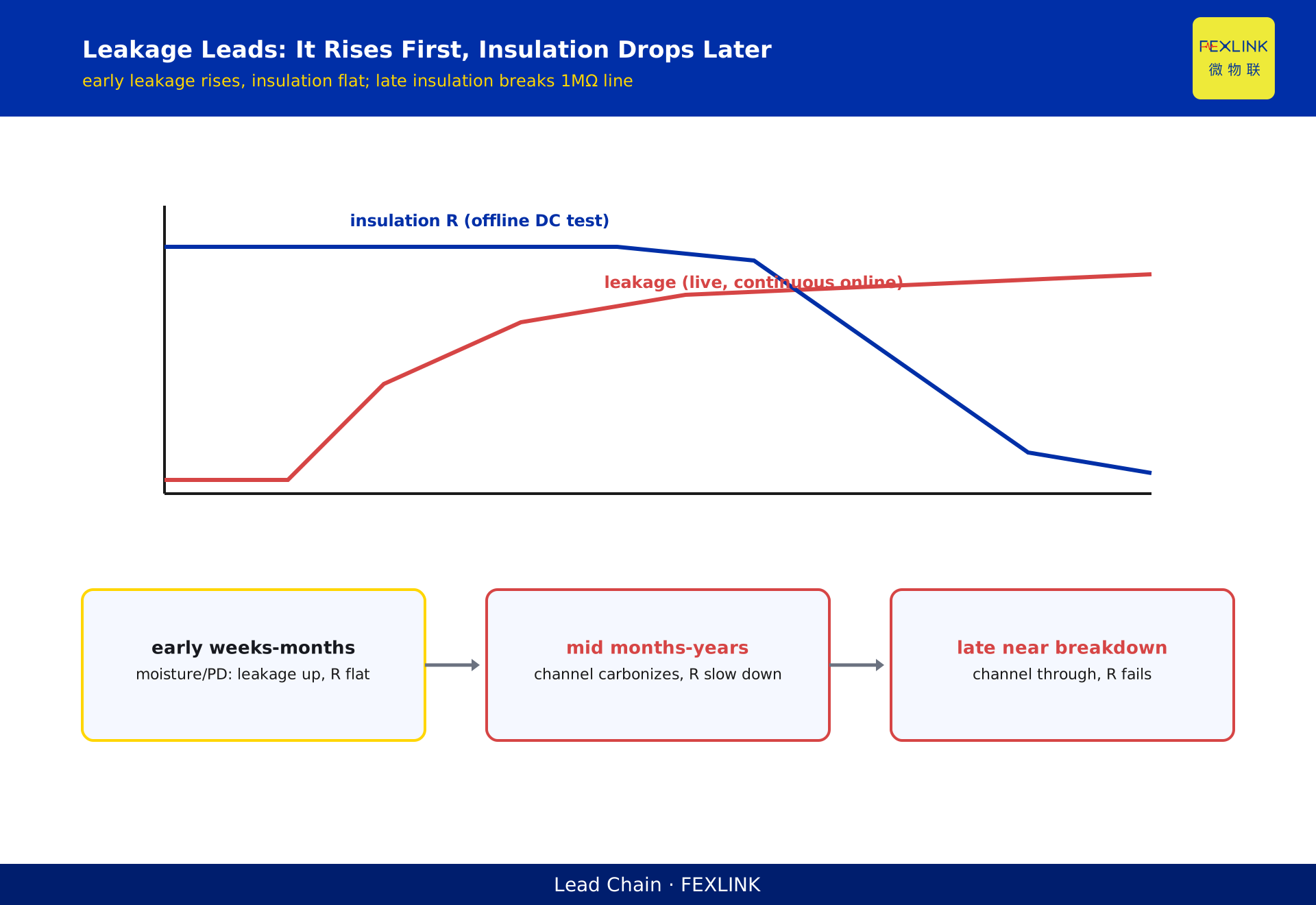
- Different sequence: early localized deterioration → leakage rises first → deterioration spreads → insulation resistance falls only later — leakage is the leading indicator;
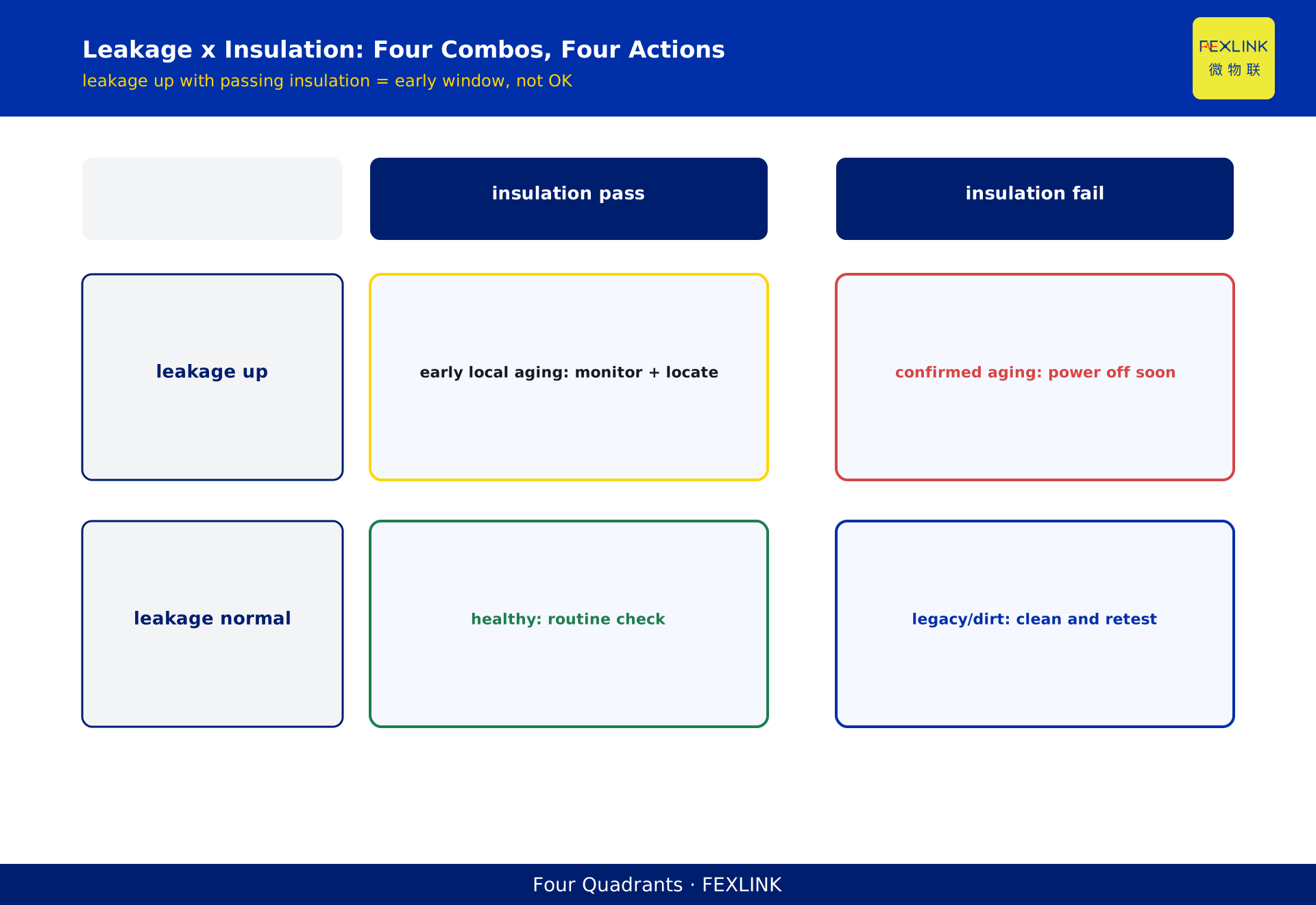
- Cross matrix: leakage up + insulation pass = early deterioration (watch); leakage up + insulation fail = confirmed deterioration (act now); both normal = healthy; leakage flat + insulation pass = normal.
Key insight: "insulation resistance passes" answers "is the bulk still hard"; "leakage is rising" answers "is a leak path forming." One is the checkup report; the other is the thermometer — the thermometer moves first, the report catches up later.
A data center's UPS output cable showed residual current climbing from 300 mA to 480 mA over 5 days (alarm at 500 mA), while an insulation-resistance test still read a passing 150 MΩ. The platform's leakage-trend + humidity-correlation analysis classified it as "early moisture signal in the cable termination"; infrared and PD re-checks confirmed moisture inside the termination, replaced during a maintenance window — relying only on insulation resistance would have found it a month or two before breakdown.
1. Why the Two Measurements Differ in Principle
To decide "whom to trust," first clarify what each one measures:
Residual current (leakage) — continuous leakage at operating voltage:
- The vector sum of three-phase current is non-zero — that is residual current;
- Measured under real operating voltage (e.g., 220 V/380 V/10 kV), so the leak path is truly energized;
- Captures: moisture, insulation aging, partial discharge, distributed-capacitance changes, harmonic superposition;
- Continuous online measurement — trends are visible.
Insulation resistance — bulk resistance under low-voltage DC:
- A megger applies 500 V/1000 V/2500 V DC and measures overall insulation resistance;
- Reflects the insulation medium's macroscopic resistance (volume + surface resistance);
- Sensitive to "bulk deterioration," insensitive to "early localized paths";
- Offline measurement, periodic checks (typically every 1–6 months).
Key differences:
- At operating voltage, the leak path is driven by the electric field, so even tiny deterioration shows; under low-voltage DC, many early paths are "out of reach";
- Residual current is "real-time + trend"; insulation resistance is "point-in-time + pass line."
Key insight: it is not that one is more accurate — they are different rulers: one measures micro dynamics, the other macro state. Early stage, watch leakage; middle stage, watch insulation resistance — complementary, not substitutes.
2. Why the Two Can Move in Opposite Directions
"Leakage up, insulation passing" is not a contradiction; it is the normal process of insulation deterioration:
The time lag in the deterioration process:
- Early (weeks–months): moisture, partial discharge, surface contamination — micro leak paths form; leakage starts rising; insulation resistance is basically unchanged;
- Middle (months–years): paths extend and carbonize — leakage rises clearly; insulation resistance starts a slow decline;
- Late (near breakdown): paths punch through — leakage nears the alarm or trips; insulation resistance falls below its threshold.
Why insulation resistance is "slow":
- The DC low voltage does not excite early conduction mechanisms (moisture adsorption, PD) strongly;
- Bulk insulation resistance is a parallel combination; early deterioration is a tiny fraction, diluted by the healthy part;
- The pass line (≥1 MΩ) is loose — even with local deterioration, the bulk stays far above it.
Why leakage is "fast":
- Operating voltage is high; the field is strong; a tiny path leaks immediately;
- Unbalance, capacitance, and harmonics are all captured;
- Continuous measurement makes the trend obvious.
Key insight: a passing insulation resistance is a "passing line," not a "health line." Between passing and healthy, leakage has already traveled a long road — a road only leakage can see.
3. Leakage Trend Leads Insulation-Resistance Decline
"Leading" is the most valuable rule in this relationship:
The lead chain:
- Moisture/deterioration starts → leakage rises (sensitive) → continues for weeks to months → deterioration spreads → insulation resistance begins to fall → continues → breakdown/trip.
Engineering meaning:
- Leakage rising while insulation passes = the best intervention window: the defect is young; handling cost is lowest (e.g., drying, replacing a termination);
- Waiting for insulation resistance to break its threshold = already late: usually near breakdown; only emergency handling remains;
- Leakage's lead time can be weeks to months — that is the value of online leakage monitoring: turning "after-the-fact failure" into "before-the-fact window."
How to use the trend:
- Record the leakage baseline (seasonal change is normal — e.g., a rainy-season rise across the fleet);
- Look at the "season-adjusted trend": steady one-way rise, accelerating rise → watch;
- Correlate with humidity/load: strong humidity correlation → moisture type; strong load correlation → overheating type; strong time correlation (steady rise) → aging type.
Key insight: leakage is the thermometer; insulation resistance is the checkup report. The thermometer alarms first, the report confirms later — do not wait for the report to act.
4. The Four Combinations in the Cross Matrix
Combine the two indicators into four states:
| Residual current | Insulation resistance | Judgment | Action |
|---|---|---|---|
| Normal | Pass | Healthy | routine patrol |
| Rising | Pass | early localized deterioration | tighten monitoring + re-check locate |
| Rising | Fail | confirmed deterioration | outage handling soon |
| Normal | Fail | legacy / surface contamination | clean re-test / evaluate replacement |
Note:
- The "leakage rising + insulation passing" combination is the most overlooked — each single item "makes sense": leakage says trouble, insulation says fine, and many people choose to believe "fine";
- Correct posture: when leakage rises, a passing insulation resistance does not rule out a problem — it marks the early window;
- "Leakage normal + insulation fail" is mostly: moisture after long shutdown, surface contamination, legacy issues — confirm with on-site re-testing.
Key insight: the four combinations are not "which one to believe"; they are "four quadrants, four actions." If you cannot remember the table, remember one line: leakage is the leading indicator — when it says trouble, investigate.
5. Combined Judgment and Action Triggers
For on-site action, follow these rules:
Trigger rules:
- Leakage exceeds 1.5× baseline or nears the alarm (e.g., 80%) → enter "watch";
- In watch state, do an insulation-resistance re-test + infrared + PD check → locate the cause;
- Leakage rising for 7 consecutive days (season-adjusted) → escalate to "abnormal";
- Insulation resistance failing at the same time → arrange outage handling immediately.
Actions:
- Moisture type (humidity-correlated): ventilate and dry, check sealing, replace moist terminations;
- Aging type (steady rise): schedule cable replacement or insulation repair;
- Capacitance/harmonic type: first inspect the load and harmonic sources to confirm "false leakage" (capacitive current, harmonic superposition);
- False-leakage confirmation: with balanced phases and no harmonics, leakage should fall clearly — if it does not, it is real.
Recording requirements:
- Each test records: leakage value, insulation resistance, ambient humidity, load — all four together enable correlation analysis;
- Recording only one number equals having no data.
Key insight: action is not "move when insulation resistance fails"; it is "move when the leakage trend turns abnormal." The whole point of a leading indicator is the lead time.
6. Product Landing: Leakage Monitoring and Insulation Assessment
FEXLINK's ESF Electrical Fire Monitor and FD Residual-Current Monitoring Module turn "leakage leads" into online capability:
- The FD module samples residual current continuously at second-level updates — trend curves auto-generate;
- The ESF monitor aggregates leakage thresholds, temperature, arc, and more, linking alarms;
- The platform's built-in humidity/load correlation analysis separates moisture type, aging type, and false leakage automatically;
- When the leakage trend turns abnormal, the Tianyan engine warns early; infrared and PD re-checks locate and close the loop;
- Connected to the Digital Electrical Intelligent Supervision System, leakage, insulation, temperature, and PD are all visible on one platform.
Design principle in one sentence: turn "leakage leads insulation resistance" into rules the system recognizes and warns on automatically — not something a human has to notice.
7. Common On-Site Mistakes
- Ruling out problems because insulation resistance passes: 80 MΩ "passes," while moisture is actively developing. Consequence: the early window is missed. Correct: when leakage rises, a passing insulation resistance is a "find the cause" signal, not a "no problem" proof.
- Using the insulation-resistance threshold as the health standard: ≥1 MΩ means "relax." Consequence: localized deterioration diluted by the bulk. Correct: the threshold is only a passing line; health is judged by the leakage trend.
- Comparing single leakage readings: today 420 mA, last month 180 mA, declaring "it rose." Consequence: seasonal factors ignored. Correct: season-adjust before judging trends; a rainy-season rise is normal.
- Not distinguishing false leakage: harmonic/capacitive current drives leakage high, treated as real. Consequence: wrong trips and replacements. Correct: confirm whether it falls after balancing and harmonic checks.
- Measuring without recording: patrol logs one leakage value and leaves. Consequence: no trend, no lead/lag judgment. Correct: record leakage + insulation + humidity + load together and run correlation analysis.
Scope and Limitations
This article discusses the cross-reading of residual current and insulation resistance as two insulation-health indicators, applicable to low-voltage distribution (380 V) and some medium-voltage scenarios. Residual-current alarm thresholds and insulation-resistance test voltages and pass criteria follow equipment manuals and relevant standards. The impact of distributed capacitive current and harmonics on leakage values must be judged against on-site conditions. All cases are anonymized (a certain distribution room / data center) and do not refer to any specific customer.
Frequently Asked Questions
Reading Leakage mA and Insulation Resistance MΩ Side by
the two indicators measure insulation health at different scales — residual current is continuous leakage at operating voltage