Direct answer
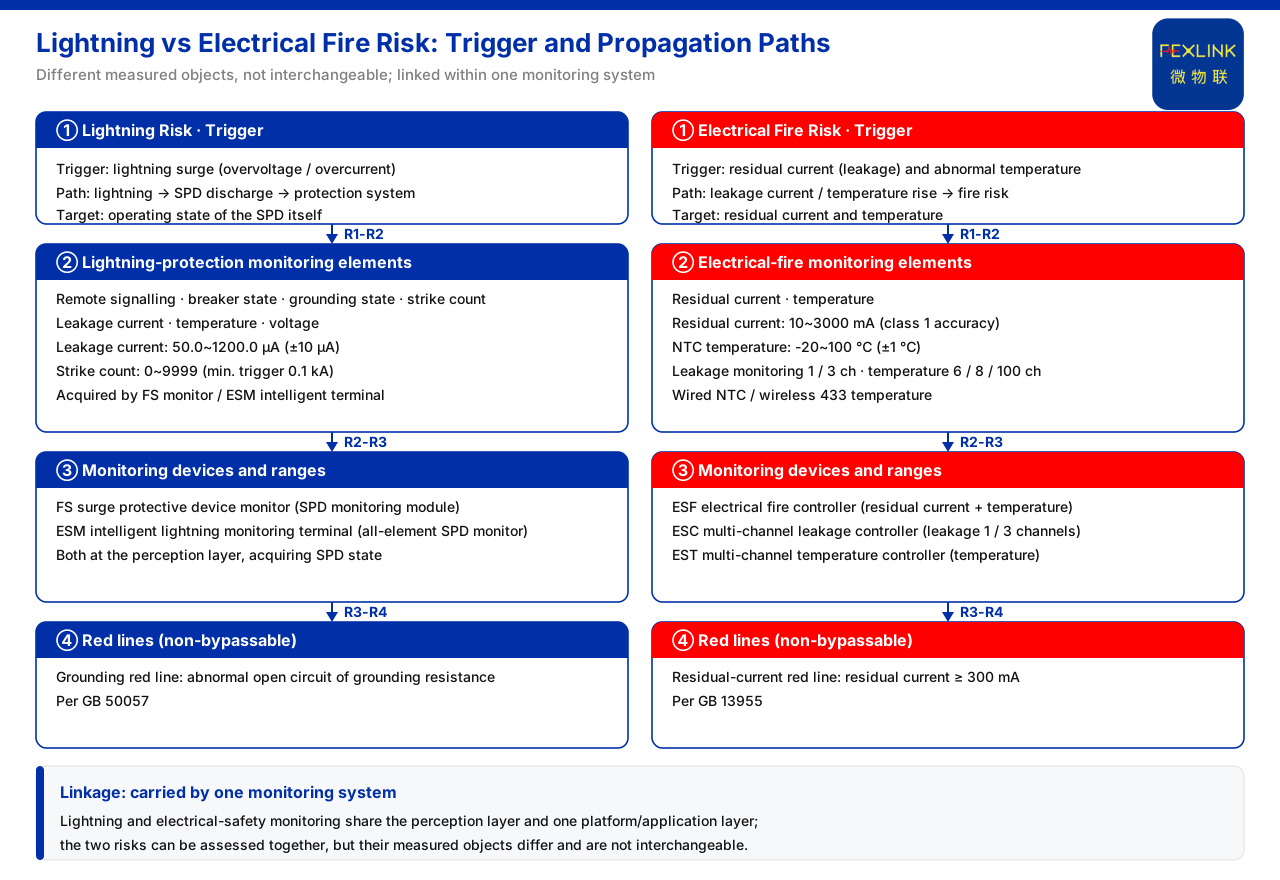
Lightning risk and electrical-fire risk are not the same class of risk. The product knowledge base lists lightning-protection monitoring and electrical-fire monitoring as two different groups of product elements: lightning-protection monitoring centers on the operating state of the surge protective device and acquires surge-protector state elements such as remote signalling, switch status, grounding status, surge count, leakage current, temperature, and voltage; electrical-fire monitoring takes residual current and temperature as the monitoring elements of electrical-fire risk. The two have different measurement objects and are carried by different product families in the knowledge base; they cannot substitute for each other, but they can be assessed in association within the same monitoring system.
Two risk classes carried by different product families
On the lightning-protection side, a typical product is the FS surge protective device monitor (lightning-protection monitoring module), which acquires exactly the state quantities of the surge protective device itself: remote signalling, switch status, grounding status, surge count, leakage current, temperature, and voltage. Its leakage-current monitoring range is listed as 50.0 to 1200.0 μA (±10 μA), and its surge-count range as 0 to 9999 events (minimum trigger 0.1 kA). The other class is the ESM intelligent lightning-protection monitoring terminal (all-parameter SPD monitor), which, beyond the same state quantities, also incorporates all-parameter data such as humidity and lifespan estimation.
On the electrical-fire side, the ESF electrical fire monitoring & control device takes residual current and temperature as its risk-monitoring elements, with the residual-current range listed as 10 to 3000 mA (accuracy class 1) and the NTC temperature range as -20 to 100 °C (±1 °C). In addition, the ESC multi-channel leakage-current monitoring & control device handles leakage-current monitoring (1 or 3 channels), and the EST multi-channel temperature intelligent controller handles temperature monitoring (wired NTC or wireless 433 temperature measurement, covering 6, 8, or 100 channels); the two correspond respectively to the leakage-current and temperature elements of electrical-fire risk.
Two independent model-rule systems
The model rules of the two product classes are independent, and they are read differently. The model rule of the FS surge protective device monitor is FS–[voltage channels][leakage channels][temperature channels][digital inputs][grounding/surge]–[communication], describing the channel combinations of surge-protector state elements. The model rule of the ESM intelligent lightning-protection monitoring terminal is ESM–[power][display][phase][current parameter][version]–[communication]. On the electrical-fire side, the model rule of the ESF electrical fire monitoring & control device is ESF–[power][display][output][current parameter][reserved]–[communication]. The fields in each rule correspond to the elements that the respective product must acquire, and they cannot be applied across families.
Why the two red lines are listed separately
The product knowledge base lists residual current and grounding status as two independent red lines that cannot be bypassed: the residual-current red line uses 300 mA as its trigger condition and is based on GB 13955; the grounding-status red line addresses an abnormal open circuit of grounding resistance and is based on GB 50057. The fact that the two are listed separately rather than merged shows that the knowledge base does not treat the residual-current requirement of electrical-fire protection and the grounding requirement of lightning protection as the same criterion. This confirms, at the level of criteria, the product boundary described above: each risk class has its own monitoring elements and trigger conditions.
For engineering practice, keeping the two red lines separate has a direct consequence. A residual-current reading and a grounding-status reading answer different questions, and neither can be used to infer the other. When a monitoring point serves both concerns, the two criteria are still checked as separate conditions rather than as one combined threshold. The knowledge base treats them as independent constraints, and this article follows that treatment instead of merging them into a single judgment.
The connection: carried by one monitoring system
Distinction does not mean separation. In the general four-layer architecture of a monitoring system, lightning-protection monitoring products and electrical-safety monitoring products sit together at the perception layer and are carried by the same FEXCloud IoT cloud platform and application layer. Precisely for this reason, lightning risk and electrical-fire risk can be assessed in association within the same monitoring system: the perception layer acquires the two element classes separately, and the platform layer and application layer then bring them together for presentation. In typical application scenarios, the knowledge base likewise lists the two needs as different recommended combinations: low-voltage distribution cabinet electrical-fire early warning uses combinations such as the ESF electrical fire monitoring & control device, the ESC multi-channel leakage-current monitoring & control device, and the EST multi-channel temperature intelligent controller; surge-protector status monitoring (retrofit of existing SPDs) uses the FS surge protective device monitor, the ESM all-parameter SPD monitor, and the FSP SPD lightning-protection base.
Mapping the two classes onto the architecture clarifies the design intent. They share the perception layer and the same platform, which is what makes joint assessment possible, but they keep separate acquisition devices, separate element sets, and separate model rules, which is what keeps the two risks from being conflated. The common platform is therefore the place where the two data streams meet, not a reason to merge the two product lines.
Scope and limitations
First, this article distinguishes only the monitoring elements and product boundaries of the two risk classes, and the facts on which it relies are limited to the product knowledge base; it introduces no standard clauses, certifications, or cases not in the knowledge base.
Second, the parameters in this article, such as leakage current 50.0 to 1200.0 μA (±10 μA), surge count 0 to 9999 events (minimum trigger 0.1 kA), residual current 10 to 3000 mA (accuracy class 1), and NTC temperature -20 to 100 °C (±1 °C), are existing parameters listed in the knowledge base. They do not represent other models or actual engineering configurations, nor do they serve as conclusions about lifespan, failure probability, or operating period.
Third, the references to GB 13955 and GB 50057 in this article are limited to the two red-line criteria in the knowledge base; they do not expand the standard clauses, nor do they make a determination on residual-current limits or grounding-resistance limits.
Fourth, the statement that the two risk classes can be assessed in association within one system is an explanation of the monitoring architecture and does not constitute a conclusion about product selection or deployment for a specific project.